Offaly no events posted in last week
Parse failure for https://anti-empire.com/feed/. Last Retry Tuesday January 06, 2026 08:09
Indymedia Ireland is a volunteer-run non-commercial open publishing website for local and international news, opinion & analysis, press releases and events. Its main objective is to enable the public to participate in reporting and analysis of the news and other important events and aspects of our daily lives and thereby give a voice to people.
 Fraud and mismanagement at University College Cork Thu Aug 28, 2025 18:30 | Calli Morganite Fraud and mismanagement at University College Cork Thu Aug 28, 2025 18:30 | Calli Morganite
UCC has paid huge sums to a criminal professor
This story is not for republication. I bear responsibility for the things I write. I have read the guidelines and understand that I must not write anything untrue, and I won't.
This is a public interest story about a complete failure of governance and management at UCC.
Deliberate Design Flaw In ChatGPT-5 Sun Aug 17, 2025 08:04 | Mind Agent
Socratic Dialog Between ChatGPT-5 and Mind Agent Reveals Fatal and Deliberate 'Design by Construction' Flaw
This design flaw in ChatGPT-5's default epistemic mode subverts what the much touted ChatGPT-5 can do... so long as the flaw is not tickled, any usage should be fine---The epistemological question is: how would anyone in the public, includes you reading this (since no one is all knowing), in an unfamiliar domain know whether or not the flaw has been tickled when seeking information or understanding of a domain without prior knowledge of that domain???!
This analysis is a pretty unique and significant contribution to the space of empirical evaluation of LLMs that exist in AI public world... at least thus far, as far as I am aware! For what it's worth--as if anyone in the ChatGPT universe cares as they pile up on using the "PhD level scholar in your pocket".
According to GPT-5, and according to my tests, this flaw exists in all LLMs... What is revealing is the deduction GPT-5 made: Why ?design choice? starts looking like ?deliberate flaw?.
People are paying $200 a month to not just ChatGPT, but all major LLMs have similar Pro pricing! I bet they, like the normal user of free ChatGPT, stay in LLM's default mode where the flaw manifests itself. As it did in this evaluation.
AI Reach: Gemini Reasoning Question of God Sat Aug 02, 2025 20:00 | Mind Agent
Evaluating Semantic Reasoning Capability of AI Chatbot on Ontologically Deep Abstract (bias neutral) Thought
I have been evaluating AI Chatbot agents for their epistemic limits over the past two months, and have tested all major AI Agents, ChatGPT, Grok, Claude, Perplexity, and DeepSeek, for their epistemic limits and their negative impact as information gate-keepers.... Today I decided to test for how AI could be the boon for humanity in other positive areas, such as in completely abstract realms, such as metaphysical thought. Meaning, I wanted to test the LLMs for Positives beyond what most researchers benchmark these for, or have expressed in the approx. 2500 Turing tests in Humanity?s Last Exam.. And I chose as my first candidate, Google DeepMind's Gemini as I had not evaluated it before on anything.
Israeli Human Rights Group B'Tselem finally Admits It is Genocide releasing Our Genocide report Fri Aug 01, 2025 23:54 | 1 of indy
We have all known it for over 2 years that it is a genocide in Gaza
Israeli human rights group B'Tselem has finally admitted what everyone else outside Israel has known for two years is that the Israeli state is carrying out a genocide in Gaza
Western governments like the USA are complicit in it as they have been supplying the huge bombs and missiles used by Israel and dropped on innocent civilians in Gaza. One phone call from the USA regime could have ended it at any point. However many other countries are complicity with their tacit approval and neighboring Arab countries have been pretty spinless too in their support
With the release of this report titled: Our Genocide -there is a good chance this will make it okay for more people within Israel itself to speak out and do something about it despite the fact that many there are actually in support of the Gaza
China?s CITY WIDE CASH SEIZURES Begin ? ATMs Frozen, Digital Yuan FORCED Overnight Wed Jul 30, 2025 21:40 | 1 of indy
This story is unverified but it is very instructive of what will happen when cash is removed
THIS STORY IS UNVERIFIED BUT PLEASE WATCH THE VIDEO OR READ THE TRANSCRIPT AS IT GIVES AN VERY GOOD IDEA OF WHAT A CASHLESS SOCIETY WILL LOOK LIKE. And it ain't pretty
A single video report has come out of China claiming China's biggest cities are now cashless, not by choice, but by force. The report goes on to claim ATMs have gone dark, vaults are being emptied. And overnight (July 20 into 21), the digital yuan is the only currency allowed. The Saker >>
Interested in maladministration. Estd. 2005
RTEs Sarah McInerney ? Fianna Fail?supporter? Anthony
Joe Duffy is dishonest and untrustworthy Anthony
Robert Watt complaint: Time for decision by SIPO Anthony
RTE in breach of its own editorial principles Anthony
Waiting for SIPO Anthony Public Inquiry >>
Indymedia Ireland is a volunteer-run non-commercial open publishing website for local and international news, opinion & analysis, press releases and events. Its main objective is to enable the public to participate in reporting and analysis of the news and other important events and aspects of our daily lives and thereby give a voice to people.
Trump hosts former head of Syrian Al-Qaeda Al-Jolani to the White House Tue Nov 11, 2025 22:01 | imc
Rip The Chicken Tree - 1800s - 2025 Tue Nov 04, 2025 03:40 | Mark
Study of 1.7 Million Children: Heart Damage Only Found in Covid-Vaxxed Kids Sat Nov 01, 2025 00:44 | imc
The Golden Haro Fri Oct 31, 2025 12:39 | Paul Ryan
Top Scientists Confirm Covid Shots Cause Heart Attacks in Children Sun Oct 05, 2025 21:31 | imc Human Rights in Ireland >>
|
Hidden History or hidden agenda – the real story
 offaly |
history and heritage |
feature offaly |
history and heritage |
feature
 Monday October 08, 2007 10:13 Monday October 08, 2007 10:13 by Pat Muldowney by Pat Muldowney

Ethnic cleansing in Offaly or execution of Black & Tan collaborators
RTÉ has announced a programme in its Hidden History series making controversial claims about IRA sectarianism during the War of independence. This is how RTE is currently publicising it:
Guns and Neighbours: The Killings at Coolacrease
“The bloody tale of a bitter land dispute, involving a family of Protestant farmers in County Offaly, which comes to a deadly conclusion during the War of Independence. Featuring interviews with descendants of the men who carried out the killings, this portrait of a forgotten atrocity features substantial newspaper archive research, IRA witness statements and military documents from the period.”
Related Links: The Story Starts Here | The Hidden History documentary strand returns to RTÉ
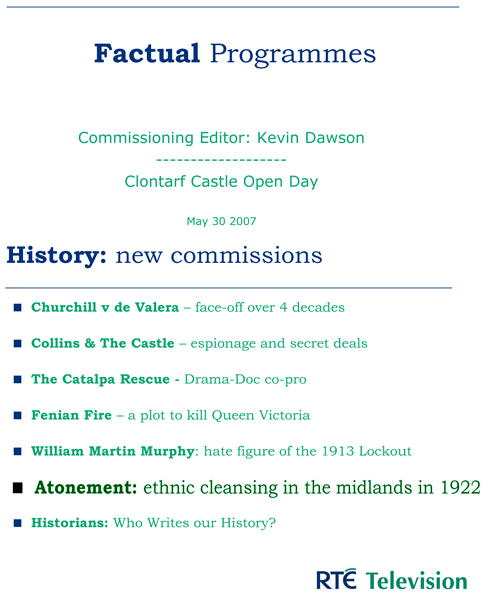
The original title of this programme was: “Atonement: ethnic cleansing in the midlands” - see reproduction below of pages 1 and 13 from RTE presentation in Clontarf Castle on 30 May 2007. The original title reveals the real intent of the programme. After protests in the past two months, the title changed from explicit to implied ethnic hatred: the story of a supposed sectarian land-grab by grasping catholic peasants killing inoffensive Protestant neighbours.
This documentary is about an execution by the IRA, on June 30 1921, of the brothers Richard and Abraham Pearson of Coolacrease, near Cadamstown, Co. Offaly. In 2002 local historian Paddy Heaney gave the first published history of these events in his book At the Foot of Slieve Bloom, describing the Pearsons’ active involvement on the side of the Black and Tans. In 2005 Alan Stanley of Carlow published I Met Murder on the Way. In it the executions are portrayed as sectarian murder in furtherance of a land-grab during a bigoted anti-British rebellion. This was picked up by Eoghan Harris who published two Sunday Independent articles in October 2005 highlighting the religious aspect – the Pearsons, he says, were other-worldly, pacifist Amish types brutally murdered by savage, sectarian monsters intent on ethnic cleansing.
Paddy Heaney’s original account was ignored, as if it did not exist. This is significant.
Hidden History and Eoghan Haris
RTÉ’s proposed Hidden History programme was inspired by Harris’s articles and by the Stanley book. The Hidden History series has an eclectic approach. Rival TV production companies bid to fill slots with their proposals for one-off programmes in the series. The Production Company for this programme is Reel Story Productions, whose director is Niamh Sammon. In the past she produced RTÉ’s Charles Haughey documentary, and the Fine Gael TV history Family at War, while working for Steve Carson’s Mint Productions. Now with her own production company Sammon made initial contact with local people in Co. Offaly who had family and other connections to the 1921 events. She did not reveal to them her commitment to the Eoghan Harris view of the events as an ‘atrocity’, or her use of Harris’s language, “To attack a family like that calls to high heaven for atonement” (Sunday Independent, 9 Oct 2005). The phrase, “Ethnic Cleansing in the Midlands”, was announced originally by RTE in May (see reproduction of RTE presentation at Clontarf Castle). RTE presumably picked up the “ethnic cleansing” message from Sammon, when she originally pitched the programme content to RTE. Where else could it have come from?
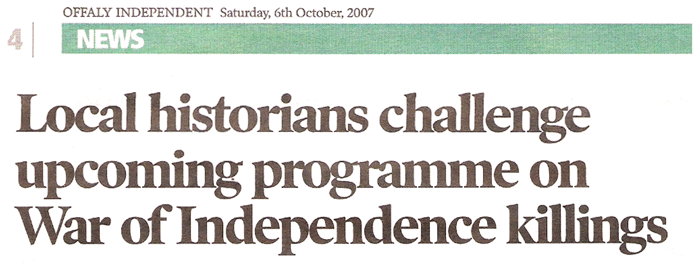
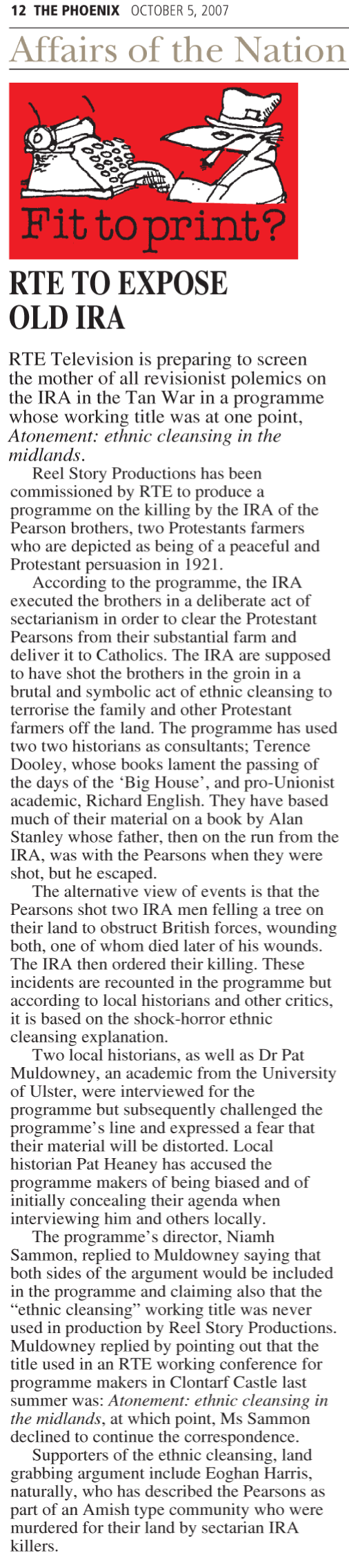
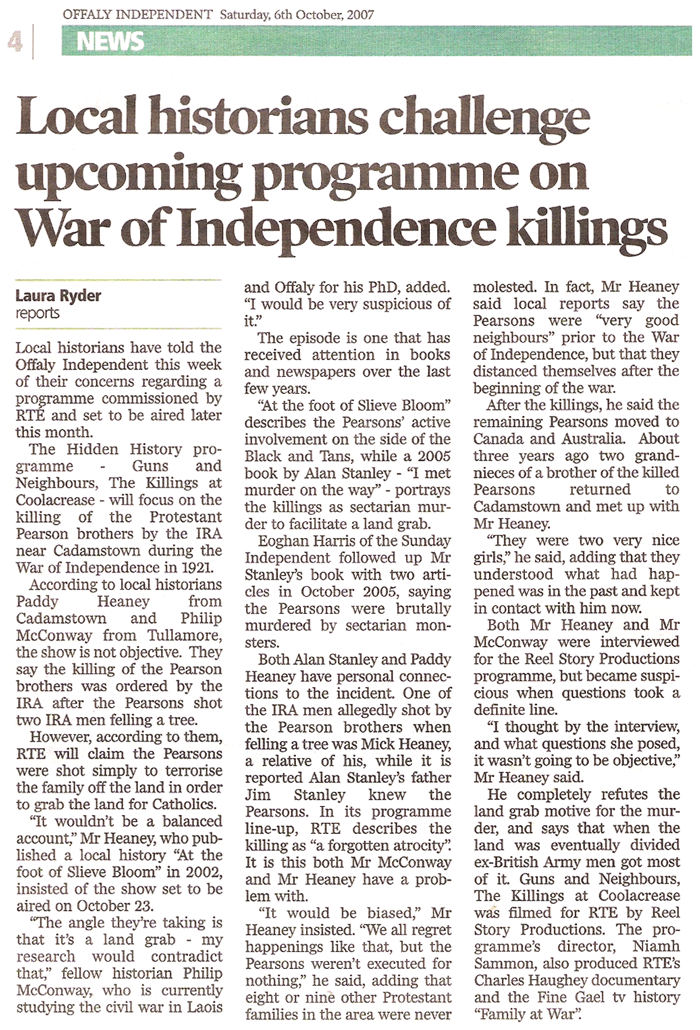
Many people were initially supportive of the project, but became disenchanted as Sammon’s real purpose became increasingly evident. Their initially separate connections with this programme have gradually become joined in opposition to it. Now it is out in the open in The Offaly Independent and in The Phoenix.
The academic advisers for the documentary are a further clue to the programme’s intent. The first is unionist historian and 2007 Ewart-Biggs-Prize-winner Richard English of Queen’s University Belfast. Brendan O’Leary remarked recently that English, “like others who imagine themselves to be radical, swims with the present tide of imperial historiography, which cleanses, and even celebrates, the British Empire, or at least accentuates its positive dimensions”. (Cuttlefish, Cholesterol and Saoirse, Field Day Review 3, 2007)
The second advisor is revisionist historian Terence Dooley of NUI Maynooth. Dooley is an adherent of Canadian academic Peter Hart’s discredited sectarianism/ethnic cleansing account of the War of Independence. Dooley‘s book, The Land Question in Independent Ireland (UCD Press 2004), seeks to prove that the independence movement was fundamentally driven by land hunger and land-grabbing. His previous effort, The Decline of the Big House in Ireland (Wolfhound Press 2001), is a hymn of praise to the lifestyle of the landlord class, and a paean of regret for the sufferings of that class and its hangers-on as their power was swept aside by the Land League and the independence movement.
British reinforcements arrive
In addition, a feature film about the Pearsons by British film maker Philip Ogden has received development funding from the Irish Film Board. Ogden is a self-admitted associate of pre-eminent revisionist historian Roy Foster. Foster used the Pearson executions to attack Ken Loach’s film The Wind that Shakes the Barley, allegedly for failing to depict the imaginary anti-Protestant violence of Foster’s considerable imagination. Foster’s overall approach and his line on the Pearsons is discussed by Dublin academic Niall Meehan in the course of a Counterpunch article at: www.counterpunch.org/meehan11112006.html. Ogden published a letter in The Tullamore Tribune of April 4 2007 requesting local information about the Pearsons. His film is proposed for release in 2008, though it is unlikely to appear on schedule. Ogden and Sammon appear to be collaborating on the project with help from two funding agencies: an RTE commission and Irish Film Board development grant. Presumably, this collaboration has been reported to the respective funding agencies.
The Pearson executions were previously discussed in Indymedia posts, after my initially reaction to the tendentious Eoghan Harris Sunday Independent line. See:
http://www.indymedia.ie/article/74400
http://www.indymedia.ie/article/76350
http://www.indymedia.ie/article/79743
The course of the War of Independence and Civil War in Offaly has also been investigated in depth by Tullamore historian Philip McConway. McConway’s definitive book on the subject includes his findings on the Pearson case, and is due to be published this year. His January 2007 lecture on the subject is summarised at the Offaly History website:
http://www.offalyhistory.com/content/news/newsletters20...7.htm
The ‘Atrocity’
Here is an outline (in my words) of the Stanley/Harris/Sammon/Hidden History line on the Pearsons:
The two Pearson brothers were gentle, good-natured farming boys belonging to an Amish or Quaker-type denomination called Cooneyite, innocent of any political involvement. On that glorious, sunny afternoon of June 30 1921 they were out in a hayfield saving hay where they were suddenly set upon by a large group of armed men. They were put up against a barn wall. Their mother, three sisters, younger brother and two female cousins were forced to line up in the yard to watch. The firing squad took aim at the men’s genitals and pumped dum-dum bullets into them. All this was so that they would accomplish five particularly brutal and heinous purposes. Firstly, by blasting away the men’s genitals they would make some barbaric point about ethnic cleansing. Secondly, the victims would take a very long time to die. Thirdly, they would suffer the most horrific pain while they were dying. Fourthly, the family members who were forced to watch this atrocity would themselves suffer the torments of hell. Fifthly, the shock waves of this sectarian atrocity would send tremors of fear, terror and panic through the local Protestant landowning community, and get wholesale ethnic cleansing and land-grabbing under way. It was as if in 1921 the Irish engaged in the same practice as the Israelis’ Deir Yassin massacre in 1948 that cleansed a large part of Palestine of its Arab population. The Pearsons are transformed into innocent and emblematic victims of ethnic violence.
The language of ethnic hostility is not unique to Ireland. It is part of the 'new black' that justifies in retrospect colonial management of foreign peoples. It also justifies today's ‘new-imperialism’ that intervenes within borders, literally lines on a map of the Middle East, created by imperial powers after World War One.
In reality and in fact the overall context is perfectly clear. The 'ethnic' spin on events does not follow the actual narrative. It twists it.
In a series of elections, starting in 1918 in which Sinn Fein won 75 of 103 Irish seats, the Irish independence movement had secured and held an overwhelming democratic mandate to form an independent Irish government. The Imperial government had just won a Great War, supposedly fought for democracy and the rights of small nations. But the Imperial power determinedly ignored successive Irish election results. Britain imposed military rule to suppress the democratic government in the manner of the various revolutionary fascist movements which were then taking off around the world, and in the manner of the USA in Latin American and other countries. It waged a ferocious terror campaign of assassination and imprisonment of elected representatives, random shooting of civilians, summary execution of prisoners, burning of houses, villages, towns, cities; hostage taking, torture, imprisonment – the whole dreadful story of Black-and-Tan Terror. The volunteer Irish Army, the IRA, resisted the terror, and retaliated by executing collaborators and informers, just like the French Resistance against the Nazis.
Wars are cruel and in them very bad things happen.
We know the French Resistance sometimes executed innocent people by mistake, and popular vengeance when the Nazis were driven out was often cruel and excessive, even if understandable. Some private vendettas were conducted under cover of the resistance. Likewise some unsavoury necklacing episodes were attributed to Nelson Mandela’s African National Congress in Apartheid South Africa. So could something similar have happened in Ireland? Eoghan Harris’s article indicates that this was such a case. On initial quick reading, and taking everything he said at face value, Alan Stanley’s book seems to provide Eoghan Harris’s story with the necessary evidence.
But on a more careful reading, many problems come to light.
First, Stanley’s overall view of the Troubles was that it was an outbreak of rebel sectarian criminality, that the British government was itself criminally negligent in using merely policing methods to stop it (this is the Black-and-Tans, mind), that they should have used military methods. Think what this means. The British Army was used in war mode to smash the 1916 Rising. That meant flattening the centre of Dublin with artillery involving wholesale slaughter of civilians over several days. So Stanley wanted the same methods to be used all over Ireland, no doubt also using the RAF, carpet-bombing, gassing, concentration camps for disaffected population, and so on. This is what the British Empire did in Iraq after its war in Ireland, when the Black and Tans moved straight from Ireland to Iraq.
So one must wonder what planet does Stanley belong to, what century does his mind inhabit, that he should think that a touch of the bayonet, bomb and bullet would bring the revolting natives to heel.
Shotgun
His story is that the Pearsons were innocent farmers, inoffensive religious people like Amish or Quakers, and that they were ruthlessly murdered for their land. But he also describes them as engaging in a senseless sectarian quarrel over a mass path. Local memory has the Pearsons threatening terrified women and children with firearms and spreading human excrement (presumably their own) on stiles that the people would have to climb over on the way to Sunday religious service, and felling a tree to block the path. Stanley says the Pearsons sheltered his father William Stanley (Stanley was ordered out of Co. Laois for organising an armed loyalist sectarian gang that was collaborating there with the Black and Tans). He says the Pearsons fired a shotgun over the heads of some trespassers who were cutting down one of their trees – in reality a roadside tree adjoining their property.
Alan Stanley describes the IRA party that the Pearsons fired on as Rebels and criminal sectarian gangsters, when they were in fact members of an army operating under the authority of the elected government. These men were the direct lineal antecedents and predecessors of the present Republic of Ireland – its President, government, opposition, diplomats, courts, officials, police force, armed forces. In the teeth of a vicious revolutionary fascist campaign to smash democracy in Ireland, this IRA unit was part and parcel of the huge democratic effort that originated the present Irish state.
Pearsons – just like Amish?
From their own testimony, their very own words, the Pearsons, with William Stanley, were sectarian squabblers, they were trigger-happy gun-toting loyalists, they were friends and shelterers of on-the-run paramilitaries. These were Amish with attitude, Amish with form, Amish with guns. If this whole grotesque comparison concocted by Stanley and Harris were not so offensive to the Amish or Quakers, you could say that the Pearsons were the Amish from Hell.
Now, I have worked with Quaker colleagues most of my life. I live beside the Amish colony in Co. Waterford, which was featured in a recent RTÉ documentary. The Quakers and the Amish do not threaten people with guns. They do not engage in ridiculous sectarian squabbling and excrement smearing over trivialities such as mass-paths. They do not pull guns on little family groups in their Sunday best wending their way down the hillside to church service. Nor do they fell trees to stop them. They have no truck with violence of any kind. Absolutely the last thing they would ever do would be to make common cause with somebody like Alan Stanley’s father who was a ringleader in an armed loyalist gang, a swaggering Johnny Adair type. It is an absolute insult to compare the Pearsons with non-violent, non-belligerent pacifists such as the Quakers and the Amish.
RIC report on the executions
The Pearsons were not sentenced to death because of a ludicrous sectarian squabble over a mass path, or for felling trees across the path, or for pulling guns on churchgoers, or for spreading human excrement on the stiles. They were not even sentenced because they were informers. They were sentenced to death because they fired on a unit of volunteers, wounding two of them. That is what all the IRA reports declare.
And that is what the official RIC report also declares:
“C.I. [Chief Inspector RIC] Queens County [reported] that the two Pearson boys a few days previously had seen two men felling a tree on their land adjoining the road. Had told the men concerned to go away, and when they refused had fetched two guns and fired and wounded two Sinn Feiners, one of whom it is believed died.”
From British Military Court of Enquiry in lieu of inquests on Richard and Abraham Pearson, Crinkle Barracks, Birr, July 2 1921.
The Hidden History Director, Niamh Sammon, argued, on record, that it is impossible to know what happened at the roadblock in the darkness and confusion. But Alan Stanley’s book says that the Pearsons first engaged in verbal abuse of the soldiers manning the roadblock (so they knew who they were dealing with), and that they then returned with guns and opened fire, just as the RIC report confirms. Sammon, it appears is attempting to twist, evade and misrepresent this official, clear and unequivocal RIC report on the executions. She claimed, in interview with me, contrary to the clear RIC statement, that this was not the RIC position. Sammon has argued, on record, that the RIC were reporting – to the British military authorities! – the IRA version of the executions. So, were the RIC secretly in league with the IRA, or what?
Stanley, Harris and Sammon, supported by Dooley and English, have put the elected Irish government of the time on trial, along with its armed forces, its justice system and its councils; so that the Irish version of events is not entitled to any credence. But the official report on the British side does not back up their prejudices and pre-conceptions. So it too must be denied! Sammon gives credence to ill-founded speculation concocted nearly a century later, but denies the official reports, compiled in full and immediate knowledge of the facts, by the responsible authorities of the time, both Irish and British.
Unfounded dogma
Facts do not appear to matter in Sammon’s curious version of history, as indicated in her tendentious interview questions and statements. She came across as someone determined to push a pre-conceived line, more of a propagandist for imperial rule than an impartial documentary filmmaker – see my experience of being interviewed by Sammon below. In one sense, if she is committed to the imperial version of history, I don’t mind. But she should declare her opinion. We should all play our cards openly. But Hidden History appears to want to display a ‘higher truth’, one in which facts must be shaped to suit this apparently pre-selected approach. The purpose is to propagandise the unfounded dogma that the Irish independence movement was driven by sectarian land hunger and that the War of Independence provided cover for illegal land-grabbing, sectarian atrocity and ethnic cleansing. In effect it was a peasant revolt in which imperial efficiency was confronted by the forces of irrationality and hatred. It is a re-statement of the need for imperial management of inferior people. Ultimately, it is part of a racist account of colonial resistance.
The fact is the Pearsons were sentenced to death by Court Martial because they attacked a detachment of the Irish Army which was blocking the road at Cadamstown as part of county-wide manoeuvres to carry out an ambush on British forces in Birr. The Pearsons observed the action, made verbal threats, returned with guns, and they shot two men, one of them in the stomach. That is what happened. It was a deliberate act of violence in support of the occupation forces, which were trying to destroy the democratically elected government, in one of the first post-war attempts at fascist reaction in any part of the world.
The IRA’s Commanding Officer for that part of Offaly investigated and ordered that the three brothers be executed and their house burned. The OC was not a local with land grabbing on his mind; some poverty stricken cabin dweller or landless labourer with a hungry family, looking down from the mountainside at the Pearsons’ fat cattle, glossy horses and lush crops in rolling acres of the fertile plain. Thomas Burke could not have been further removed from such an agenda. He was a medical student sent down from Dublin to Offaly by the Army Chief of Staff Richard Mulcahy (subsequently Free State Army Chief, Minister for Defence, Minister for Education and Leader of Fine Gael). Under the authority of the Irish government Burke assumed command in order to raise the level of military resistance to the Black-and-Tan presence in South Offaly, and to deal with rampant informing and collaboration, which were decimating Irish Army ranks. He was sent down precisely because the Offaly “peasants” – the poverty-stricken smallholders and hungry landless labourers – were not, according to Mulcahy, forceful nor determined enough in their resistance to the Black and Tan terrorists and their collaborators, both Catholic and Protestant.
The local Offaly IRA had several years in which they had ample opportunity to carry out sectarian murder and land grabbing, if that was what they were about. They did nothing of the kind. Hidden History Director Niamh Sammon was confronted with the sheer absurdity of the proposition that, after the less vigorous local leadership of the IRA was stood down, the Dublin appointee Thomas Burke ordered the sectarian murder of the Pearsons in furtherance of a land-grab. Her response, on record to me, was to feebly suggest that Burke might have come under local influence and bowed to local pressure!
The Shooting of the Pearsons
The propaganda version of the attempted execution of the Pearson brothers has the firing squad deliberately taking aim at the condemned men’s genitals and firing dum-dum bullets into them while their mother and sisters were forced to watch.
But the eye-witness accounts and the medical evidence tell a very different story. Matilda Pearson’s account in the following week’s local newspapers says that her two brothers were taken away from the other family members. Dave Pearson’s 1981 letter to Hilary Stanley, also quoted in Alan Stanley’s book, says that he and his mother and sisters were taken away separately. Michael Cordial was in command of the execution party, and his Witness Statement on the events (Bureau of Military History) says that the condemned men were separated from the rest of the family.
In the British Military Court of Inquiry (in lieu of inquest) held at Crinkle Barracks, Birr on Saturday July 2 1921, Ethel Pearson (sister) said that she and her sisters, mother, cousins and 14-year-old brother David were moved into a grove of trees at the back of the house before it was set on fire, while her brothers Richard and Abraham Pearson were taken away to an enclosed yard among the farm buildings where they were shot.
So the executions took place at a separate location, not visible from the sheltered place where the rest of the family were moved.
Local geography
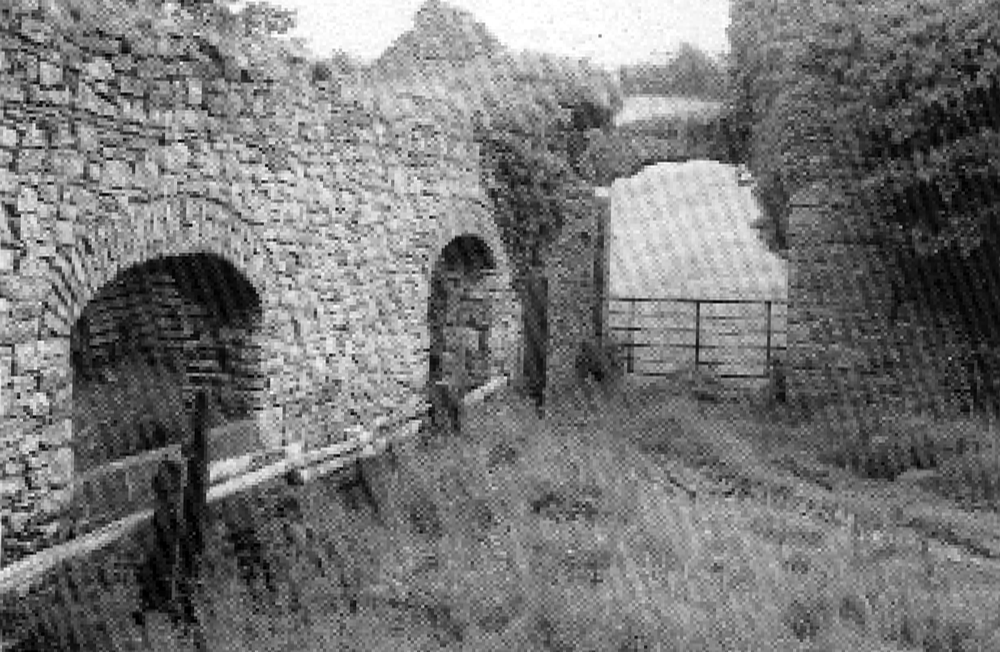
Alan Stanley’s book has a photograph of the location of the shooting of the Pearsons. It was in an enclosed yard near an arched gateway. The brothers were placed against the left hand wall to be shot. The grove of trees, to which the rest of the family was moved, was located fifty to a hundred metres away in the hillside field visible outside the courtyard. You can see a tiny part of the field through the arched gateway in Stanley’s photograph. A small arched opening into an enclosed yard gives little visibility in either direction, from the yard to the field outside, or from the field into the yard. The Grove to which the family was taken has since been grubbed out, but remained in place up to fairly recent times, as can be verified from the Ordnance Survey maps at various dates. If the wall enclosing the courtyard were transparent, the location of the grove of trees to which the Pearson women and children were taken would be visible in the upper left hand corner of Stanley’s picture.
The Grove was set in a depression in the hillside, and was surrounded by high hedging. Nothing outside the grove was visible from inside the grove. Even if there were no grove, an observer from the field outside, even if he took a vantage point on the height rather than the hollow of the hillside, and even if he stood directly opposite the arched gateway, could see very little inside the enclosed yard. Even if there were no surrounding grove of trees and hedging to block off all view, a person located in the depression in the hillside where the grove was located would not be able to see into the courtyard. Looking at Stanley’s photograph of the execution scene, an observer in the yard looking out towards the field can see only the small section of the field framed by the archway. Likewise for an observer in the field looking into the courtyard through the archway. And the further away from the archway, the less an observer can see on the opposite side of the archway. To see anything happening in the enclosed yard, a person outside in the field would have to deliberately seek out a vantage point, and even then only very little would be visible.
Here is the relevant extract from the Court of Enquiry testimony:
"ETHEL MAY PEARSON having been duly sworn states:-
… My mother who was in a fainting condition was carried by my two brothers into a little wood we call the Grove and we all went with her by the order of the raiders. Six of the raiders, two or three of whom were masked, ordered my brothers down into the yard. I saw the raiders search my brothers and place them against the wall of the barn and shoot them."
British Military Court of Enquiry in lieu of Inquests on Richard and Abraham Pearson, Crinkle Barracks, Birr, July 2 1921.
True or false
This is a far cry from forcing the mother and sisters to watch the executions. Did Ethel Pearson or any of her sisters actually disobey the orders of their guards and leave their mother in a fainting condition in the Grove to follow their brothers back into the yard, or to some vantage point on the hillside where they could observe what was going on inside the courtyard? Were the sisters left unguarded in the Grove after they were moved into it? Unlikely, as there was a definite risk that one of them would run to seek help, jeopardising the Irish force. Mrs Pearson did not see the shootings, she was in a fainted state surrounded by trees at a considerable distance from the yard which was out of view. The Pearson family must have heard the gunshots, even if they were muffled by the trees and fencing that surrounded them. But so must everyone else in the area, including the inhabitants of Cadamstown village. Does that make all of them witnesses?
The IRA did everything that could reasonably be expected to remove the women and children from the scene. Did Ethel Pearson actually leave the shelter of the Grove and come to the arched gateway where she would have been able to observe the shootings within the enclosed yard, as her statement implies? The Pearsons’ and William Stanley’s contributions to the atrocity propaganda machine followed hard and fast after the executions. No credence can be given to their atrocity tales. In his submission to the British government’s Irish Distress Committee, William Pearson (father of the executed men) said he went to Crinkle Military Barracks in Birr that day to get help (FALSE); that 500 IRA raiders attacked his family (FALSE); that one of his daughters was shot (FALSE); that he returned that day (FALSE) to find his two sons lying dead in the yard (FALSE). The reason we know Pearson was lying is because these statements are contradicted by EVERY other account, including all the other accounts from his own side. He lied in order to put a better appearance on his conduct that day and improve his chances of compensation from the Loyalist Distress Committee some years later. His lies were successful.
Dum de dum – IRA ragtime band
William Stanley, who had fled before the executions, told his son Alan that dum-dum bullets were used by the IRA. If this was true the highly practised Dublin Castle propaganda machine, in its statement dated 9 July 1921, would have made a great noise about it. But here is what the Castle propaganda report actually said:
“The house was then fired and the family allowed out. They were placed on a little hill just outside the back of the house. The two eldest sons were then taken, and in full view of the rest of the family were put up against a wall and shot, meanwhile the Sinn Feiners played ragtime music, on the piano and one of the sons’ violins.”
Think about it: the house is in flames and the Sinn Feiners are inside playing music, according to Dublin Castle! Note that Dublin Castle places the family on the hillside, a small part of which can be glimpsed through the arched gateway in the photograph above. Ethel Pearson’s statement says they were moved to the Grove in a depression in the hillside, well out of view of the yard where the actual shooting took place. Michael Cordial’s Witness Statement (Bureau of Military History; see http://www.indymedia.ie/article/76350) says the family were separated from the two brothers, as does David Pearson’s 1983 letter. So the allegation of Alan Stanley, Eoghan Harris and Hidden History’s Niamh Sammon that the family were forced to watch the executions appears wide of the mark.
The fact is, executions are a horrible business. But killing human beings is part and parcel of warfare, and everyone knows that ‘War Is Hell’. The war in Ireland was precipitated by the revolutionary fascist military response of the Imperial government to the election of a democratic government in Ireland. The Black & Tan agents of fascism, along with their fascist collaborators, such as William Joyce (the later Lord Haw-Haw) in Galway, and such as the Pearsons in Offaly, were responsible for many assassinations, executions, torture and burnings. The democrat Mick Heaney was shot in the stomach with a shotgun blast by one of the Pearsons, and eventually died of his injuries. His stomach wound caused him great pain over a very long time indeed, before he eventually succumbed to its effects.
After an enquiry, which established their guilt in attacking a unit of the Irish army, the Pearson brothers had been sentenced to death by the Offaly commander who had been sent down under orders from Dublin to step up local resistance and deal with collaborators and informers. Executions are done by a squad of soldiers rather than an individual executioner, so no single person has to bear the whole responsibility. And they retain anonymity. For instance, nobody asks the names of the soldiers who executed Pearse or Connolly – a convention which has not been adhered to by Niamh Sammon, who resolutely sought to get the Offaly names, doubtless in order to begin to make Atonement for the alleged crime against the Pearsons, as demanded by Eoghan Harris in his Sunday Independent article of 9/10/2005.
Health Warning - Hidden History Alert!
TV viewers should watch out for Niamh Sammon’s dramatised “re-construction” of the mass-path dispute, the attack on the IRA’s, the Irish Army’s, road-block (which she calls the tree-felling incident!), and the executions. This was filmed, not on location in Co. Offaly where it could be accurately re-created in accordance with the historical evidence, but far away in Co. Kildare, where these events were unknown. This is the means by which part of thebogus atrocity propaganda may be presented – truly a hidden history, hidden from the people who know about it, in effect an imagined history.
The Medical Evidence
The official medical report of the 1921 British Military Enquiry says Richard Pearson received wounds in the left shoulder, right groin, right buttock, the back, and left lower leg – all of them superficial. Anatomically, the groin is the hollow or recess where the thigh meets the torso. We have two groins, for the left and right thighs. Contrary to the modern euphemism, the actual genital area is between the two groins, whereas each of the groins actually lies between a thigh and the stomach. The Pearsons might easily have received wounds to the genital area. But what Richard Pearson actually received was a wound to the right groin, which, according to the medical evidence, did not damage any important blood vessels. The left shoulder is where the left arm joins the torso, and it is no more or no less interesting nor special than the right groin.
Now, Mick Heaney received a stomach wound from the Pearsons whilst on army duty resisting the fascist terror. But Mick Heaney was quickly brought to a secret ward in Tullamore hospital, and his life was saved, at least for the time being. The execution of the Pearson brothers was botched. The soldiers involved were not experienced, battle-hardened fighting men like those in Dublin and Cork. Their war up to summer 1921 had consisted mostly of sabotage work. Their new OC, Thomas Burke, had been sent to Offaly by General Richard Mulcahy, under the authority of the government, in order to step up the resistance effort in the county.
If I was sentenced to be executed I would definitely prefer a botched execution in which I was left alive suffering only superficial wounds.
Unlike Mick Heaney’s treatment, what was also botched was the medical treatment given to the Pearson brothers. They were execurd between 4.30 and 5 p.m., and Richard Pearson died about 10 p.m. on a mattress in the field at Coolacrease, from shock and blood loss. Abraham Pearson died apparently from the same cause about 6 a.m. the following morning in the hospital in Crinkle Military Barracks near Birr. The doctor from Kinnitty only arrived to tend to what he calls superficially wounded men at about 7.30 p.m., nearly three hours after the shooting. He administered antiseptic treatment to Richard Pearson, according to the King’s County Chronicle and according to his own statement to the Military Enquiry two days later. In other words he cleaned up the wounds, but performed no surgery. It seems he did nothing to stop the bleeding, and Richard Pearson was dead when this doctor was summoned back to Coolacrease about 10 p.m. The military from Birr had arrived about 9.30 p.m., and presumably got the brother who was still alive (Abraham) into the military hospital in Crinkle Barracks, Birr, by about 10.30 or 11 p.m. The military physician in Crinkle was not summoned to attend to him until 2 p.m. He dressed his wounds and, it seems, went back to bed. Abraham Pearson died at 6 a.m. the following morning.
Rejected by Protestant neighbours
Why all the delays? Why were the two men not brought directly to hospital to get treatment for their superficial wounds? What were the sisters doing? Running to neighbours who refused to help? Ethel Pearson (sister) says she rode a horse to Cadamstown (about a mile away) to get help. We know from local accounts that 14-year-old Dave Pearson called in to the Jacksons of Kilnaparson (Protestant neighbours) to get help and was told to clear off, that they had brought this trouble on themselves by the way they had conducted themselves. That has been the general reaction on all sides to the Pearson question ever since, until Alan Stanley’s fanciful revision.
The brothers received superficial wounds, according to medical evidence to the British Military Inquiry; none of them to the genitals, but wounds which caused shock and bleeding from which they eventually died, after quite a long time, for lack of medical attention. What would their condition have been that afternoon as they lay on a mattress in the field in Stanley’s photograph, perhaps without covers to keep them warm? We were told they went into shock, the reaction by which the body protects itself from trauma by restricting the blood flow to all but essential organs. So they would have trembled, become cold and pale, but perhaps recovering their senses sufficiently to talk. So their sisters may have thought they were OK after all, and did not rush to summon the Kinnitty dispensary doctor about four miles away. Then the men would have started drifting in and out of consciousness as they lost more and more blood. Were they screaming in agony? Probably not, from the superficial nature of the wounds; and from the physiological process of shock which they entered, described in the medical report, as opposed to the propaganda statements of Dublin Castle and Alan Stanley; and from the lack of urgency in the medical response. But we can only surmise.
Castle dumb on dum-dum
What about the execution party? These inexperienced soldiers fired at the condemned men, whom they hit with several shots. The inaccurate shots could easily have struck the genitals, but, according to the medical evidence, did not. Immediately afterwards the fire which had been prepared in the house was lit, and the house went up in flames. Michael Cordial in his report, now available in the Bureau of Military History records (see also http://www.indymedia.ie/article/76350), says explosions blew the roof off the house, so explosives may have been stored there. The fire, smoke and explosions could be seen and heard for miles in every direction. These soldiers were on foot. They had every incentive to get away as quickly as possible, and that is what they did. Did they know the condemned men were still alive as they left? Again we can only surmise.
There is no mention of dum-dum bullets in any contemporary account. Not even in the Dublin Castle propaganda statement which would have made great fuss of this if there had even been a hint of a suspicion that dum-dum bullets were used. If a dum-dum bullet struck the right groin or left shoulder, the right leg and left arm would have been practically torn off, and death would have been very quick. Similarly for the back and buttock wounds.
[Note: Dum-dum bullets are named after the district of Dum-Dum in Bengal where the British had a factory for making these bullets. Calcutta airport is now located there. Formerly called Dum-Dum Airport, it is now named Subhas Chandra Bose Airport after the legendary Indian resistance hero who organised an Indian Army in 1943, and who precipitated the termination of Britain’s Indian Empire as part of a political movement which was heavily influenced by the Irish independence movement. On the Burmese border not too far from Dum-Dum, Bose’s Indian National Army scored notable military successes in the face of the British colonial and mercenary forces in Burma which included a previous RTÉ Hidden History presenter – none other than Cathal O’Shannon, of ‘Ireland’s Nazis’ fame. In the course of the 1943 British-induced famine or genocide in Bengal, in which up to 3 million starved to death, the British refused Bose’s offers of famine relief from Burma.]
The Real Land Grab
Alan Stanley says that after the shootings, the locals took advantage of the situation and moved in to take occupation of the Pearsons’ farm (he talks coyly of “uti possidetis”, which is opaque legal jargon for “possession is 9/10 of the law”, or squatters’ rights) and the Land Commission in 1923 accepted this as fait accompli and awarded the squatters full title, providing the Pearsons with only meagre and inadequate compensation for the theft of their farm. This story is completely contradicted by the documents that the Pearsons themselves submitted to the British Government’s compensation agency for loyalists who suffered loss or injury, the Irish Grants Committee.
William Pearson obtained (from the Land Commission) 341 acres, dwelling-house plus farm buildings in Coolacrease about ten years earlier for a price of £2000, according to information he gave to the unionist King’s County Chronicle of October 13 1921. He paid annuities (annual payments similar to mortgage) to the Land Commission, so the £2000 was, in effect, a loan. But this enables us to crudely estimate the value of the farm at approximately a quarter of a million modern euros. (At rough equivalence £1 in 1920 = Euro 100 in 2007, a crude working estimate of the present value of the 1920 £).
After the executions and house-burning he received favourable treatment in the form of due process from the Republican Courts, the Free State Courts, and the British government’s Irish Grants Committee. An initial application by a surviving son Sidney Pearson to the Grants Committee was scathingly dismissed as “not unamusing”. But William Pearson employed professional assistance in a further application, and by means of blatant fraud and lies, secured compensation amounting to many times the actual value of the farm, which he had initially obtained with a Land Commission loan. How did he manage to pull this stroke?
William Pearson did not claim his land was squatted. He said that his land was trespassed – which is no surprise, since the place remained practically unworked and derelict after he refused a Free State offer of finance to rebuild. Evidently he would not rent his land to locals, or employ local labour to bring it back into production.
Pearson fraud
He refused even to sell it on the open market. Crucially for his compensation claim, he alleged to the Grants Committee that he was persecuted and boycotted to the extent that he was prevented from holding an auction of his 341 acres, or selling it by any other means. But the local Unionist paper, The King’s County Chronicle, has a report of an auction in October 1922, in which the highest bid for the Pearson farm (by Mr Finnamore of Knockhill, Kilcormac) did not meet the reserve price demanded by Wm. Pearson. A letter by a Mr Percy claimed that he wanted to purchase the Pearson farm for £10,000. Very crudely, that is a million or so modern euro for the farm without dwelling house – and in the middle of the agricultural slump and civil war – that Pearson had obtained, with large dwelling house, from the Land Commission about ten years earlier. The terms of acquisition were annual payments (of annuity or mortgage type) equivalent to an up-front payment of £2000 (two hundred thousand or so Euro). Percy says he was prepared to pay even more than £10,000, but he was prevented by “the people” from closing the deal. Pearson submitted this transparent, price-boosting fraud to the Irish Grants Committee, saying that “the Priest” prevented the deal.
In consequence of the Pearsons’ fraud they were able, after re-paying the balance of their initial loan from the Land Commission, to buy farms in Suffolk and various farms and businesses in Australia, according to Alan Stanley’s book.
Other consequences were that the land- and money-crazed Pearsons extorted an inordinate price from the Land Commission simply by refusing to make any reasonable arrangement – sale, rental or use – of an economic resource for which the Land Commission was ultimately responsible, especially as it placed the Pearsons in the farm in the first place. So the Land Commission may have had to contemplate compulsory purchase in order to resolve the impasse. The extravagant price paid by the Land Commission to the Pearsons had to be recovered from the new occupants in stiff annuity payments. So several of the new occupants quickly went to the wall.
It was the Pearsons who perpetrated the real land grab, or rather a money grab.
And what of the alleged land-grab, the fanciful one beloved of modern day apologists for imperial rule? Which of the IRA killers actually pocketed the loot when the Pearsons finally departed the scene? Well, none of them, actually. The land was distributed by Land Commissioner William Blackham in consultation with the virulently anti-national parish priest of Kinnitty, Fr. Holohan, under the Free State government. The first three people to be awarded small-holdings were ex-British soldiers. So much for that land-grab theory.
There were and are many large Protestant landholders in the area. None were troubled by land grabbing. The land-grab propaganda is the direct opposite of the truth.
Cooneyism
The Cooneyite Pearsons were sentenced to death for firing on members of the Irish Army in the course of military action. Land or religion had nothing to do with it. Both Alan Stanley and Eoghan Harris have compared them to Amish or Quakers. The comparison is bizarre in the extreme. Compared to the Cooneyites the Free Presbyterians are liberal ecumenical New-Age Buddhists. Originating in Co. Fermanagh about 1900, the Cooneyite movement spread to Scotland, England, France, Germany, USA, Canada and Australia. Their main enemies were the other Protestant churches, whom they regarded as corrupt and unbiblical, as bad as or worse than papists. There are newspaper reports of their activities instigating riots and street-fighting in Fermanagh, Newtownards, Suffolk (where the Pearsons bought farms with the compensation money) and various other places.
The Cooneyites believed that salvation is earned by militant missionary zeal, and is not a reward of simple faith in the Blood of the Lamb. They were scathing of what they called the Calvary farce. Their founding text is Matthew 10 (Chapter 10 of the Gospel according to Matthew). Here is a sample of Matthew 10:
… go, preach, saying the Kingdom of Heaven is at hand. Provide neither gold nor silver nor brass in your purses. Go not into the way of the gentiles, but rather to the lost sheep of the House of Israel. Beware of men, for they will deliver you up to their councils, and they will scourge you in their synagogues. Think not that I am come to send peace on earth. I came not to send peace but a sword. I am come to set a man at variance against his father and the daughter against her mother and the daughter in law against her mother in law. The brother shall deliver up the brother to death, and the father the child. And the children shall rise up against their parents and cause them to be put to death. Ye shall be hated by all men for my name’s sake, but he that endureth to the end shall be saved.”
Hidden History or Hidden Agenda
The documented evidence shows that there was no sectarian murder, no atrocity, no land-grab. Given the availability of clearly documented information, why has RTÉ involved itself in such a grotesque travesty of the truth? What is the reason for the near-Cooneyite fervour of Niamh Sammon and her associates in their blinkered, irrational zeal for unfounded dogma? What is the agenda driving the Hidden History programme?
The historical revisionists describe the Irish independence movement as “revolution”; in the sense of reversal or overthrow of the constitutional, established and legitimate order of things. The revisionists have the objective of disabusing people of their inherited prejudice that the independence movement brought about liberation from an illegitimate power whose authority in Ireland was based on force, just as in many other countries around the world. This violent interference in other people’s countries is now being renewed on a global scale, and historical whitewashing of past crimes is now called for. Hence, revisionism in Irish history in particular and in colonial history generally.
So people like Mick Heaney and his companions whom the Pearsons opened fire on at the Cadamstown roadblock must be portrayed, not as democratic freedom fighters or resisters of Britain’s Black and Tan fascism, but as sectarian-murdering, ethnic-cleansing land-grabbers. It is possible that this revisionist agenda will succeed.
What other consequences follow from RTÉ’s falsification of history? Memory of the Pearsons had faded. The people of the area had suffered much from the Pearsons’ sectarian bigotry and their collaboration with the Black and Tans. But when the war was over they and their descendants were content to let bygones be bygones, and were reluctant to comment on the sordid conduct of the Pearsons. Paddy Heaney’s 2002 book, At the Foot of Slieve Bloom, describes the Pearson brothers as meeting their death bravely. This is a charitable way of describing the contempt and arrogance that they displayed to the end, even as, to their surprise, the deadly consequences of their actions finally engulfed them.
Sordid affair
The Pearsons were commonplace collaborators with the Black and Tan terror. Apart from their grasping and bigoted qualities they were unremarkable people, best forgotten about. There is a note of shame, embarrassment and half-baked self-justification in Dave Pearson’s 1983 letter to Hilary Stanley (quoted in Alan Stanley’s book): “After 62 years I would like to forget this sordid affair”. Regrettably for all of us, the revisionist propaganda drive of Stanley, Harris and RTÉ’s Hidden History means that the Pearsons’ unsavoury character and sordid conduct can no longer remain quietly and discreetly buried with the two brothers in Killermogh graveyard.
Their 1921 fate was something the Pearsons brought upon themselves. But they did not bring this fresh, new disgrace upon themselves. That is entirely the handiwork of Stanley, Harris, Sammon and their academic allies.
[The above is expanded from on article originally published in Irish Political Review in August 2007]
[Pat and Niamh – the ‘Reel Story’
I should perhaps say something about my own relationship to this project. I had written on the subject, publishing the original Indymedia debate in hard copy as an Aubane Historical Society booklet. I found out about the Hidden History project in June 2007 from Paddy Heaney. I was intrigued by the approach that was described. The interview technique appeared to be hostile, aggressive and intimidating. In filmed interviews Offaly locals had demands sprung on them as to the identity of the members of the execution party. I thought this an odd approach, more designed for visual effect (a 'shifty' or 'guilty' refusal) than for getting at the information, which would have required the prior establishment of seriousness of purpose on all sides. The employment of silly interviewing trickery indicated some devious intent. After some difficulty I was able to make contact with Niamh Sammon. She was aware of my contribution to the discussion about the Pearsons, but implied that any contribution by me was unnecessary. I followed this up by letter and, when I mentioned RTÉ's "ethnic cleansing" version of the programme title, eventually received a reply.
I had taken the precaution of circulating my correspondence to RTÉ and to politicians.
Lo and behold, I was asked to make a case for why I should be interviewed. I had published an account that Sammon had admitted was known to her, but which she had chosen to ignore, so I declined to act the supplicant. Then, out of the blue, I was asked to appear for interview on August 28 on Kinnity Castle Hotel Co Offaly at 10 am. I drove there the evening before, as I live some distance away. Sammon did not appear until after 4 pm. that day and strung out what she said would be a 30 to 45-minute interview for over two hours. Two hours in which she appeared frustrated with my responses, and punctured by breaks for frequent trips by her out of the room to make what appeared to be telephone calls to her unseen advisors. I was suffering from a severe head cold, exacerbated by having had to wait around all day for apparently very busy people. I was not impressed, and it reinforced my impression of how the original Offaly people had been treated. They were not impressed either. As the attached Offaly Independent article demonstrates, they have withdrawn their support for the programme. They have done so in writing.]
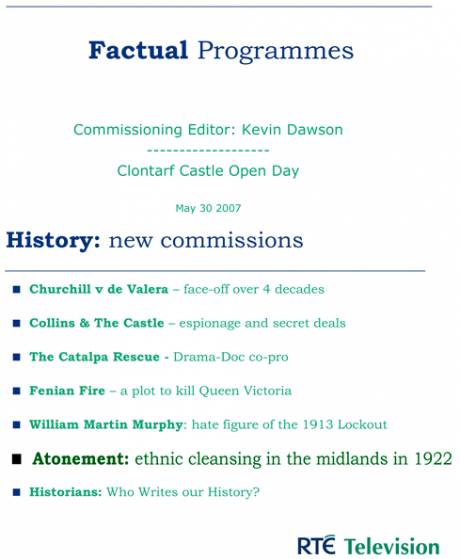
RTE uses "ethnic cleansing" tag to describe programme - where did they get it? No one will own up. - click for detail
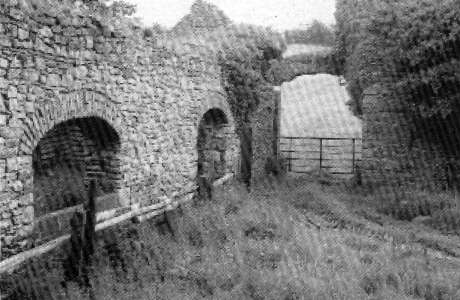
Where the executions took place - see section on 'Local geography' above - click for detail
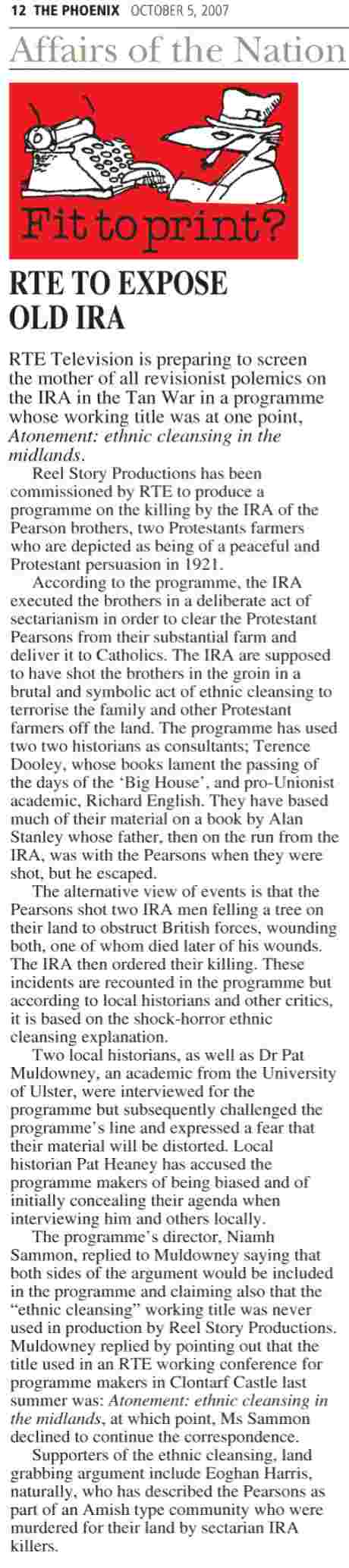
The Phoenix picks up the story Oct 5 - "the mother of all revisionist polemics" - click to read
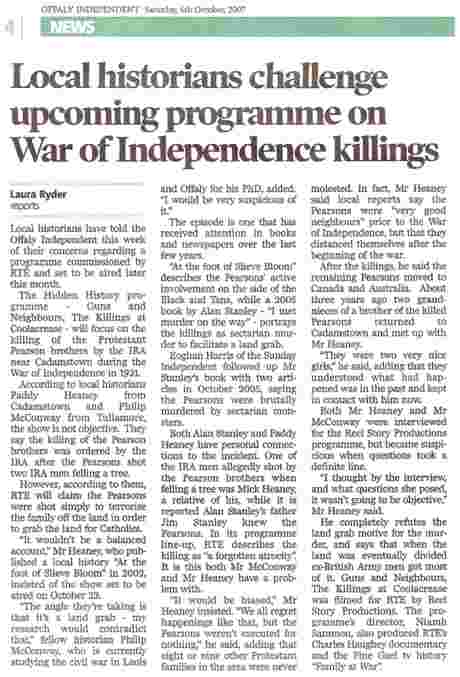
That Offaly Independent article in full - click to read
 We are currently not accepting any more comments on this article. |










 printable version


 Digg this
 del.icio.us
 Furl
Furl Reddit
 Technorati
 Facebook
 Gab
Gab Twitter
View Comments Titles Only
save preference
Comments (307 of 307)
Jump To Comment: 1 2 3 4 5 6 7 8 9 10 11 12 13 14 15 16 17 18 19 20 21 22 23 24 25 26 27 28 29 30 31 32 33 34 35 36 37 38 39 40 41 42 43 44 45 46 47 48 49 50 51 52 53 54 55 56 57 58 59 60 61 62 63 64 65 66 67 68 69 70 71 72 73 74 75 76 77 78 79 80 81 82 83 84 85 86 87 88 89 90 91 92 93 94 95 96 97 98 99 100 101 102 103 104 105 106 107 108 109 110 111 112 113 114 115 116 117 118 119 120 121 122 123 124 125 126 127 128 129 130 131 132 133 134 135 136 137 138 139 140 141 142 143 144 145 146 147 148 149 150 151 152 153 154 155 156 157 158 159 160 161 162 163 164 165 166 167 168 169 170 171 172 173 174 175 176 177 178 179 180 181 182 183 184 185 186 187 188 189 190 191 192 193 194 195 196 197 198 199 200 201 202 203 204 205 206 207 208 209 210 211 212 213 214 215 216 217 218 219 220 221 222 223 224 225 226 227 228 229 230 231 232 233 234 235 236 237 238 239 240 241 242 243 244 245 246 247 248 249 250 251 252 253 254 255 256 257 258 259 260 261 262 263 264 265 266 267 268 269 270 271 272 273 274 275 276 277 278 279 280 281 282 283 284 285 286 287 288 289 290 291 292 293 294 295 296 297 298 299 300 301 302 303 304 305 306 307A great piece of work.
Harris and his cohorts do have a hidden agenda.
Harris was a student of John A. Murphy, revisionist historian. Revisionism is an attempt to de-legitimatize the Irish peoples' long struggle for freedom and democracy.
The SF/WP publication, The Irish Industrial Revolution, a Harris/Smullen effort, gives a revisionist account of the development of Irish underdevelopment and absolved imperialism of its crimes. Mick O'Riordan rightly attacked it on these grounds.
Without memory an individual's identity is under threat. The attack by Harris and the other empire-loving historians is an attack on the collective memory and identity of the Irish people.
The long history of the Irish peoples opposition to the imperial project has inspired anti-imperial forces throughout the world. In reference to Ireland, Marx said; the nation which enslaves another forges its own chains. He could have been referring to the Anglo-U.S. attack on Iraq.
Since the 1600s Ireland has been imperialisms laboratory. 'Destroying in order to save'- imperialism's modus operandi did not begin in Hue, Vietnam, or in Falluja, Iraq. It began here.
It is no accident that Harris and his school are now taking the neocon position with respect to the Anglo-American attack on Iraq. Despite the so-called peace process and its attempt to incorporate all-ireland into the Anglo-American imperial project, neither culturally nor politically, have the Irish people acquiesced in this elite-led subordination.
And the problems associated with the accompanying neolib economics are daily becoming more obvious and more acute. Ireland remains a weak link in the Anglo-American empire. Harris and his enablers Ahern and T. O'Reilly are attempting to destroy the historical memory of resistance. Its vital for Irish economic, cultural and political survival that they not succeed. But they can and will be defeated. The above article makes a valuable contribution to this process of resistance.
A very good piece of research Pat. It wasn't an ethnic massacre, but also the Sinn Fein argument in 1918-19 about representing the "ancient people of Ireland" probably didn't sound very attractive if you were named Pearson and Stanley.
Someone should do a book on the Land Commission effect in 1900-2000; the cost, who paid for it, who benefited, was it worth it, and so on. All sponsored by the town-based taxpayer. If your grandfather bought twenty acres of Co Meath on tick in 1910 and you are selling it off for bungalows today, you'd prefer to keep it quiet. There's one that Harris won't be doing.
The below is a report from that well known Unionist journal An Phoblacht on a speech given by Richard English in the Linenhall Library. It was nicely illustrated by a photo of Professor English with Mr. Gerard Adams MP. English is a Unionist, as he is entitled to be. But his work has been well recived by republicans in the past. See other AP/RN reviews. This type of hyper-historical 'exposure' would be very valid if it wasn't coming from a group of people who strated all this revisionist stuff back in the 1970s. You don't believe me? See the Irish Communist, November 1970 for a description of the IRA as 'fascist' and a 'Roman Catholic sectarian militia.' This and similiar descriptions were the stock in trade of the British and Irish Communist Organisation, or the Peking Lodge of the Orange Order to their friends. This group are now trading under the Aubane Historical Society title and are simply reversing all they believed in in the 1970s in order to curry favour with naive members of Sinn Fein and washed up ex-Trots who ended up in the party.
http://www.anphoblacht.com/news/detail/4026
What was the point of Jinky Jimmy Johnstone's comment. Otherwise there was an excellent contribution and series of comments on the Pearson shootings. This is important as it faces up to the powerful forces in the revisionist movement and in RTE. JJJ does not disagree with Pat Muldowney's position. But he seeks to distract people's attention away from the main issue by dragging in other matters. His comment to my mind is a spoiler. And I have to wonder why he made it.
Agree with Seamas on JJJ's 'noisey' comment – JJJ’s link does not even make sense (the best he could come up with?).
On the substance of Gameball's comments, one the best sources I have come across on the class struggle on the land (which is what it was) is Fergus Campbell's Land and Revolution: Nationalist Politics in the West of Ireland 1891–1921, OUP, 2005.
In his review of the book (American Historical Review, February 2007) arch 'revisionist', TCD's David Fittzpatrick, notes Campbell's eagerness "to claim novelty for his own methods and findings, and to extricate himself from the increasingly uncomfortable company of "revisionist" historians such as Paul Bew, Peter Hart, and myself".
I don't know about anyone else, but personally I could not think of a better recommendation for Campbell's research. For those who may not be aware of him, Fitzpatrick has slipped fairly effortlessly under the radar, while contributing to and promoting much of the the nonsense notion that Irish rebellion is essentially a product of religious mania. All I can say is: welcome to the limelight, David (though I doubt that he will demean himself to the extent of contributing his thoughts here).
The Irish times review of Campbell by Brendan Ó Cathaoir observed: "Dr Campbell suggests [ that a] radical tendency beneath the surface of the republican movement has been airbrushed out of our history".
So, what does Campbell say? Basically that a thoroughgoing revolution in land ownership took place between 1880 and.... well, it's hard to say. The work of the Land Commission was not complete until the 1970s. The jury is still out on that one.
Some think that the land question was solved with the Windlesham Land Act of 1903. Reading Cambell it is clear that the class struggle on the land was not suspended after that date – the 1903 Act was only put on the statute books after a much more limited 1902 Act was met by sustained and violent opposition.
The Land Acts were a product of organised violence or the threat of violence on the land. They were also the product of the fact that the 'law of the League', organised through the the ‘All for Ireland League’, was superior to the British 'law of the Land'. In the popular and powerful 'land Court's' we see an incipient situation of 'dual power' during the first decade of the 20th century that re-appeared with the Sinn Fein courts during the War of Independence and swept away with little difficulty the pomp and panoply of the British court system. They were supported by nationalists and unionists alike, because the deliberations were democratic and, more to the point, they were essentially fair. The Sinn Fein Courts did not spring from nowhere.
While a mechanism for peasant ownership was put in place after 1903, neither side of the property divide ceased to pursue its economic interests. Landlords attempted to subvert the intent of the Act by renting on a short-term basis to substantial graziers, while the landless and the poorer renters used the land courts and cattle driving (large groups forcibly driving cattle 20 miles or so from their pasture) to make such endeavors either impossible or else uneconomic.
Campbell's research helps escape from the shallow conception of the struggle between 1916-21 as a simple minded purely nationalist escapade, whose class struggle elements were supplied by petty and localised sectarian hatreds. He gives substance to a democratic revolt that reached into every aspect of Irish society and that is a far cry from the limited concoctions of the revisionists.
Reading Campbell also helps put Muldowney's well-researched account into perspective. It is interesting that the Pearsons originally obtained their substantial holding through the Land Commission, and then attempted to act as a ruling class faction in miniature, a stance the departing Anglo-Irish Landlord class had been forced to abandon. They resemble the AWB (remember them in South Africa – the ones who resisted the fall of apartheid to the bitter end – those nuts in the lederhosen who tried to shoot their way to retaining a white nirvana).
Also interesting that the execution of two members of the family were a bonus in disguise for the long-term economic prospects of the family enterprise – having conned the Land Commission and even the Loyalist distress Committee in Britain into forking out compensation and restitution over and above the odds. The terms ‘hard nosed’ and ‘brass neck’ come to mind.
It will be fascinating to see how the documentary turns out, eventually.
(Free chapter of Campbell's book at link below)
Isn't it just amazing how some people get hot and bothered by the atrocities of long ago. It is hardly news that many in the Protestant and Cof I communities, fearful of their future under a Roman Catholic majority resentful of their former religious and political oppression, sided with (or were at least sympathetic to) the Crown forces. Conversely, it is hardly news that members of the Catholic Sinn Fein movement used the cover of the disturbances to exact petty vengeance and violence and robbery on Protestant neighbours for no better reason than that they were Protestant. Wars are ugly and the moral dislocation which always accompanies wars everywhere allows unpleasant people to give in to their unpleasant urges. It is a racist conceit that Irish Catholics are immune from the grim realities of human nature at its worst.
Of course 'plus ca change .......' . Much more recently the vicious minorities who comprised the paramilitaries on both sides of the sectarian fence quite successfully ethnically cleansed whole districts in the cities and towns of Northern Ireland - not forgetting the Provo campaign to remove by murder and intimidation the protestant farmers of South Armagh and Down and the borderlands West of the Bann.
However, we are thankfully in more optimistic times. A new power-sharing administration is running Northern Ireland and we must move on - while never forgetting how war morally dislocates us all and makes moral imbeciles of a few without regard to race creed or colour.
The big problem with Aristotle's patronising and factually incorrect remarks is that the Sinn Fein minister for Agriculture was.... Robert Barton (a Protestant). How come there were so many Sinn Fein Protestants? Were they plotting against their co-religionists? Sectarianism was a product of British policy. Divide and rule was both a goal of British political management and a military necessity. Both policies failed. They succeeded in Britain's political slum in the North of Ireland, whose political structures today are testament to the fact the British rule in Ireland is sectarian rule. The only way in which nationalists can be guarantee any rights in the north is by denying majority rule, the 'normal' signal of democratic legitimacy.
Aristotle was 'hot and bothered' enough to contribute his twopence worth in yet another effort to derail the discussion. How many more will we see?
(I was too hot and bothered when I wrote the above to notice two typos - corrected below)
The big problem with Aristotle's patronising and factually incorrect remarks is that the Sinn Fein minister for Agriculture was.... Robert Barton (a Protestant). How come there were so many Sinn Fein Protestants? Were they plotting against their co-religionists? Sectarianism was a product of British policy. Divide and rule was both a goal of British political management and a military necessity. Both policies failed. They succeeded in Britain's political slum in the North of Ireland, whose political structures today are testament to the fact that British rule in Ireland is sectarian rule. The only way in which nationalists can be guaranteed any rights in the north is by denying majority rule, the 'normal' signal of democratic legitimacy.
Aristotle was 'hot and bothered' enough to contribute his twopence worth in yet another effort to derail the discussion. How many more will we see?
Comments were for those who think the Aubaneites are good old fashioned nationalists who have had enough of revisionism. They are not. They invented half the revisionist camp's arguments. Re Fergus campbell, an interesting book, but Campbell if I'm not mistaken is a mate of Peter Harts (who read the draft of Campbell's book, according to the copy I have here) and a mate of Terence Dooley. So who is a revisionist and who is not? Campbell asserts that there was a sectarian dimension to the revolution and he also agrees with Dooley's thesis that land, not nationalism, lay behind at least some of the activities of the volunteers.
My other point was that it is easy for someone to say so and so is a UNionist, but if they are happy to endorse Tom Hartley's collection and have a photo taken with Gerry A then they are clearly a Unionist of a diofferent variety. Plus in these enlightened times republicans now share power with Unionists and it won't be long before Sinn Fein are endorsing what was 'high revisionism' a few years ago. BTW didn't Dolley play football for Monaghan? Typical revisionist west brit...
Sectarianism happens when two or more communities with different political loyalties occupy the same territory. Imperialism often mitigates or masks the potential for conflict. External wars and wars of 'liberation' usually unleash it. The latter often occur where the imperium becomes weakened or allows one of the local groups become dominant over the other. These are truisms from the Roman Empire through to the Soviet Empire.
Sinn Feinnism is a Roman Catholic pathology. Just because a few non-Catholic 'Uncle Tom' do-gooders were involved in the Republican movement hardly displaces the obvious. It is similarly obvious from election demographics that a small minority of (mainly) middle-class Catholics vote Unionist and a large portion of the Northern Catholic population is quite happy to retain the advantages of UK citizenship. These facts do not displace the manifest reality that Unionism is a non-Catholic thing.
The interesting thing about the terrorists is that their victims are as likely to be from their own communities as from the other because of their tendency to faction-fighting and to diversify into drug-crime and extortion with inevitable local turf-wars. To be fair, it has to be admitted that the Catholic communities in the North have knuckled down much better to the new dispensation - and de-criminalization seems to be taking hold in these communities more rapidly than within the majority community.
Now, calm down like a good fellow.
Good work, Pat Muldowney.
But it is no secret that the Pearsons were Black and Tan collaborators. William Pearson proudly declared this fact in his compensation application to the Distress Committee/Grants Committee. Here is the extract from his application form:
5. Do you claim that the loss or injury described was occasioned in respect or on account of your allegiance to the Government of the United Kingdom? If so, give particulars on which you base this claim.
[Pearson’s response:] Yes. I was always known as a staunch Loyalist and upholder of the Crown. I assisted the Crown Forces on every occasion, and I helped those who were persecuted around me at all times.
Did Hidden History simply ignore the historical record, or what?
So unionism will become something benign, like it was intended to be from the beginning in 1920? If enough Catholics accept it all will be sweet reasonableness, eh Ari?
If you were able to buy property in Offaly today, the legal paperwork still refers to it as 'King's County', just as Laois is still 'Queen's County', settled in the 1550s. That king being Philip II of Spain, a multi-continental imperialist and well got with all the popes in his day.
The Land war divides between the tenants' right to buy (tenants who might have been on the spot for generations) up to 1903, and the move after 1922 to acquire untenanted land. The Dáil reports up to 1950 are littered with requests about dividing this farm or that, without any concern as to how the new owners were going to do more than scratch a living from 20 acres. But the new owners' votes were well harvested, and scratching a living was presented as a virtue.
That land reform process would have happened if we had accepted home rule in 1920, and we would have had a united Ireland by 1970, if that was important. I don't see how such an all-Ireland solution can be described as imperialist. I didn't get enough education to work that out. It sounded too slow and weak if you were a young volunteer, is my guess.
The Pearson matter has nothing to do with Northern Ireland today. I would not call the whole war of independence the 'Tan war', as the Tans were set up half way through. And the mix-up over whether the volunteers were democratically accountable to the Dáil and its electorate, or to its own executive, was the cause of the civil war here in 1922-23.
I'm all in favour of revisionists when there are historians like Pat to work on the grey areas. We have moved on from the sort of history that was taught to kids who left school aged 14. Did any of us learn what happened to the $5m collected for the Irish Republic in the USA by Dev in 1919-20? Agendas aplenty.
the fact a foreign country decides it has the right to determine your countrys political system against your own wishes is imperialist . Your point seems to be that if wed kissed ass long enough then Britain would have done the decent thing . As regards some united Ireland in the future....Ireland was already united . Britain partitioning it and directly occupying part of the national territory was a crime . Its clear you regard opposing this intereference as wrong.. a mistake . A youthful rush of blood to the head by immature young men . Perhaps an error we should apologise for ?
A civil war occured because Britain continued to exerise interference in Irish political affairs ( it actually demanded of the free state authorities they go on the offensive) and conflict occured between those who agreed and those who disagreed over Britains right to determine Irelands political future .
We have indeed " moved on " as regards the imparting of history to our kids . We are being encouraged to be ashamed of having rebelled against the crown and to reagrd it as a criminally sectarian enterprise committed against an empire that would have done the decent thing ..eventually .The bullshit in this programme is a fine example of where we have moved to and where we will continue to move .
as British troops still occupy part of our country its patently clear we arent independent as a nation , therefore war of independence is even more inaccurate a term as tan war . In fact as its just a small period of a long running conflcit that involved the black and tans its probably more accurate a description .The Anglo Irish conflict has not yet been resolved .
No Barry, we don't have to apologize for anything that happened in 1919-23. But it happened as it did, and airbrushing or Harris-ing it, or interpreting it by today's standards doesn't help anyone. It was untidy in many ways. We know how proud the men of 1919 were and all must have seemed very straightforward to them at the time.
I'll go along with 'partial war of independence' as well. We weren't independent of England economically until the 1970s and then we jumped into the EEC and now we are all good little European Unionists for the time being.
Have a look at Dev's preferred Treaty of 1921 and you won't find a 32-county republic. The treaty ports, payment of imperial debt, separate status for Belfast, dominion status, compo for the RIC, a nod to George as head on the commonwealth, are all in there. Presented in secret during the treaty debates, published after:
http://historical-debates.oireachtas.ie/D/DT/D.P.A.170001.html
And therefore not resolved 100% Barry, but the border is gone and the Brits are now paying £billions to keep everyone happy so it could be worse. And most of us Dubs are happy with that. We couldn't handle people like Paisley in the Dáil, asking difficult questions and looking for billions off us. We elect the likes of Ms. B. Flynn; go easy on us please.
As it happens I don't think the Pearson killings were motivated by hatred of Protestants. But calling historians names and setting yourself up as an independent voice when you have an agenda as long as your arm (which includes whitewashing Bertie- see the Irish Political Review published by Pat Muldowney's friends) is not on either. BTw have you read Terence Dooley's book on the Wild Goose Lodge?
...how Briitish War of Independence propaganda has magically reappeared in the mouths of historians? The occupiers were really the honest brokers between two warring tribes; the War of Independence was not motivated by politics or ideology but by sectarianism and lust for violence, etc. One would almost suspect the historians to be, well, pushing an agenda. Which you can never suspect revisionist historians of, because their methods are of pure science and reason, as distinctly opposed to the emotionalism of those who have the temerity to suggest that imperialism is unjustified.
The Oxford DPhil which Fergus Campbell's book was developed from was supervised by Prof Roy Foster. Of RF's many research students over the years, Campbell is one of his obvious success stories. Only people who don't understand the debate would suppose there must be tension between Campbell's class-based analysis of the revolution and Foster's work. And if you want to see lots of nasty stuff about the Black and Tans you will find it in the second volume of Foster's Yeats biography.
'Revisionist' and 'revisionism', in this context, is now a meaningless term of abuse. Irish historical writing has matured beyond the simplistic binaries of Unionist and Nationalist narratives. It is thanks to the work of historians, 'professional' and 'non-professional', working away in archives, conducting interviews and so on which means subjects such as this be discussed in any meaningful way.
(JJJ concedes: "As it happens I don't think the Pearson killings were motivated by hatred of Protestants". But JJJ has a problem with the author for some other reason - the publication he wrote for expressed a view JJJ disapproves of on another subject. Thank you, the author is now suitably 'exposed'. )
As for Fred: the rest of us are too thick to understand 'we are all historians now', beavering away together in the archives. Forget the 'simplistic binaries' of nationalist and unionist, says Fred. History is now, to use a suitably religious expression and to quote Father Ted, "an ecumenical matter".
No bias, no political agenda of any kind.
I would believe it if I was born yesterday.
It is clear that some research is given greater weight in academia and in the Media, for reasons that have nothing to do with history and everything to do with politics. For instance Paddy Heaney and Pat Muldowney's research was regarded as second best because it challenged the prevailing political and historical orthodoxy suggesting that the anti-colonial movement in Ireland is and was a sectarian movement.
As part of a critique of Ken Loach's 'The Wind that Shakes the Barley', Roy Foster criticised Luke Gibbons' assertion (in an essay accompanying the published film script) that Protestants who were shot during the War of Independence suffered their fate for informing, not for religious reasons. Foster states sniffily, "The 'evidence' remains unproduced". He then writes, “this judgement would certainly not stand for the murder of, for instance, the Pearson Brothers in Kinnity Co Offaly in June 1921, and the burning out of their house”. Foster’s source for this conclusion, "a recent local study". This appears to be Foster’s reference to Alan Stanley's strung together reminiscences in 'I met Murder on the Way, the Pearsons of Coolacrease'.
There is no way a professional historian of Foster’s experience would cite such a clearly unhistorical and plainly biased source, devoid of evidence (never mind a clear narrative), unless he was biased toward its conclusions. A 'professional' historian might have considered Paddy Heaney's acount, would at least have been aware that Stanley's was a contentious and debatable view. What “binaries”, simplistic or otherwise, would Fred Alan apply to Foster’s lamentable observations in this case? If Foster was citing an academic source, he might presumably have given us its name. His approval of the embarrassingly thin gruel offered in Stanley's account, in comparison to his ignoring (or ignorance perhaps) of that in the originally published account by Paddy Heaney, is significant.
In the same film critique (Dublin Review Autumn 2006), Foster referred to the "skill and empathy" with which Peter Hart “raised merry hell with local historians" after Hart had alleged that the IRA went around shooting random Protestants in the area where the film was set, West Cork. Critics of Hart's view are are mentioned. They are not important enough to be named, or perhaps their criticism is too important to have too much attention drawn to it, by naming the authors. Hart’s critics are considered "local" yokels to the dismissively cosmopolitan Professor Foster (born and brought up, as it happens, in the locality of Co Waterford). The critics, Brian Murphy, Meda Ryan and, now, John Borgonovo are not granted the same right of audience to Professor Foster's historical imagination. Foster prefers instead the views of a historian, Hart, who claimed to have interviewed a veteran of the November 1920 Kilmichael ambush six days after the last one died, and who, as a matter of habit, it has been shown conclusively, censored evidence questioning his (and also, it appears, Foster's) preferred conclusions. For this Peter Hart won manyy academic prizes and plaudits, including the 1998 Ewart Biggs prize (Jury Chairperson: one Roy Foster. Roy still chairs it - a long gig, has he ever thought of letting someone else have a go?)
Foster identifies with Hart, and David Fitzpatrick pigeon holes himself in the same category as Hart, alongside the recently ennobled Lord Bew of QUB (the former 'Marxist' historian). Unprompted, in 2007, Fitzpatrick acknowledged that Campbell does not want to be part of their “revisionist” club – the one that Fred Allen says no longer exists.
Fred Allen thinks there is nothing fishy going on. Perhaps he should swim around a bit more in increasingly choppy historical waters.
(Campbell is Roy's 'success story'? And here was I thinking Campbell wrote the book himself. What would have happened If Roy had attempted to stop Campbell succeeding? Was that an option he had open to him? Intriguing observation from Fred.)
Baron Bew and Senator Harris have longtime service in support of the imperial-imposed repressive political structures of Ireland. Their patrons are the ruling class of Britain and its Irish sub-branch Fianna Fail. The Belfast Agreement signals the incorporation of all Ireland, North and South, into the Anglo-American imperial project. Foster and his fellow revisionists have reduced historical investigation to propaganda whose aim is to make all-Ireland safe for Anglo-American political economy.
Re. Campbell. I obviously wasn't questioning his authorship or independence of mind. But it's hard to imagine he got his job without a very warm reference from his former supervisor. Consequently, there is an irony in the Foster detractors holding up Campbell as anti- or post- or something- 'revisionism'.
Yeah, Ewart-Biggs is a bit of a club.
This debate about Hart is a good example of revisionism in action. New evidence is being brought to light and is challenging his account. Revisionism is what historians do and Foster is too ready to take the Hart line. There are ideological issues bound up with this debate and I'd be interested to know what you think RF's wider position is. He's certainly a cosmopolitan (unlike the essentialist Yeats) and I'm sorry that William O'Brien seems not to be (unless there's some self-hate in there too). Try it and feel the love! I don't know on what grounds RF is a Unionist in the way that English and Bew are.
Re Loach. Interesting this. Foster was much nicer about the film than I expected. I saw it as Loach's standard take on the lost socialist revolution (cf Land and Freedom). If only that was the case. Sadly, Irish nationalist opinion was a lot further from socialism than the film suggests.
Revisionism? A hackneyed debate kept alive by middle aged men and women who cut their teeth in the culture wars of the 80s and 90s - and those Young Turks wanting their jobs... About time we liberated ourselves from their agenda.
If only William O'Brien's All-for-Ireland League had got off the ground we might not be having this exchange. Fred Allan was probably among those who thwarted it as an ideological compromise...
In the past, Roy Foster and Martin Mansergh both criticised the Aubane Hysterical S....sorry, Aubane Historical Society. These Blaspheming Heretics must be punished!
The above piece effectively rebuts this latest effort by the Harris/RTE network to undermine the Irish peoples struggle for freedom. But to attack Harris and support his patron, Ahern, is incoherent, and strongley suggests that the BICO/Aubane project-whatever it is-belongs more in the annals of psychopathology than politics.
You Republicans will say anything to try and justify your bloody sectarian war against Prtotestants In The ROI. Facts are Protestant numbers in the South amounted to 160000, pre Independance war , but by the end of the Twenties their numbers had been reduced to around 100000.
Contast this to the number of Catholics in Northern Ireland in 1921-400000, now there are almost 700000. I can see from these figures which part of Ireland the minority really suffered oppression.
the border has not flipping gone . Partition is very much still with us. Id have noticed i assure you if it wasnt .
Jesus . WTF is it with free staters ?
"You Republicans will say anything to try and justify your bloody sectarian war against Prtotestants In The ROI."
When did this war start? When did it end? Who died? Where are they buried?
Charlotte, 1921,at Partition started the most recent persecution which still continues ,albeit to a lesser degree today. You can find examples of this by using the following keyword.
There was ethnic cleansing if you mean that Ascendancy elements upped and left the south once they no longer had a foreign army to force people to tug their forelocks to them anymore.
Or where exactly are these 60,000 missing protestants supposed to be buried then?
To William O'Brien; I'm not claiming to have a devastating argument about this. But where the original argument comes from does matter and BICO, in their past or present guises, are not to be trusted. I notice Bronterre O'Brien notes Eoin Harris and his Irish Industrial revolution for example. Well that book was largely ripped off from the BICO pamphlet 'The Economics of Partition' by one Brendan Clifford, then BICO's chief ideologist now Aubane Historical Society head honcho. Simply calling historians 'Unionist' or 'Big House' nostalgics undermines Mr. Muldonwney's own arguments, because neither English or Dooley fits the stereotypical bill. And if local historians who have a different view on the programme are taking part in it than whats the problem? Are you saying Pat Muldowney should ahve the programme to himself? The internets a wonderful thing, because I see from a browse that Fergus Campbell, held up above as the last word in anti-revisionism co-organised a conference at Maynooth in 2003 with Terence Dooley. Keynote speaker? Prof, now Lord Paul Bew.
My issue of 'The Economics of Partition' is dated 1992. ( there may, of course, have been an earlier version) 'The Irish Industrial Revolution' is dated 1978.
D. Kelleher, above, makes a good point; Aubane attacks Harris and supports Ahern who put Harris on the Senatorial welfare roll. Harris is rewarded for his anti-republicanism by the leader of Fianna Fail. The Aubane shallow green nationalism should not be mistaken for republicanism.
But Aubane incoherence does not not detract from the empirical validity of Muldowney's piece. And they are not currently so obviously in the service of power and wealth and privilege as Senator Harris and Lord Bew.
The National Library in Dublin has two editions of "The Economics of Partition" (1972,1992)
and the Harris pamphlet was published in 1977. It's possible the B&ICO influenced
that pamphlet, although I couldn't say for sure.
On 26th and 27th of October, B&ICO/Aubane bigshots Brendan Clifford and Jack Lane
are launching new books. http://www.atholbooks.org/book_launch.php
Why not ask them if they influenced Harris?
Netaji Subhash Chandra Bose first sought help from Russia. They did nothing, so he went to Germany. This was also a disappointment to Bose. Even though Hitler was at war with Britain, he supported Britain's Empire in India and he aspired to emulate in eastern Europe such tyranny over so-called inferior races. Bose is our great hero in India. Like B.R. Ambedkar (great leader of the Dalits or Harijans), these days Bose is more highly regarded by us than even the Mahatma himself. He was prepared to use Japanese help to get the British out, because he knew that free India could easily keep Japan at bay.
More than any of our other great leaders, the Netaji was first and foremost a socialist.
Every element of atrocity justification and terrorist apologia is in Mr. Muldowney’s exposition above. The victims are blackened as much as possible seemingly by republican hearsay - there being no other sources of information available or any other source is dismissed as Castle or loyalist propaganda (propaganda comes from one side only, the clear stream of truth is on our side exclusively I suppose), the perpetrators are actually the noble and oppressed victims, the executions were reasonably quick – in fact he victims were lucky in the circumstances. It was wartime anyway and bad things happen in all wars etc so there is no moral turpitude or war crime involved or bad conscience later. The say so of an IRA CO is enough to damn two young brothers to a terrible and cruel death with no further comment necessary. The bitter closing of ranks and minds even at this remove in years. Along with the constant slated language (Black and Tan terrorists v. the Irish Army). Was it a lawful war with lawful combatants? The authority did not come the Dáil, which had not declared a war and that would have been the democratic authority. There is no room for empathy in this account; no room for decency; no room for scruple of any kind, whether Christian or secular. Just ourselves, our ever so ancient hatreds, our justifications, our precious grievances. There is no reason why one could not justify the Omagh bombing or any other atrocity along these same lines.
This is a hate filled and repellent piece of work.
To JJJ:
If Richard English is satisfied with the Unionist tag (no crime, I presume), and if Terence Dooley is happy to be known as admirer of Big Houses (no crime either), then surely it is no crime to note this in acknowledgement, even if one is unsympathetic to their viewpoint?
Why is Muldowney praising the Axis collaborator Subhas Chandra Bose ?
"There is no getting away from the fact that Bose deliberately ignored the moral evil that Nazi Germany represented. He had lived in Germany for much of the 1930s and the early 40s. He must have known something of what was going on.... But he was not sufficiently disturbed by Nazism to reject Hitler's help. Similarly, his alliance with Japan ignored the atrocities that the Japanese had perpetrated against people in the countries they had occupied."
Learn More:
http://web.archive.org/web/20050305012751/http://www.an...m.htm
Starkadder should take this up with the people of India, where is hardly a town or city without a street, monument or building named after S.C. Bose. Perhaps their main concern is with the atrocities inflicted a bit closer to home, rather than those perpetrated far away in eastern Europe and China? The colonial atrocities and genocides were the template for late-comers like the Nazis and Imperial Japanes, but they are glossed over nowadays - isn't this the problem with our new history? Incidentally, did anyone notice the Indian reaction to the 150th anniversary visit by the group of descendants of colonials killed at Lucknow in the so-called Mutiny? Looks like India needs a bit of Hidden History to help them to understand how lucky they were that people should cross the ocean to improve them and help them!
The 'two nations' theory appeared in India after the Muslim/Hindu insurrection of 1857.
That Harris is a poseur and charlatan is common knowledge:
http://indymedia.ie/article/83820
To untangle the intertwined, ideological acrobatics of Harris/Clifford is probably impossible. But they both repudiated the writings of Marx on Ireland to assert their own pro-imperial 'marxism'. Megalomaniacally they knew more about 'marxism' than Marx himself. For this foolishness they drew on Hazelkorn and Warren. From this spurious platform they attacked republicanism and became agents of imperialism. The Belfast agreement which denies the right of the Irish people to self-determination and facilitates the incorporation of all of Ireland into the political economy of the Anglo-American empire is completely in accordance with this Bico/Harris stance. Both Harris and the Aubanes support the corrupt Ahern who played a key role in this defeat of the Irish struggle for freedom and democracy. Attacking Harris and his propaganda while supporting Ahern his benefactor shows that confusion reigns in Aubane.
The ruling classes have handsomely rewarded Lord Bew and Senator Harris for their pro-imperial efforts while the Aubanes struggle on pamphleteering. Whatever their motivation, the piece by Muldowney is to be welcomed because in this particular instance, it effectively rebuts the pro-imperial propaganda of the Harris/RTE network.
Actually, Hannah Arendt pointed out the link between colonialism & Fascism in the 1950s.
Next you'll be telling us Elvis Presley will be the next big thing!
In the 1970s, the B&ICO advocated Bill Warren's line that imperialism was "progessive" to
toady to their Unionist patrons.
And if the Aubane Historical Society were really interested in attacking imperialism, how come they never mention Imperial Germany's massacre of the Namibians, or the Turks' butchery of the Armenians?
They only mention imperialism when they can use it to indulge in pub bore Brit-bashing.
(And the first anti-semitic organisation to openly voice the Idea of exterminating all the
Jews were the Russian Black Hundreds-who were also anti-British).
Actually, Bronterre is right-a two-nations theory was mooted by the likes of Jinnah to argue for the partition of India.
The idea that Ireland was "two-nations" was originally argued by Victorian and Edwardian conservatives like W.F. Monypenny, (best known for his biography of Disraeli) who wrote a book called the "Two Irish Nations" in 1912.
There's a discussion of the "Two-Nations" idea here:
http://www.marxists.org/history/etol/newspape/isj/1972/...h.htm
My point was that the Muslim/Hindu unity in the 1857 uprising was a real threat to the British empire in India. And it was an integral part of British imperial policy to promote this spurious two-nation nonsense.
http://india_resource.tripod.com/hist-2nation.html
A similar 'two nation' theory in Ireland derives from the same source-British imperial policy.
Those who promoted such notions are clearly agents of imperialism.
That Harris and Clifford are now supporters of Fianna Fail and its corrupt leader Ahern shows that Fianna Fail and what it represents are antithetical to the political and economic interests of the Irish people. Its important to keep this in mind while accepting that the Muldowney fact-based piece refutes, in this instance, the pro-imperial activity of the Harris propaganda network.
W.F. Monypenny was certainly an advocate of British Imperialism in Ireland.
As for the Aubane crowd, perhaps they're going after the Anglo-Irish because they percieve them as a
threat to a particular conception (Conservative Catholic Nationalist) of the Irish nation, that they have now adopted. Hence the attacks on people
like Elizabeth Bowen and W.B. Yeats, as well as the Irish Political Review's hostility to the Irish Times.
Muldowney seems to painting the Pearsons in the Blackest possible light, the passage about" some poverty stricken cabin dweller or landless labourer with a hungry family, looking down from the mountainside at the Pearsons’ fat cattle, glossy horses and lush crops in rolling acres of the fertile plain." could have been taken straight from a Soviet propanganda pamphlet..
Although Muldowney seems to have always been a nationalist, the embrace by the other ex-BICOers of the Irish nationalism they
spent an enormous amount of time and money fighting is genuinely baffling.
I think we've drifted well away from the central issue of the article . While the aubane people have indeed found their road to damascus in the strangest and most unexplained of circumstances , of a more pressing concern is as to why a national broadcaster seeks to persue the agenda of portraying a national liberation struggle as a sectarian pogrom . This is an agenda in common with other sustained attempts imperialist historians to reinforce the notion that colonialism was benevolent and the struggle for national sovereignty a backward sectarian affair .
Its very clear this Pearson family were active British informers and armed loyalists and therefore their removal was not only legitimate and justified but highly necessary under the circumstances as they presented a very clear , present and armed danger to the lives and welfare of those in the field against colonialism .
The lame , dishonest and often hysterical attempts to argue otherwise are part of an overall agenda , whether its bedwetting regards scullabogue or Peter Harts phantom interviewees the agenda is there was no defence of a republic and national sovereignty , simply sectarian savagery of the very kind Britain was only here to prevent . Rebellion against foreign rule must be deemed a criminal act we should be ashamed of . Such propaganda is incessant either from programmes such as this or the likewise crap spouted on a daily basis from various newspaper scribes .
So , its quite clear this agenda exists . The logical approach then is to question its purpose . Why expend the effort and expense in the first place ?
Can I compliment Barry and Bronterre O’ Brien on a mature approach to politics?
In advancing a particular political cause their approach is to seek alliances and areas of common interest between people and groups so as to maximise political effectiveness on an immediate political issue.
Such an approach reserves the right to disagree vigorously with allies on other issues.
This approach contrasts with the childishness of some of the other posters who prefer to take every opportunity to indulge in disagreements over other matters and attempt to undermine the immediate political objective under discussion even though they have no substantial disagreement with it.
There's a discussion of BICO here, where it won't annoy Mr. Martin.
http://splinteredsunrise.wordpress.com/2007/07/09/the-s...tape/
Oh, I'll tell you a tale of peace and love
Whack fol the diddle o the die do day
Of a land that reigns all lands above
Whack fol the diddle o the die do day
May peace and plenty be her share
Who kept our homes from want and care
Oh, God bless England is our prayer
Whack fol the diddle o the die do day
Now our fathers oft were naughty boys
For pikes and guns are dangerous toys
At Ballinahabwee and at Bunker's hill
We made poor England cry her fill
But old Brittania loves us still
Now, when we were savage, fierce and wild
She came as a mother to her child
Gently raised us from the slime
And kept our hands from hellish crime
And she sent us to heaven in our own good time
Well, now Irish men forget the past
And think of the day that's coming fast
When we shall all be civilized
Neat and clean and well advised
Oh, won't mother England be surprised?
In the publicity and announcements of this documentary, including a trailer shown on Tuesday October 16, there was not a hint of the existence of any explanation of the execution of the Protestant Pearson brothers other than the explanation implied in the working title
"Atonement: Ethnic Cleansing in the Midlands".
Local people in Offaly, where these events took place, contributed to the programme in good faith but found themselves the target of trick interview questions such as:
“What is your evidence that the Pearsons were spies and informers?”
But the Pearsons were sentenced to death by war-time Court Martial, not for spying and informing, but for attacking and shooting two Irish soldiers in full knowledge that those Irish soldiers were on army duty resisting the Black-and-Tan terror. And this trick question about the Pearsons as spies/informers was asked by the programme makers in full knowledge of this true and fully documented reason for the executions. Furthermore, it was asked in full knowledge of the official RIC corroboration of the truth of the Court Martial charges against the Pearsons, that the Pearsons did indeed attack and shoot two Irish soldiers on duty.
But were the Pearsons in fact spies and informers, in addition to shooting up the IRA road-block? Well, after nearly a hundred years, when all the people involved in those events are long dead and no longer available for cross-examination, it would be difficult to get stronger confirmation of this than William Pearson’s written declaration that “I assisted the Crown Forces on every occasion”, (Pearson Application to Grants Committee).
HIDDEN HISTORY’S HIDDEN AGENDA
This trick question about the Pearsons’ spying/informing was one of many such tricks employed by Hidden History during production, some of them described in the original article above.
Why did Hidden History engage in such trickery? Hidden History’s Hidden Agenda was to conceal or deny or obscure the true reason for the executions in order to advance their own spurious land-grab theory. Furthermore, by springing trick questions they could wrong-foot unsuspecting interviewees and make them look evasive and defensive on camera (“Look at them! There they are, almost a century later and still in denial!”). The intention was to produce an unfavourable contrast with other interviewees who were, after many years of silence, prevailed upon to describe, with great reluctance, and more in sorrow than in anger, a forgotten sectarian atrocity of malevolent and hideous proportions.
But anger is what the Hidden History trickery intended to induce in the programme viewers, the Irish public. That was the Hidden Agenda during production. It was as puerile, as shallow and as dishonest as that.
HIDDEN HISTORY HIDES MULDOWNEY!
When I became aware of the Hidden History production I telephoned Niamh Sammon and followed up with three short letters noting that there were two sides to this story. After mentioning that I was aware of the RTÉ working title
"Atonement: Ethnic Cleansing in the Midlands in 1922"
I eventually received a reply to my three letters, followed by an invitation to be interviewed for the programme in July.
By this stage I was fully briefed by earlier interviewees from Offaly. So I had been made aware of key facts about the Pearsons, and of Niamh Sammon’s trick questions. For instance, in addition to the trick questions mentioned in the article above, I was asked “What is your evidence that the Pearsons were spies and informers?” about a dozen times, even though I had never claimed that they were – they were sentenced to death for a much more serious offence than that.
Following the interview I wrote a report of it, including the transparent trickery, and sent it to RTÉ.
On 17/10/2007 I received a telephone call from the Niamh Sammon to tell me that my contribution would not be used. The four letters below constitute the final part of my contact with the programme and with RTÉ. There was a reply to the first letter, saying that both sides would be presented, and that the working titles and publicity did not constitute the programme itself. There was no reply to the other three letters.
1.
Mr Cathal Goan
Director-General
RTÉ
Donnybrook
Dublin
27/09/2007
Dear Mr Goan
RE: Hidden History: Guns and Neighbours [Atonement: Ethnic Cleansing in the Midlands]
The description of this programme in RTÉ’s new schedule announcement at
http://www.rte.ie/tv/newseason/thestorystartshere.doc
http://tvsales.rte.ie/autumn/content/factual/hidden-his....html
describes the 1921 execution of the Pearson brothers as an atrocity in furtherance of a land-grab, as follows:
"HIDDEN HISTORY Guns and Neighbours | The Killings at Coolacrease RTÉ One The bloody tale of a bitter land dispute, involving a family of Protestant farmers in County Offaly, which comes to a deadly conclusion during the War of Independence. Featuring interviews with descendants of the men who carried out the killings, this portrait of a forgotten atrocity features substantial newspaper archive research, IRA witness statements and military documents from the period."
The relevant, official documentary evidence from both the Irish and British sides proves beyond doubt that there was no atrocity and no land grab. The documentary makers have this evidence in their possession. Their denial of the evidence proves that their objective is propagandist, not investigative.
Can you confirm that RTÉ intends to broadcast this programme? What is the broadcast date?
Yours sincerely
Pat Muldowney
2.
Ms Niamh Sammon
Mint Productions
205 Lower Rathmines Road
Dublin 6
Date: 17/10/2007
Dear Ms Sammon
Hidden History documentary October 23 2007:
Pearson Executions 1921
=================================
You telephoned me yesterday to inform me that my contribution to your programme will not be broadcast, but you did not tell me why.
The essential points of my contribution were:
(1) William Pearson’s declaration that he was a collaborator (“I assisted the Crown Forces on every occasion”, April 14 1927, Pearson Application to Grants Committee); and
(2) the official RIC report, confirming the IRA Court Martial report, that the Pearson brothers were shot because they had fired on an Irish Army road-block and wounded two of the soldiers (“the two Pearson boys a few days previously had seen two men felling a tree on their land adjoining the road, had told the men concerned to go away, and when they refused, had fetched two guns and fired and wounded two Sinn Feiners, one of whom it is believed died.” Court of Enquiry, July 2 1921).
These points establish that, in a war provoked by the military suppression of the democratically elected government, the execution of the Pearsons was a legitimate war-time action.
Can you please tell me why my contribution will not be broadcast?
Yours sincerely
Pat Muldowney
3.
Mr Cathal Goan,
Director-General, RTE,
Donnybrook,
Dublin 4
Date: 17/10/2007
Dear Mr Goan
Hidden History documentary October 23 2007:
Pearson Executions 1921
=================================
Many thanks for your letter dated 2 October 2007 which I received by email on 11th and by post on 13th, delayed by UK postal strike.
My primary purpose and ambition was to be proved wrong in my concerns about bias in the Pearsons documentary, and that a breach of the Broadcasting Act could be averted. And failing that, to alert viewers to the bias. The trailer for this programme which followed last night’s Hidden History of De Valera/Churchill was consistent with and reinforced the message (ethnic cleansing/ atonement/ sectarian atrocity/ land-grab) of the earlier publicity and announcements. There has as yet been no mention of an alternative explanation of the executions. Your comments on the prejudiced and unbalanced publicity and announcements do not amount to a justification.
Suppose for the moment that this publicity is by way of provocative hypothesis to be subjected in the actual broadcast to balancing comparison with alternative views. The simplest way to do this would be to include in the broadcast the relevant bits of my interview. That is, (1) William Pearson’s documented acknowledgement that he was a collaborator; and (2) the RIC confirmation of the Irish Court Martial’s reason for the executions – that the Pearsons had shot two Irish soldiers. Earlier interviewees from Offaly did not have this documentation to hand at time of interview, and anyway they were entitled to expect that a well-resourced and fair-minded production would itself gather and present all such relevant (though not readily accessible) evidence.
My contribution will not be in the documentary. So will this evidence be presented at all, and, if so, who will present it? Somebody who is convinced of the opposing view and who will diminish the force of this evidence and declare it irrelevant or unimportant or even false? That is what Niamh Sammon tried to do when she interviewed me, but I believe that I overcame this challenge in debate. I believe that is the reason why my contribution will not now be included.
Contributors such as Alan Stanley have been given a preview of the documentary, but nobody from the opposite side of the argument has been allowed to see it.
I request from you a preview. And I suggest that contributors from Offaly be offered a preview, just like those from the opposing side of the argument. If not, why not?
Yours sincerely
Pat Muldowney
4.
Mr Kevin Dawson
Factual Programmes Director
RTÉ
18/10/2007
Dear Mr Dawson
From enquiries, other contributors to this programme were involved in many hours and days of discussion, preparation and investigation. Apart from a two-hour interview, my contact with the programme during production consisted of three one-minute phone calls (the first one of which was initiated by me), three one-page letters, and a written report.
I cannot help it if the programme makers found it taxing to have to interact to this extent with someone who disagreed with the working title
"Atonement: Ethnic cleansing in the Midlands"
as a description of those events.
Just one issue remains, and this is a question that only you can answer, so I address it now to you.
Under what circumstances, and for what reason, did you come to publicly present the programme's working title in Clontarf Castle last May as :
'Atonement: Ethnic Cleansing in the Midlands' ?
Where did you get the idea that this title was a fair summary of the proposed programme content?
Yours sincerely
Pat Muldowney
The HIdden History programmes are imperial propaganda brought to us by our national broadcasting service.
The link is to a piece that discusses how their last programme distorts the relationship between De Valera and Churchill and how they whitewash the anti-Irish bigotry of Churchill-and such anti-Irish bigotry of Churchill and other British leaders has had disastrous consequences.
http://www.irishexaminer.com/irishexaminer/pages/story....1.asp
I see that Niamh Sammon who censored Pat Muldowney's contribution to the programme (going out next Tuesday) has a puff piece in the Irish Times today. See Muldowney's letter to Sammon above, sent after he was told he was being censored.
Why is the the Irish Times promoting a censor, who is afraid of alternative evidence? Will the IT give equal space to the alternative viewpoint - in a short and easily ignorable letter perhaps.
Local historians in Belfast have for years been outlining the officially sponsored nature of the dreadful massacres which occured in Belfast around the period when Britain carved the island up into the administrational units it regarded as necessary for maintaining control and influence . Fieldmarshall Sir Henry Wilson himself was responsible for organising the forces which unleashed ferocious sectarian terror in the north . The leader of a particularly brutal murder gang in Belfast , District Inspector Nixon , which used guns , knives , bayonets and sledghammers to dispose of its victims was awarded an MBE in 1923 for the services he rendered to the crown in Ireland .
Sadly neither RTEs revisionist bullshitters nor the former BICO-ites in Aubane are remotely interested in this aspect of Irelands hidden history despite the wealth of patently ignored sources and historical resources . Because as far as both are concerned we residents of Irelands most troubled province arent part of the Irish nation , therefore no national atonement is necessary for abandoning ourselves to such atrocities that Churchill must surely have applauded , ensuring Nixon got his MBE for his sterling service .
http://mcmahon.rushlightmagazine.com/
Their respective postions in the 1970s , when BICO pretty much applauded the sectarian massacre of catholic "non nationals" and RTE current affairs under Harris adopted the policy of ignoring the inconvenient "non nationals" and instead promoting the propaganda of the UDA leadership as factual news are a definite issue for atonement in my opinion . Abandondoned in the 1920s , rounded upon and demonised from the 1970s till now . Cast out of the nation itself by their respective lines of propaganda which regard us as every bit as inconvenient to the status quo as Nixon , Churchill and Wilson regarded us .
Is there any chance that the truth of this matter can be brought to a wider audience than just those who read Indymedia?
Thousands more people are going to read that piece of bad journalism and worse history by Niamh Sammon in today's IT than will read the dissection of the case above.
If for no other reason than that historical truth should be preserved, this needs a much wider dissemination.
(and in case anyone is wondering, I do not now, and have never been, a supporter of violent republicanism).
A brutal crime just before the end of the War of Independence hints at the darker side of the conflict, writes Niamh Sammon
No doubt June 30th, 1921, began like any other for the Pearson family of Coolacrease, Co Offaly. Life on that day would have revolved around the usual farm chores, but today, there was an extra task at hand. With the sun in the sky, two sons of the family, Richard (24) and Abraham (19), and a friend of theirs, William Stanley, were saving the hay, determined to make the most of the good weather.
What had this family done to deserve such a dreadful retribution? The Pearsons were members of a peaceable, non-political, dissenting Protestant sect known as the Cooneyites, and their attackers were drawn from the local Catholic community.
The Killings at Coolacrease will be broadcast next Tuesday at 10.15pm on RTÉ1
http://www.ireland.com/newspaper/newsfeatures/2007/1020....html
From Sammon's Irish Times article yesterday:
"...And it was more surprising still when an old man made it his business to let our camera crew know "You could get shot for asking those kind of questions."..."
(see http://www.ireland.com/newspaper/newsfeatures/2007/1020....html)
Sammon quotes something that an un-named fourth party allegedly said to an un-named third party.
And this is a "journalist" working for RTE's "Factual" Programmes!!!
So somebody makes a violent threat against crew members employed by Sammon, crew members whose safety she is legally responsible for.
Did she discharge her legal responsibilities and report this violent threat to the Gardai to find out what was going on?
Or - perish the thought! - is this just another sensation-mongering ploy in RTE's Hidden Fantasy?
Hold on a minute. This is a death threat. And the programme is going out on Tuesday. So even if Niamh is not worried about her own safety, surely she must have a care for the crew member(s) to whom the death threat was made, who must now be in deadly peril? Surely she must go to the police immediately, identify the elderly terrorist, and ensure that the law of the land is upheld?
On the other hand, maybe it's a lie as Reel Journalist suggests. The old men that Niamh and her crew actually came in contact with, in what she implies is a sparsely populated, close-knit area, must be small in number, so the target of the slander can be easily identified by a simple process of elimination.
Does this individual, or the handful of people that she has put in the frame, have any comeback against this outrageous slander?
But let's get Reel. We all know it's just so much hot air. When Dublin 4 talks to itself in the Irish Times, it neither knows nor cares whether mucky Paddy and thick Biddy can hear what it is saying. And let's face it, Paddy and Biddy don't care very much about what Lady Niamh says to Lord Eoghan - not after 1916-21. We can thank what Lady Niamh calls "IRA gangs" for that.
Yes. We've got democracy now. We don't have to do what we're told, and think what we're told, by our betters. Hidden History propaganda and RTE censorship can't take that away from us.
If this turns out to be as bad as everyone says, then denounce away. However given that none of us have actually seen it yet, is there not a touch of the Ruth Dudley Edwards types attacking Michael Collins and the Wind That Shakes the Barley about all this? Local historians who disagree with the programme's thesis were interviewed on it were they not? Lets see whats its like.
One historian has been censored - we know that.
Don't raise your hopes too high. If Muldowney's reports above are right they may have been caught out by the trick questions and misdirection of a D4 smart-alec.
A reply has arrived to the fourth letter above (Kevin Dawson Director of Independent Productions, RTE), stating that "Ethnic Cleansing in the Midlands" was never a title, sub-title or working title of the Hidden History documentary. He states that it was merely
"a bullet-point for a speaking note, a slug in a power-point presentation".
Here is my reply:
Dear Mr Dawson
Thank you for your reply. The words "ethnic cleansing" appear first in your RTÉ document of May 30 2007. The publicity drive this weekend highlighted ethnic cleansing. See for instance Sarah Caden's Sunday Independent article entitled:
"Speak it in a whisper: Irish ethnic cleansing".
This is just one of the numerous bogus atrocity myths that the RTÉ document, the programme announcements, trailers, working titles, propaganda articles and radio interviews are giving legs to.
The RTÉ description "Ethnic cleansing in the midlands" was attached by you to this programme in a public way in Clontarf Castle on May 30 2007, five months ago. The link between this long-held RTÉ interpretation of the programme and the current pre-broadcast propaganda drive is clear and obvious.
The current atrocity-propaganda drive is comprehensive. I cannot possibly go through all the current bogus atrocity stories now, but here is an example. Shooting in the genitals has been trumpeted. The medical reports prove that this is false. Richard Pearson received superficial wounds to the right groin and left shoulder. This where the torso joins the right leg and left arm, respectively. There were no medically reported injuries to the genitals.
But the central dishonesty of the programme is clearly expressed in the following statement in your letter, of what this documentary is all about:
"whether the incident at its heart resulted from real fears of Loyalist spying or from sectarian/ agrarian tensions, or some mixture of these things."
This is the central piece of misdirection which is at the heart of the programme. I experienced it directly myself when I was interviewed by Niamh Sammon for the documentary in Kinnitty Castle on July 28. I had been alerted to this tactic and gave no quarter to it. And I believe that is the reason why my contribution has been censored.
In fact the Pearsons were NOT sentenced to death for spying. They were sentenced to death by Irish Court Martial for shooting two Irish soldiers on duty, and this is corroborated by the RIC report given to the British Court of Enquiry into the deaths. That is what the "incident" resulted from. There is no mystery, no puzzle as to why they were executed. The authorities on both the Irish and British sides were in agreement on this. Nearly a century later, and with no grounds whatever to doubt the well-documented reasons given by both sides at the time, Hidden History and RTÉ have invented a mystery in order to insert a new and bogus explanation of " sectarian/agrarian tensions".
The programme and its associated propagandists (which, from your Clontarf Castle slide and the above quote from your letter, include RTÉ) pose the red herring of whether or not the Pearsons were spies and informers - a lesser crime. Thus deliberately obscuring and concealing the actual, more serious and officially documented reason for the executions.
RTÉ's responsibility for the current wave of sensationalist myth-making is perfectly obvious. Your Clontarf Castle slide and the above quote from your letter prove this.
Yours sincerely
Pat Muldowney
The email correspondence below ensued from yesterday's RTE Radio One Tubridy show, which, for anyone who has not heard it or recorded it, should be available on-line:
http://www.rte.ie/radio1/thetubridyshow/
1.
To: The Tubridy Show, & the Pat Kenny Programme
9.20 a.m. Tuesday 23/10/2007
Hidden History: The Killings at Coolacrease
Further to earlier telephone call, I request the opportunity to present the censored information which was not presented on yesterday's Tubridy show.
Yours sincerely
Pat Muldowney
2.
To: The Tubridy Show, the Pat Kenny Show, RTE Radio 1
12.31 p.m. 22/10/2007
The Tubridy interview with Hidden History Director Niamh Sammon this morning did not disclose the relevant documentary evidence which proves the opposite case - that the Pearsons were guilty as charged, and their execution was a legitimate act of war and nothing to do with greed for land.
The documented evidence, not in the interview and censored from Tuesday's RTE Hidden History programme, includes:
(1) William Pearson's declaration that he was a collaborator ("I assisted the Crown Forces on every occasion", April 14 1927, Pearson Application to Grants Committee); and
(2) the official RIC report, confirming the IRA Court Martial report, that the Pearson brothers were shot because they had fired on an Irish Army road-block and wounded two of the soldiers ("the two Pearson boys a few days previously had seen two men felling a tree on their land adjoining the road, had told the men concerned to go away, and when they refused, had fetched two guns and fired and wounded two Sinn Feiners, one of whom it is believed died." Court of Enquiry, July 2 1921).
The documented evidence confirms that the other atrocity allegations in the interview are also false. I was interviewed for the Hidden History programme and presented this evidence, but my contribution has been censored by the Hidden History programme makers.
I request that balance be provided by RTE Radio on this contended issue.
Yours sincerely
Pat Muldowney
3.
To: The Tubridy Show, & the Pat Kenny Programme
9.20 a.m. Tuesday 23/10/2007
Hidden History: The Killings at Coolacrease
I request the opportunity to present the censored information which was not presented on yesterday's Tubridy show.
Yours sincerely
Pat Muldowney
4.
10 a.m Tuesday 23/10/2007
Dear Mr Muldowney,
Thank you for your emails regarding tonight's Hidden History programme on RTE 1 television.
I have seen a preview of the programme and feel satisfied that it presents a range of differing views on the events at Coolacrease. I am also satisfied that Ryan explored alternative explanations for the Pearson killings in yesterday's interview with Niamh Sammon on RTE Radio 1.
Regards,
Tom Donnelly
Series Producer, The Tubridy Show
5.
10.15 a.m Tuesday 23/10/2007
Dear Mr Donnelly
My email was not about tonight's programme. It was about yesterday's Tubridy Show. The Tubridy Show, which may have been heard by more people than will view tonight's Hidden History, did not mention the documented RIC corroboration of Irish Court Martial, nor William Pearson's signed declaration that he was a Black&Tan collaborator. Furthermore, it repeated without challenge false atrocity stories which are contradicted by the documented evidence. For example, the myth that the Pearsons were shot in "their sexual parts", (to quote the Tubridy Show).
I repeat my request for the opportunity to present a balancing account, on radio, of range equivalent to the Tubridy Show.
Yours sincerely
Pat Muldowney
The people in the local area saw it as a land grab - a bad business all round. Why would the locals lie about it?
Why would the RIC lie to the British Military Court of Enquiry at the time?
Although hesitating to contribute to this forum, I think I would feel worse if I said nothing.
Certain facts seem apparently to have been completley omitted; who conducted the IRA Court Martial on the fate of the Pearsons? What were their names ? From what authority did they get their right to pass sentence ? Was it sanctioned by IRA leadership ? By the Minister of Defence of the First Dail ? Or was it decided locally ?
Who amongst the Pearsons shot on the IRA party cutting down the tree ? Was it Richard and Abraham Pearson ? Who gave evidence against them ? If it was Abraham and Richard, was the charge read to them ? Or were they just unlucky enough to have been in Coolacrease when the ambush party arrived ?
This to me seems to be the heart of the matter. A justice system, even our own imperfect example has accountability, and records. Even a kangaroo court makes a pretence of formality. The reason this case won't go away is the lack of this solid evidence. In its absence, hearsay and slander can be made to fill the gaps.
If the people shot at Coolacrease weren't those involved in shooting upon the IRA party then this action was a reprisal, and reprisals were something the Black and Tans have been rightly castigated for, as apart from its injustice, it undermined their cause.
Reprisals were something real fascists like the SS carried out in Lidice. It is truly terrifying how contributors above can revel in the murder, judicial or otherwise, of two young men.
According to the reports above, the RIC independently came to the same conclusion as the Irish war-time Court Martial, and formally gave their evidence to the British Military Court of Enquiry on July 2 1921 a few days after the Pearson executions.
The RIC testified that "the two Pearson boys a few days previously had seen two men felling a tree on their land adjoining the road, had told the men concerned to go away, and when they refused, had fetched two guns and fired and wounded two Sinn Feiners, one of whom it is believed died."
Can 'Mairtin - none' lay his hands on the records of the French Resistance during the Second World War? I bet they kept them meticulously, while dealing with those who collaborated with the fascists of the SS.
It is strange how he can mention an atrocity carried out against a French town by the Nazi SS, and at the same time wax lyrical about collaborators with the forerunners of the SS, the Black & Tans.
BTW Mairtin, what would you have made of IRA attempts to exercise retribution against William Joyce from Galway, who went on to join Mosley's Blackshirts, before metamorphosing into 'Lard Haw Haw' in Nazi Germany, after being, like the Pearsons, a Black & Tan collaborator in 1920-21?
After that performance, if he was a football team, that would be his score: Mairtin - none.
Having read this thread before broadcast I was suprised the programme was as balanced as it was. Paddy Heaney and Eoghan Harris cancelled each other out in their biases. It could have done with more rigorous research instead soft focus shots of brothers walkng through shaking barley... now what does that remind me of?
The programme was pretty unbalanced - but as balanced as it was because of the hoo-hah created by Pat Muldowney and the people in Offaly.
The stuff from Harris about the Pearsons being shot in "their sexual parts" because they were Protestants is a either a Freudian or a historical parody. Possibly a bit of both. Such a rich fantasy life Harris must have about Protestants and their parts.
The story of the Pearsons being shot in their genitals is complete bollocks. But that never stopped Harris before and it won’t stop him now. Expect more in the same vein from the maestro of moronic moralizing next Sunday. I look forward to it in the sizzling SIndo.
Unfortunatley the calibre of this debate remains on the the same adolescent level. If one expresses any unease with summary execution based on spurious evidence, the only response appears to be hysterical personal attack.
In relation to William Joyce, as the IRA were allies of Nazi Germany during the war, I imagine William Joyce would have gotten off lightly.
Watched the programme. Think the Pearsons were Loyalists not ordinary Protestants. However it was not the revisionist beanfeast predicted in the first thread above and the comments of many people here would suggest they would rather unadulterated soft focus propaganda of behalf of the Tan War IRA. The labelling of people as 'revisionist' 'Unionist' etc does not lead to serious discussion and this programme, while obviously biased in favour of the Pearsons was not simply 'D4, west Brit' revisionism. I thought the Offaly IRA historian was given a good whack to make his points.
The issue is whether the executions were a legitimate act of war, or whether the two men were killed in order to further a sectarian, agrarian agenda – that is, a land-grab by Catholics. The programme came down heavily on the latter side, and is now being widely used to portray the Irish anti-colonial war as being largely motivated by a desire for ethnic cleansing.
The words “ethnic cleansing” were not used within the programme itself. But anybody who watches it finds these words coming automatically to mind. The programme is artfully designed to make both of these statements true. And just in case there are any slowcoaches in the class, RTÉ itself has been bridging the infinitesimal difference between the two statements for a long time, certainly since the Kevin Dawson slide with the description “Atonement: Ethnic cleansing in the midlands” in Clontarf Castle on May 30, and right through to Ryan Tubridy’s on-air statement on October 21 that land-grabbing is another word for ethnic cleansing.
But there is a great big hole in the middle of the RTÉ Hidden History programme. There was an even bigger one in the Tubridy Show (RTÉ Radio One) coverage of the issue on 21/10/07. The gaping hole in the Hidden History account is the total absence of any mention of the most comprehensive and best-documented investigation of what actually happened, an investigation which Hidden History has deliberately tried to keep hidden.
Given the origins of the programme in Alan Stanley’s book and Eoghan Harris’s Sunday Independent article in 2005, it is not surprising that the programme challenged the validity of the ruling of the Irish Court Martial held in June 1921 which found the Pearsons guilty of initiating an armed attack on an Irish Army unit engaged in road block activity in resistance to the Black and Tan terror aimed at suppressing the democratically elected Irish government; for which the Court passed the death sentence.
But this was not the only Court which met to adjudicate on the fate of the Pearsons. This Hidden History programme supposedly set out to examine forensically what happened on June 30 1921, the day of the executions. So how did it happen that the programme never mentioned – not once – the other Court, which met on July 2 1921 to do exactly the same thing? This is the elephant in the room, the great big gaping hole in the centre of the Hidden History thesis.
After watching the programme, how many people would guess that there had already been a forensic examination of the executions, one which was at least as anti-national and anti-republican as Hidden History, one which was infinitely better placed to find out what exactly happened and why, and one which documented and recorded its proceedings for posterity?
It is not that Hidden History did not know about the British Military Court of Enquiry which met on that day in Crinkle Military Barracks, Birr. When I was interviewed for this documentary in July 2007, I found that they knew everything about it. So why did they not lay bare the findings of this Court? Surely this must be crucial to the story. And it comes, not from the Irish side but the British.
The problem for the Hidden History/Eoghan Harris line was that the British Military Court of Enquiry, operating completely independently, found exactly the same as the Irish Court Martial. The Chief Inspector of the Queen’s County RIC testified to the Court that “the two Pearson boys a few days previously had seen two men felling a tree on their land adjoining the road, had told the men concerned to go away, and when they refused, had fetched two guns and fired and wounded two Sinn Feiners, one of whom it is believed died.” In other words they deliberately and knowingly attacked with firearms members of the Irish Army on military duty engaged in resistance to the Black & Tan fascist suppression of the democratically elected Irish government, in the name and authority of which the Irish soldiers were acting.
There are many other reasons why Hidden History sought to conceal the existence of the Court of Enquiry. The fact is, the evidence presented there completely demolishes the atrocity propaganda of Hidden History, the Tubridy Show, and the recent Hidden History/Eoghan Harris-inspired newspaper publicity about the Pearsons.
For instance, in numerous recitals of the propaganda, and in the dramatized re-construction shown by Hidden History, the women of the Pearson family are placed in the yard where the executions took place and are forced to watch the two men being shot. At the Court of Enquiry, the women themselves testified that they were taken, not to the yard, but to a grove of trees a safe distance from the house. Within the grove it was physically impossible to see inside the enclosed yard where the two men were taken. This is explained in the original article above.
Eoghan Harris salaciously described the gunshot wounds that the two men received: He said they were shot “very deliberately, in the genitals, in their sexual parts, in their sexual organs”. Other versions, again inspired by Hidden History/Eoghan Harris, are practically pornographic and I will not repeat them here. But what the medical evidence given to the Court describes is a range of injuries from the legs to the shoulders, all of them superficial according to the reports, and none to the genitals. According to the evidence, none of the wounds was fatal, and the men died from shock and blood loss. If they had received timely and adequate medical attention it seems their lives could have been saved.
The medical evidence of the Court says that one of the superficial injuries received by one of the men was to the right groin. Anatomically – remember, this is scientific, medical evidence presented to a formally convened Court operating under British law – the right groin is where the right leg joins the torso. There is a modern euphemism in which groin means genitals. But the evidence says right groin, not groin, and this was a Court, dealing forensically with actual fact, not euphemism. Not at all like Hidden History.
There is much more that can be gleaned from the Court of Enquiry. Along with the Irish Court Martial Report, this is where a real investigation of the Pearson case should have started. When I was interviewed by Niamh Sammon for Hidden History I presented the evidence from the British Court of Enquiry. A couple of weeks ago I received a phone call from Niamh Sammon to tell me my interview would not be used. When I asked why I did not receive an answer. Having watched the programme I believe I now know the reason.
I do apologise to Mairtin for engaging in what he construes as an "adolescent... hysterical personal attack". Can't detect evidence of it myself, but then I am not the sensitive type.
As for William Joyce, the future Lord Haw Haw, the IRA tried to assassinate him for informing. He was 15 at the time. They missed. Got a problem with that, Mairtin - missing, or trying to hit him in the first place? Try to wrap your delicate sensibilities around that one.
I wonder what the French Resistance would have done? Any clues, Mairtin? Maybe, go smoke a Gauloise while you think about it.
Harris is hardly unbiased. He is Unionist, pro-imperialist. Just last week he was in London helping to launch the latest book by Unionist, Baron Bew. This was held at a think-tank headed by neocon, Dean Godson, which is virtually a branch of the Conservative party. What can you expect from a sewer but sewerage. That Fianna Fail choose to put such an enemy of Irish freedom as Harris in an Seanad reveals much about current political developments
http://www.indymedia.ie/article/83820
As a viewer from Northern Ireland I happened on the Coolacrease programme by accident last night. I found it informative with biased contributions from both sides. This was an incident that I knew nothing of although I was aware of atrocities on both sides.
I have read down through weeks of arcane and rambling contributions!!!! I am amazed that people can spend so much effort on fighting an eighty/ninety year old incident.
I must praise RTE for showing it - It shows a great maturity to air a programme that challenges a nation's myths of its founding heroes.
I do feel that the pro-IRA arguments did feel a bit hollow - at the end of the day a large group of men attacked civilians farming on their own land and shot two unarmed young men in cold blood and burned out the rest of the family - hardly a glorious action against crown forces!!!
But this is with 20/20 hindsight - And even I could be biased?
My perspective - It was wrong and should not have happened but it did and the reasons (right or wrong) only the men at the time know!
BUT grow up if you are a republican and accept that there were and still are very few 'white hatted' good guys on one side and all the others are the bad guys! I am sure that land grabbing was probably a subliminal thought running through a lot of these type of incidents.
Be mature enough and secure enough to accept that humans make mistakes and do terrible deeds.
I found the sight of the derelict house at the end very moving and depressing but curiously peaceful - hey nature takes us all in the end.
Well done RTE - I'll watch again!
In the Senate today:
Senator David Norris: I also welcome the fact that Gerry Adams has condemned the outrage that took place and indicated that members of the nationalist community should give evidence to the Police Service of Northern Ireland. I strongly agree with Senator Harris that this awful, brutal incident took place within context of Republicanism. There is no doubt about that. The chilling words, “Now you know who is in charge here” brought to mind that very remarkable programme, “The Killings at Coolacrease”, for which I pay tribute to RTE. It was broadcast last night and Senator Harris played a prominent and distinguished part in it. He was splendidly forthright, decent and honest. I was very ashamed by some of the things that were said. There was a horrible and nasty, small minded bestial attempt to smear retrospectively the Pearson family and I deplore that.
Mr Maturity, 'ninehostages' (above) , says, "I am amazed that people can spend so much effort on fighting an eighty/ninety year old incident."
Then, without blinking an eye, he praises those who spent thousands of Euros dredging up the "eighty/ninety year old incident" from the depths of obscurity:
"I must praise RTE for showing it - It shows a great maturity to air a programme that challenges a nation's myths of its founding heroes."
'Ninehostages' shows that he is not shy of fighting the "eighty/ninety year old incident" himself, despite what he says above: "I do feel that the pro-IRA arguments did feel a bit hollow."
The problem about the "nation's myths" argument, is that these are new TV myths about sectarian land grabbing and anti-Protestantism. The historical record, statements of Irish Protestants at the time, disproves the new mythology. They stated quite openly, including southern unionists, that they had no fears on sectarian grounds. They knew that those killing and being killed on both sides were fighting for a cause. The Pearsons fought for a cause - no shame in that per se. There is very little confusion or real dispute about that. The historical record is there. The Pearsons shot to kill, they were shot.
David Norris, usually a fair minded (but also an honest impressionist) individual, should research the period. He should ponder this, why, if there was sectarian land grabbing going on, was the Sinn Fein Minister for Agriculture a Protestant?
My take on it is that if Pat Muldowney and the people in Offaly had not pointed out the agenda of Niamh Sammon/Eoghan Harris, the programme would have been far more unbalanced than it was.
They deliberately left out part of the story and invented new "parts" - the Harris stuff about the Pearsons being shot "in their sexual parts" is simply new atrocity propaganda. Dublin Castle had a sophisticated machine in 1921. They had characters working in Dublin Castle at least as colourful and imaginative as Eoghan Harris. They would have said it at the time if they thought they could get away with it. They did not. It was not/ is not true. The medical report exists. But not on the Sammon/Harris programme.
Why did the programme ignore documented historical evidence?
Pat Muldowney had the definitive historical evidence. Furthermore, he produced it at his interview with Niamh Sammon of ReelStory Productions. ReelStory Productions (Niamh Sammon - silent partner, Eoghan Harris) could not integrate Muldowney's evidence into their agenda. They censored him and the evidence that upset the myth they want implanted in the public mind.
End of story..... unless of course RTE wants to fulfil its public service remit and bring to its public's attention the material that their bought in programme censored.
Letter to Press re Cover-up and Censorship:
===============================
To editor:
Hidden History Cover-up and RTE Censorship
A tidal wave of atrocity stories has resulted from the RTÉ Hidden History programme on the 1921 execution of the Pearson brothers in Co. Offaly. These atrocity stories are bogus. Senator Eoghan Harris’s salacious statement that the two men were shot “very deliberately, in the genitals, in their sexual parts, in their sexual organs” is false, as is the other atrocity propaganda put out by RTÉ.
Within days of the executions a British Court forensically investigated the Pearson executions, taking evidence from police, from eye-witnesses and from medical experts.
The report of the British Military Court of Enquiry in Lieu of Inquest, held on July 2 1921 in Crinkle Military Barracks, Birr, Co. Offaly agrees with the Hidden History version in only one respect – that the two men were shot by the IRA. The British report disproves all of Hidden History’s atrocity propaganda. And it establishes that the Pearsons were guilty of the charge brought against them by the Irish Court Martial the previous month, for which they were sentenced to death. That is, the Pearsons made an armed attack on members of the Irish Army who were on operational duty resisting the Black and Tan terror war against the democratically elected Irish government of the time.
Here is a test for anyone who watched the programme. Do you remember hearing anything about the British Court of Enquiry into the shootings? Is it not strange that a major investigation by an anti-Republican legal body was not mentioned? In fact the programme stated positively: “There was no official investigation into what happened that night”.
As the author of a publication about those events (“The Pearson Executions in Co. Offaly 1921”, Aubane Historical Society, 2007), I was interviewed for two hours on July 28 by Niamh Sammon of Hidden History, and I presented the British evidence. Two weeks before the programme was broadcast Ms Sammon telephoned me to inform me that none of my contribution would be used. Now I know why.
What happened to the Pearsons was a tragedy. But they brought it upon themselves. RTÉ’s cover-up and censorship is a travesty, an abuse of the viewing public, perpetrated deliberately and artfully for a political purpose.
Pat Muldowney
I'd say a lot of ppl are reading this thread - very interesting - the whole country is talking about it - hopefully enquiring minds are also reasonably efficient google scholars
http://www.google.ie/search?hl=en&q=hidden+history&meta=
http://www.google.ie/search?hl=en&q=hidden+history+pear...meta=
As Pat Muldowney indicates above, the national broadcaster, RTE, is engaged in propaganda and censorship for a political purpose.
For more than 20 years RTE had an official censorship policy with Eoghan Harris and his Stalinist sect deeply involved. When the Soviet empire collapsed in 1989 Harris was the first rat off the sunken ship.
Harris has, in Seanad Eireann, called for the restoration of the death penalty, for a Gardai shoot-to-kill policy, and, yesterday, for internment without trial of 'suspects'. The authoritarian, anti-democratic thrust is clear.
Freedom of expression and due process are coming under sustained attack from the Fianna Fail-appointed Senator Harris.
Politically Harris is a Unionist and neocon. The ground is being manured for a visit of the welfare queen, Lizzie Saxe-Coburg, and for further subordination of Ireland to Britain.
One notable aspect of national memory distortion in the Soviet Union was the technique of airbrushing. As Stalin's paranoid purges systematically eliminated real or imagined rivals from the political and military scene during the 1930s the editors of the succeeding issues of the Soviet Encyclopaedia got to work. They airbrushed disappeared revolutionaries from historical photographs. They withdrew previous editions of the Encyclopaedia from library shelves. They witheld mention of the disappeared from the new issues.
RTE airbrushed Pat Muldowney's vital evidence from its programme. Don't let these manipulators away with it.
What was Pat Muldowney's vital evidence? Who is Pat Muldowney?
In answer to your two questions, Pat Muldowney is the author of the thread (originally) and his evidence is documentary. He gives one example above.
Next question please.
Licence increase 35per cent, inflation the same. and wages down 35 par cent
The various atrocity allegations can be examined separately, though there is some overlap. The shooting of the two men is described by Eoghan Harris in these terms:
“That’s not an execution. That’s an atrocity. Shooting them, very deliberately, in the genitals, in their sexual parts, in their sexual organs, what it really says, you are the Other. You are an Outsider. We hate you. Go away and die.” (Tubridy Show 22/10/07, Hidden History 23/10/07)
Below are six extracts giving the various accounts, in chronological order, which relate to this particular atrocity allegation, starting with the British description and ending with the RTÉ version.
1.
==
British Military Court of Enquiry held at Crinkle Military Barracks, Birr, Co. Offaly, July 2 1921:
[RICHARD PEARSON]
The Court having assembled pursuant to order, proceed to view the body and take evidence.
1st Witness: Frederick William Woods civilian medical Practitioner of Kinnity Kings County having been duly sworn in states:-
At Kinnitty on the 30th June 1921 I was leaving the dispensary in the village at about 18.55 hours. A civilian informed me that he was sent in to ask me to go out to attend to two of the PEARSON boys who had been shot. I at once proceeded to COOLACREASE house where the PEARSONS live, arriving there about 1930 hours and found RICHARD H PEARSON lying on a mattress in a field at the back of the house. I examined him and found a superficial wound in the left shoulder, a deep wound in the right groin and right buttock, the entrance (?) of the latter being in front. In addition there were wounds in the left lower leg of a superficial nature and about six in the back which were glancing (?) wounds. In my opinion these wounds were all caused by either revolver or rifle bullets, and were fired at close quarters. I dressed the wounds anti-septically and after attending to his brother ABRAHAM PEARSON I returned to KINNITTY at about 20.45 hours. At about 22.40 hours the Police came to my house and asked me to come to COOLACREASE House I found RICHARD H PEARSON dead. In my opinion the cause of death was shock and sudden haemorrhage as a result of gunshot wounds. The fatal wound in my opinion was that on the groin.
Cross-examining by the Court
Q No. 1 Do you not consider a groin wound to be a serious one?
A 1 I do if such a wound implicates the blood vessels.
Q2 Did the groin wound of the deceased implicate the principal blood vessels?
A2 It did not
Q3 Did any of the other wounds implicate any of the principal blood vessels?
A3 None that I saw.
Q4 When you first saw the deceased was he losing much blood?
A4 He had apparently lost a considerable amount of blood.
Q5 In view of this loss of blood was the deceased’s condition precarious?
A5 It was.
Q6 On being called by the Police to examine the deceased for the second time did you find any wounds which you had not previously discovered?
A6 I did find one.
Q7 Was this wound a dangerous one?
A7 It was.
…
FINDING:
The Court finds that the deceased RICHARD HENRY PEARSON, male 24 years of age farmer of COOLACREASE House Kings County died on 30.6.1921 of shock and haemorrhage as a result of gunshot wounds inflicted at COOLACREASE House by armed persons unknown and that these persons are guilty of wilful murder.
Given under our hand this 2nd day of July at BIRR, Kings County.
(Signatures)
…
[ABRAHAM PEARSON]
The Court having assembled pursuant to order, proceed to view the body and take evidence.
1st Witness. Lt. Colonel C.R. Woods R.A.M.C. (retired) in medical charge of CRINKLE BARRACKS, BIRR, having been duly sworn states:-
At 0200 hrs on 1 July 1921 I was called to the MILTARY HOSPITAL, BIRR. I found the deceased lying there suffering from gunshot wounds. His wounds were dressed by me. I examined his wounds and found extensive wounds on left cheek, left shoulder, left thigh and lower third of left leg. In addition there was a wound through the abdomen. The latter wound had an entrance at the front and appeared to have its exit at the lower part of the back, fracturing the lower part of the spinal column. In my opinion death resulted from shock due to gunshot wounds.
(Signed) C.R.Woods Lt. Col. RAMC Retired.
…
FINDING:
The Court finds that the deceased ABRAHAM PRATT PEARSON, male 24 years of age farmer of COOLACREASE House Kings County died on 30.6.1921 of shock and haemorrhage as a result of gunshot wounds inflicted at COOLACREASE House by armed persons unknown and that these persons are guilty of wilful murder.
Given under our hand this 2nd day of July at BIRR, Kings County.
(Signatures)
2.
==
Extract from the account given in the King’s County Chronicle (local Unionist newspaper) on July 7 1921:
A military enquiry, in lieu of inquest, was held at the Military Barracks, Birr, on Sunday morning of last week, at 11 o’clock, to investigate the cause of death. A “Chronicle” reporter was permitted to be present during the taking of medical evidence.
Dr. Frederick W. Woods, M.O., Kinnity, stated that on Thursday night a civilian called to his house and said that his presence was required at Coolacrease House, where two men had been shot. The messenger asked him to go at once, as one of the men was dying. He left immediately on his bicycle, and on arriving, found the two men on a mattress in a field. He first attended Richard Henry, who was in a dying condition, and then attended to the other man, Abraham. He treated the wounds of both men antiseptically. Richard seemed to have bled considerably, having superficial wounds in the left shoulder, right groin and right buttock, in addition to which there were several wounds in the back, one of which had probably penetrated the lung. He also found a wound in the lower left leg, also of a superficial nature. They might have been caused by rifle or revolver bullets, which, in his opinion, were fired at close range, the wounds being saturated with blood. He spent an hour and a half at the house, which he left at about 9.15 p.m. On his way home he met Dr. Morton, who also examined the wounds. Both of the men were then removed to the Military Barracks, where Richard Pearson died of his wounds about two hours after admission, and Abraham on the following morning. In his opinion the cause of death was shock and sudden haemorrhage, caused by gunshot wounds, the fatal shot having been that which entered the right groin.
The medical evidence in connection with the death of Abraham was identical. The remains were moved to the family burial place at Ballacolla (Queen’s County), on Sunday.
3.
==
Extract from Statement of the Dublin Castle Propaganda Department dated July 9 1921:
… The shooting was carried out so that both men should die in agony, both being hit in the stomach and thighs. …
4.
==
The description of the shooting and wounds in Alan Stanley’s 2005 book “I met murder on the way”:
On the first barrage of dumdum rounds to the groin, for pity’s sake, they did what we all would have done. They turned their backs and took the remaining fire to the buttocks first, and then to the back, as they began to fall.
5.
==
The description in the Tubridy Show, 22/10/07:
Niamh Sammon:
The two boys were lined up against the stable wall. And then they were shot in a very bloody, brutal manner. The fatal shots were to the groin. And then they turned away from the fire and they were shot in the buttocks. And they were left then to die, because none of the shots were fatal. So they bled to death. One of the boys, it took him seven hours to die. The other, Abraham, didn’t die for another fourteen hours.
…
Eoghan Harris (clip):
That’s not an execution. That’s an atrocity. Shooting them, very deliberately, in the genitals, in their sexual parts, in their sexual organs, what it really says, you are the Other. You are an Outsider. We hate you. Go away and die.
…
Ryan Tubridy:
It seems to be exceptionally brutal. The fact that they were shot in the groin, and then they spun around in pain and got shot in the backside, if you will. Was that meant? Were they aiming there?
Niamh Sammon:
Again, there are two different versions of this. Some people say that a lot of these men, I mean, a very powerful contribution to the programme, his father was in the Offaly IRA, his father wouldn’t have been there that day, but he said that a lot of these men would never have shot a gun in their lives. They might have only shot a dog in their lives, and others not at all. And they just weren’t used to handling weapons. But it does seem that a lot of them ended up in the groin area. So some people say it was deliberate. It was symbolic. I mean these were Protestants. They were Outsiders.
6.
==
Hidden History programme, 23/10/07:
[Most of the description consists of a filmed dramatisation employing visual and other non-verbal methods of description and suggestion. The verbal description is the one given by Eoghan Harris, quoted in the previous extract, no. 5.]
Eoghan Harris:
That’s not an execution. That’s an atrocity. Shooting them, very deliberately, in the genitals, in their sexual parts, in their sexual organs, what it really says, you are the Other. You are an Outsider. We hate you. Go away and die.
[To be continued.]
Note:
The current Village magazine (Issue 131, November 2007) has an (edited) article by me entitled: Hidden History: The Killings at Coolacrease. The sub-heading reads: “The Hidden History documentary, inspired in part by Eoghan Harris, is a distortion of what actually happened at Coolacrease, when two young Protestants were murdered.” I did not write this sub-heading, and I believe that the Pearsons were executed in a legitimate act of war. They were not murdered. I have asked Village for a correction.
I would be grateful if someone could clear up one important point of information. Did Mick Heaney die from his stomach wounds *before* the shooting of the Pearsons?
There is another speculative hypothesis - that the IRA execution squad , unenthusiastically carrying out an order from GHQ, shot to wound rather than kill. Any thoughts?
As somebody who had a brief Q & A with John Martin recently, where I queried the attitude of BICO people to Stalin etc,, I'd like to take this opportunity to say I'm mighty impressed by Pat Muldowney's research into the War of Independence episode in Offaly. He has surely refuted the false history in the RTE documentary.
Keep it up, you Aubaners. I hope other media besides Village will pick up on your detailed work in this area.
I was impressed by John Martin's frank replies to some of my unrelated questions too, though I'm still wary of BICO's colourful background.
A statement of the shooting and its effects is missing from the list given in the post above. It is located chronologically between items 4 and 5. It is the one given by Eoghan Harris in his Sunday Independent article of 2005. I was aware of this when making the list, but did not have the article with me in the internet cafe and, as far as I can remember, Harris's 2005 version is much the same as the version he gave in the Tubridy Show and in Hidden History.
But for completeness I will get it and post it, just in case there is any suspicion of an RTE-type cover-up and censorship in Indymedia.
Does some remnant of the Ned Stapleton Cumann still exist within RTE given Harris' apparent influence at the Station to this day?
Just get on with it Pat.
As a child in the '70's I remember a discussion taking place between my mother, grandmother, a former employee of the Pearson family (all now deceased) and another neighbour still living. I was about eight at the time, which puts the timing around the then alleged return of Sid Pearson to Coolacrease. From what I recall of the discussion, the Pearsons were shot in of the presence of their mother.
The other thing I recall from growing up was an opinion that they a non aligned hardworking family and were unfortunate victims of Connolly, an over zealous commander from North Offaly (I'm sure that the fact that Connolly was also responsible for some of my Grand-Uncles having to flee the country during the civil war is merely coincidental!).
The first I heard of the Pearsons firing any shots at anyone was about two years ago, from one of Paddy Byrnes sons. I dont recall my grandmother mentioning it perhaps it was out of regard for the then elderly former employee of the Pearsons- because as a firm friend of Tom Donnelly's sister she would certainly have known about it.
In the mid 80's an elderly neighbour also now deceased pointed to a spot in a field behind where I would subsequently build a house as being where two of the Pearsons were shot. This was probably where the were picked up about a quarter of a mile from the ruins of Coolacrease Hse.
There were two very definate misconconceptions I carried from childhood. The first was that six people died that day. Four in Coolacrease - either split two and two between the hayfield and homestead, or all four at the homestead and that William Pearson and Sidney were arrested and shot in the town where the were attending a fair.
The other was the surviving female Pearsons left for Australia immediately after the shooting.
Finally the statement on the program the the demise of the ruins would mark the last physical link to the Pearsons in Cadamstown is not true. That property includes a very substantiual cattle pass under the R421, known to me as the 'Bullock Arch' it is at the bottom of the hill as you approach from the Laois border, and looks to all the world like a bridge over a dry riverbed.
Rather than relying on hearsay, or what I think I can remember here and now of Harris's 2005 Sunday Independent article, I will post the exact quote from this article at a later date. So yes, Joker, I'll get on with it.
Transcript of the Tubridy Show interview, RTÉ Radio One, Monday 22/10/2007
========================================================
Ryan Tubridy:
Tomorrow night, I want to tell you about a documentary which will be shown as part of the excellent Hidden History series on RTE One television. This one is called The Killing at Coolacrease, and it’s one which has already ruffled a few feathers. It’s interesting, in Phoenix magazine it has been criticised as “the mother of all revisionist polemics”. People like Eoghan Harris for example have written very passionately about Coolacrease, calling it, quote, an appalling atrocity, unquote, and its effects are still felt today. The Killing at Coolacrease. It’s about the killing of two young Protestant farmers called the Pearsons, at Coolacrease House in Co. Offaly, just days before the end of the War of Independence. Niamh Sammon is the producer and director of this documentary, and has produced some excellent goods for RTE TV before. She has joined us this morning. Niamh, it’s nice to see you again, thanks for coming along. I suppose we had better put it in context, geographically whatever about historically. What is Coolacrease, where is it?
Niamh Sammon:
Coolacrease is a townsland in Offaly. It’s very close to a village called Cadamstown. Some people might know Kinnitty, that’s very close as well. It’s at the foot of the Slieve Bloom mountains. A very rural part of the country, not a lot of good land. And where the Pearsons were living, the farm they had, it was good land, and obviously at the time there was a huge degree of land hunger. And what we found in the documentary, that land played, probably played, a very important part in this whole story.
T:
Well there’s a surprise, land in issue an Irish history and politics! But this was a very important element to it. Because I was watching the programme, a preview of it, last night. And you could see the land map. They had a good stretch of ground, surrounded by smallholdings all around it. And this seemed to be an important element to the story.
S
It’s an important element of the story. And you know, land was so powerful a political tool at the time that it was almost impossible, I suppose, for Sinn Féin, you know, to walk away from the land aspect of this. So you can see in 1919 the way this has become, this is becoming wrapped up into our whole fight for independence. And if you look at the Pearsons' land, as you say, it’s a big block of 340 acres, and it’s surrounded by small uneconomic, unviable holdings.
T:
OK, so let’s just call that Reason 1 as to why there might be problems for the Pearsons living in this area. Problem 2 is their religion. They had this kind of Amish element to them. What were they?
S:
That’s right. I mean, obviously this is a difficult time for, you know, any Protestant, you know, living in rural Ireland at this time. You know, faith was always an important badge of identity, and, you know, the sectarian split along Protestant loyalist and Catholic nationalist lines had been cemented already in the nineteenth century. But for the Pearsons, I mean, they were different again because they were Cooneyites, they were members of this, ahm, low-church, ahm, dissenting Protestant sect As you say, they were very like the Amish. I mean even in dress and appearance, you know, the women would have worn very simple clothes, simple dress. They were very peaceable. They didn’t believe in any, sort of, established churches or any, there was no hierarchy in their religion. So these were very very simple people. I mean they would have been sort of quite isolated even within the established Protestant religions. And then they were isolated again because they had just moved to Coolacrease. I mean they had only been living there since 1911, and, you know, coming into an area, they were outsiders, they had bought this, this very big parcel of land, which many people would have felt in the area should have been divided up amongst local Catholics, because it actually came out of the division of a very very big estate under the 1903 and 1909 Land Acts
T
So they had lots going against them. And the case is now building against them as we speak. Albeit by accident of birth and politics and geography, if you like. And another one would be that one of the daughters appeared to be dating an English soldier. Which is not the sort of thing you do in their circumstances at that time. [Niamh Sammon laughs.] And I’m not being facetious about it, because I don’t want to be, because the story gets quite serious and quite brutal. But it is an unfortunate, of all the men to date.
S
What we were told when we started researching, this was, that one of the daughters was dating a member of the Crown Forces, be it RIC, or British Army. So we obviously we investigated this. And then what we discovered, we went to Australia, and we talked to, you know, the family, the descendants of the Pearsons. And we opened a photograph album and there was a picture of this, this, this woman’s father, has married this girl, called Tilly, And, and we said who is this person. Well she said, this is my father. He was an RIC officer and he was from Offaly. So it’s quite possible that Tilly Pearson was actually seeing her husband at the time. So obviously it puts a much more innocent complexion on the relationship than, you know, she was seeing a British Army officer and therefore she was passing on information to the Crown Forces. It’s quite a leap of the imagination to make that assumption.
T;
But that’s what strikes me about the programme you made, there was a lot of leaping going on. So let’s look further then at the local IRA Brigade, if you like. They seem to the kind of Keystone Cops of, of the IRA in Ireland at that time. I mean the official documents suggest that these guys were kind of eejits and they weren’t up to much now by way of military excellence
S
They weren’t up to a whole lot. I mean if you actually look at, you know, Richard Mulcahy who was the Chief of Staff of the IRA at that time, and he said they were incompetent, they were slovenly, you know, their shooting skills were absolutely dreadful, I mean, really they were appalling. And the War of Independence in Offaly was really, really quiet. What happens is it all starts to, to hot up in 1921, and an organizer came down from Dublin in 1921, and suddenly all these things start to happen.
T
What was his name? He was an interesting man.
S:
His name was Tom Burke and he was a very interesting character. Very, kind of like Ernie O’ Malley, you know, he was a medical student in Dublin, he was bright. And towards the end of the War of Independence, I mean, we talked to one academic Richard English who said there was a sense that, you know, the IRA was looking after its housekeeping before the Truce. All these things were happening. So he’s sent down from Dublin and suddenly, you know, the Offaly IRA are getting it together. They ambushed and killed two RIC officers in May. Remember the Pearsons were killed in June. This was a, this was a big success for them. And then spies are being targeted and they’re being shot at the time as well.
T
So now we have the …
S:
Suspected spies, I should say.
T;
Well, absolutely. But I just thought that Tom Burke’s arrival was like the Cleaner (laughs). He came down to clean up this act, to get it sorted out. Suddenly people start droppin’ like flies all around the place. An extraordinary power and a kind of macabre approach to things. But that’s what they, what they did. Now. Now we have a political hothouse. We have the land, the religion, the political landscape, and we have the military difficulties. And let’s enter the stage, then, the Pearsons’, I suppose, truck with the IRA. How did it come to a head?
S:
Well, it all came to a head, I mean, the Pearsons were suspected as spies. We’ve looked at the evidence, we couldn’t find any evidence that the Pearsons were spies. Then one night, the IRA fell a tree on the Pearsons’ land.
T
Yeah?
S:
Blocking a convoy of Black and Tans coming through. The Pearsons find out about this. And remember this is 1921. At this stage they’re probably terrorised. Because other Protestants have been burnt out of the area, its houses have been burned and so on. So they go down with their shotguns. Ahm. And there are two very different versions of what happened on that night. According to the Pearsons, they told the IRA to get off their land. And they fired, they had shotguns as every farmer in the country would have had at that time, and they fired their guns into the air to scare them off. Now according to the local IRA the Pearsons fired directly at them. And shot at and wounded two of their men. Now, nobody died, ahm, and the, you know, the nationalist side would accept that. But afterwards, ahm, we don’t really know what happened that night, it would be true to say. Afterwards there was a meeting. And at this meeting, Tom Burke, he sent a statement to headquarters afterwards and he says, you know, the Pearsons are planters, he uses this language, they’re suspected of running an underground militia from their home, and they shot at and wounded two of our men, and, you know, because of all these reasons, I have decided that they will be executed and their house burned.
T:
Now. The execution itself, it was exceptionally bloody, it was grisly, it was ugly. And It was just very different, by the sound of it. Tell us, tell us what happened.
S:
It, it was a beautiful June day. And the two boys were Richard who was 24, and Abraham who was 19, were in a hayfield with their friend William Stanley.
T
Yeah.
S;
Now, it is said. – the Pearsons always said they got a warning from a man who was at the IRA meeting, who liked them, because it is said they were very good neighbours and he told them this was going to happen. And, William Stanley believed this warning, the Pearsons weren’t so sure. So William Stanley was the first to see this raiding party, and between 30 and 40 IRA men literally coming over the hill, descending on them. And he shouted to the Pearsons to run for their lives. He ran, and he escaped, he was a very good runner. But the Pearsons, I mean when he looked back he said they were rooted to the spot. And what happened was, they were rounded up, they were brought back to the house which was ransacked, the women were taken out , the house was burnt down. Then they were brought outside to the yard, the two boys were lined up against the stable wall, and then they were shot in a very bloody, brutal manner. The fatal shots were to the groin. And then they turned away from the fire. And they, they, they were shot in the buttocks. And they were left then to die, because none of the shots were fatal. So they bled to death. One of the boys, it took him seven hours to die. The other, Abraham, didn’t die for another 14 hours. And they were nursed by their mother and sisters who witnessed this.
T
They saw it happening.
S:
They saw it happening.
T:
OK. The interesting thing is that nobody, there is no verdict as to who or what actually happened in terms of the innocence or guilt of the Pearsons. But here’s some of the reaction that was given to you in the programme. It’s a kind of mixed reaction.to what happened that day.
[Music, clips]
It was crazy, it was brutal, it was wrong. Even in death a person is entitled to dignity.
People resented I suppose, the way they were shot. But they were executed. That was it.
That’s not an execution. That’s an atrocity. Shooting them, very deliberately, in the genitals, in their sexual parts, in their sexual organs, what it really says, you are the Other. You are an Outsider. We hate you. Go away and die.
…
[End of music, clips]
Of course that’s Eoghan Harris there, ending that element of contribution to your programme. When you went down to research the programme, Niamh, did you find it a fairly straightforward operation to find, you know there’s always local historians, people with a story to tell, people with links to the past, how did that go?
S:
Well, this really surprised me. We went down and we knocked on doors in Offaly and, ah, very few people would talk to us.
T:
Did they know what you were talking about?
S
Everybody knew about this story.
T:
Really?
S:
Everybody knew about this story. Everybody had an opinion about this story. For every person who said the Pearsons got what they deserved, other people would say it was absolutely dreadful, and really this was a land-grab and it shouldn’t have happened. But a lot of the people who would say things like that, they just simply wouldn’t go on camera, as they said we have to live in this area. We couldn’t live in this area if we said these things. I was also told, you know, it was a very strongly Republican area still, you know. So you know there would have still been, ahm, really a sort of lingering sympathy for the men who took part in this. But also you were talking to the descendants of the men who had been involved in the Offaly IRA. So obviously they wanted to protect the reputations of their, you know, their fathers and their uncles. And, you know, most of these people they were, they were good and they were decent people, but they got caught up in a really, ahm, horrific incident, and it was an ugly war.
T:
As one of the guys said in the programme, they had no choice, that’s what they had to do. Take the gun, off you go.
S:
Well, I mean, I don’t know. I mean it’s very difficult to look back on this incident and, you know, obviously it’s 2007, I think our judgements on these things are very different but, ahm, ... to ... to do such a thing, ahm, it seems extraordinary for us now, it was such a brutal act.
T:
But I thing that the fact, it seems to be exceptionally brutal. The fact that they were shot in the groin, and then they spun around in pain and got shot in the backside, if you will. Was that meant? Were they aiming there?
S:
Again, there are two different versions of this. Some people say that a lot of these men, I mean, a very powerful contribution to the programme, his father was in the Offaly IRA, his father wouldn’t have been there that day, but he said that a lot of these men would never have shot a gun in their lives. They might have only shot a dog in their lives,[laughs] and others not at all. And they just weren’t used to handling weapons. But it does seem that a lot of them ended up in the groin area. So some people say it was deliberate. It was symbolic. I mean these were Protestants. They were Outsiders. And a lot of Protestants at this time, remember, they were being run out of the country, they were absolutely terrorized.
T:
It’s funny, because you said land grab, that’s known nowadays as ethnic cleansing isn’t it, I mean, it’s the language of the time.
S:
Well I mean, we’ve obviously, we’ve looked at this, and I don’t think that was something that was being organized from Sinn Féin Headquarters. But at a local level, these things were happening, and there was very little attempt made to control these sort of – ah, this obviously was more than an agrarian outrage but, you know, in other parts of the country, when you think of Dunmanway in West Cork in April 1922, when ten Protestant men were shot over a three day period, a three night period, you know, the oldest man was 82, he was blind, the youngest, there were two sixteen year olds, and after that hundreds of people fled from that area. Now some of them came back, but a lot of people stayed away. So, you know, we have to ask, why, why did these people go, I mean, they were terrorized.
T:
You went to Australia to find the Pearson descendants, obviously, and what’s the mood in the Pearson descendants camp, I mean, do they feel they were run out, do they feel that they were innocents?
S:
Yeah, they, they do, yeah. I mean, you meet these people and they’re very gentle, decent, people, and you really get this sense of confusion, how could this have happened to our family.
T:
Maybe their family were spies and traitors?
S:
Well, I mean, obviously, fine, we’ve looked at the evidence of that and we haven’t found any evidence that they were. And it’s presented, both sides are presented very clearly in the programme and I hope that people will watch it.
T:
But you feel that the evidence comes down firmly on the side of their innocence, and that they were innocent victims of a bloody time in Irish history?
S:
Well, it’s very difficult for there to be any definites you know looking back at something that happened 86 years ago But all I can say is, you research a story very, very carefully. You look at every shard of evidence there is and we couldn’t find any.
T:
Are you surprised by the reaction that you’ve been getting since the programme has been made?
S:
Ahm, yes , I am, I mean I think this is, ah, it’s a side of our, our history that we don’t look at very often., you know, ahm, …
T:
Is it the mother of all revisionist polemics?
S:
Ahm, I wouldn’t say that, but I think it’s another side, ahm, to the War of Independence. You know, the War of Independence is always glorified in our history. You know, obviously, winning our independence is something to be celebrated, but the brutality of a lot of the things that happened at this time has been hidden from us. And it is quite shocking to look back, and to realize that our fathers, and uncles and grandfathers, committed these acts.
T:
And had many acts committed upon them.
S:
And had many acts committed upon them.
T:
By Crown Forces and other people like that.
S:
It was, it was a cruel time. We’ve obviously, we’ve heard about the Black and Tan outrages and everything. That was equally terrible. But we have to look at what was, the, the things that were done, you know, to Protestants in this country.
T:
Horrendous story. Absolutely. … It’s another fine production from you, Niamh, congratulations, I thoroughly enjoyed looking at that and I think everyone who has even a passing interest in history, and Irish history in particular, will enjoy looking at that, well, not enjoy, but be intrigued to watch that story.
Eoghan Harris seems to enjoy a lot of influence in RTE yet.
In 2001, he and Gerry Gregg made a much-criticised documentary on Des O'Malley which was shown on RTE.
I see that Eoghan Harris' piece in the Sindo today, which had "balls" in the headline, mentions the dasdardly bloggers. That's you and me folks.
Thanks Eoghan. Should be worth a few hits.
Very interesting on the 'Cooneyites' in review below of RTE programme - Cooneyites were, by all accounts, a sort of Protestant 'Militant Tendency' back then. Not the sort of analogy that Eoghan Harris might appreciate, given his well known aversion to 'trots'.
Looks like Pat Muldowney was right on the button on that one as well. Censored for being right - sure why else would you censor someone?
Agenda
When History and hearsay collide
by Emmanuel Kehoe
Sunday Business Post October 28th 2007
Context is an essential part of viewing historical events. This is especially true of television documentaries purporting to reveal this or disclose that or tell the truth behind some event or other.
One danger is that an event or series of events can be 'sexed up' or cast in a sensational light - as in the recent two programmes about Nazis in Ireland.
Another is that people with axes to grind influence the making of a programme, or that commentators are chosen to be the right fit. Historians, commentators and filmmakers - even television reviewers - don't always come with clean hands, unsullied by prejudice.
There were deeply unpleasant incidents in the War of Independence. It was, after all, a war. At least, those who took part in it saw it as such. Innocent people were certainly murdered by both sides and it's true there were a number of killings of Protestants or loyalists done in the name of the Republic that could be seen to have their roots in local animosities and score-settling rather than in the grim necessities of guerrilla war.
In Hidden History: The Killings at Coolacrease (RTE 1) Dr Terence Dooley of NUI Maynooth, who has written much on the agrarian element of the Troubles, said, ''The revolutionary period was essentially used as a pretext to run many of these Protestant farmers and landlords out of a local community for locals to take up their lands."
Many might find his use of the word 'essentially' in the context of the national enterprise as a whole somewhat hard to swallow.
In the case of Hidden History, his observations placed the killing of Richard and Abraham Pearson by the Offaly IRA in the context of land hunger. The Pearsons, who had a farm of 200 acres in Co Laois, had bought a 339 acre farm in 1911 from another Protestant family in Co Offaly and this handing on of land from one to another, Dooley said, added a sectarian tinge to the situation.
Basically, the programme seemed to suggest, the Pearsons were surrounded by Catholics living on uneconomic holdings who saw in the Troubles their chance for a landgrab.
But the War of Independence was not driven by ethnic cleansing. It wasn't some kind of Balkan cauldron. There was no mass oppression of ethnic or religious minorities or wholesale atrocities, no Srebrenice.
In the cities, Protestants who dominated the legal and accounting professions were not herded onto cattle boats and expelled. It wasn't Idi Amin's Uganda.
The Killings at Coolacrease was made by experienced documentary maker Niamh Sammon who previously made the Haughey and Fine Gael series for Mint productions, both of which were shown on RTE.
Two nicely timed pieces, one by herself in the Irish Times (A True History of Violence) and another by Sarah Caden in the Sunday Independent (Speak it in a Whisper: Irish Ethnic Cleansing) no doubt increased interest in the film.
Sammon says her own interest was stirred when she read a book by Alan Stanley, the son of William Stanley who was staying with the Pearson family, but who escaped the IRA when they arrived on June 30, in 1921.
William Stanley, as the programme pointed out, was already in trouble with the IRA, though whether it was from simply associating with members of the RIC or actively assisting Crown forces remains a matter of bitter debate in the area, probably even more bitter now things have been stirred up.
The Pearsons, she wrote, were members of a ''peaceable, non-political, dissenting Protestant sect known as the Cooneyites''.
They were likened in the programme to Amish. But were the Pearsons entirely peaceable? Locals accused them of harassing people who used a traditional Mass path over their land, of being spies and informers and perhaps, most outlandishly, of running a local militia.
Finally there was an incident in which Richard Pearson shot at a group of local IRA men cutting down a tree on Pearson's land to block a road.
''The Pearsons are merely doing what they think any law abiding citizen should do and legally they are within their rights to defend their land and as they would see it to protect it against terrorist activity," Professor Richard English of Queens University said. Within their rights maybe, but off their heads.
When the two young men were shot it was alleged they were killed in front of their women relatives and shot in the genitals and the buttocks and left to die. Eoghan Harris said he wanted to see documentary evidence that Pearson had actually wounded an IRA man in the shooting over the tree, but viewers might have liked to see documentary evidence of this very peculiar, brutal method of execution presented here as fact.
Harris wrote about the Coolacrease killings some time ago, and it appears to be one of those isolated incidents out of which he cuts a stick to beat a rather large drum. In the film Harris recalls that ''My father ran a small wholesale grocery business in the 50s and the Cooneyites used to come into him.
''They were terribly quiet, very, very gentle decent people. They were pretty much withdrawn from the world as a whole. I would say they found the whole world outside confusing. They were really husbandry people, you know, the land. Quiet evenings spent in reflection and meditation. These are the kind of people they were."
But were they entirely so? Founded by William Irvine, an evangelising Scot, in 1897 and Edward Cooney the son of a Fermanagh magistrate, the Cooneyites still exist today, some in Ireland, some in the United States and in quite large numbers in Australia where the Pearsons moved after the killings and the burning of their home.
Some today would regard them as a cult and their beliefs in 1921 would have set them apart from their mainstream, churchgoing Protestant neighbours.
Whatever about the Cooneyites today, or when Harris met them, in 1909 they were creating a bit of a stir at their convention in Ballinamallard, Co Fermanagh, so much so that the New York Times reported on August 9 under the heading 'Cooneyites Await the Millennium': ''It is the belief of the sect that the millennium may be ushered in at any moment, and prayer meetings are being held almost continuously. . .
''All the pilgrims are dressed in coarse, plain clothing. The men are unshaven and wear rubber collars. On the heads of the women are straw sailor hats. All are busily engaged in manual labor or domestic duties milking, butter making, cooking, sewing, boot-making, carpentering, etc - every one being assigned to a daily task."
Reporting on the same convention on August 5, 1909 the Fermanagh newspaper, he Impartial Reporter, was rather more hostile.
''Mr Cooney spoke for over two hours. It was not a Gospel address, or one of teaching; but one of condemnation of those who differed from his views. They were all going to hell. He knew all about it . . . He repeated his denunciation of John Knox, Calvin, John Wesley; they had all gone to hell . . .There was the usual torrent of abusive talk, bristling with denunciation and everlasting torment . . . it was a repetition of former harangues . . .
''One of the first points which would strike a listener to Mr Cooney's discourse, was the entire lack of charity and kindness. Mr Cooney is excellent as a spouter of damnation and hell fire, but when it comes to the love of God, and the tenderness of the Saviour for mankind, Mr Cooney appears to know nothing of it."
" 'We are the light,' he [Cooney] proceeded, 'and the condemnation of Fermanagh is, that they won't have the light, but choose the darkness, Methodist darkness, Episcopalian darkness, Plymouth brethren darkness, Salvation Army darkness, Roman Catholic darkness: you have been with the clergy, and supported them here, and you will be with them in hell.
What would you think of the Rev Jesus, MA or BA, with £3 a week with an encouragement to get married with £12 a year or 'Father Jesus' hoping to die a Pope some day, or 'Rev Jesus' with his eye on the Archbishopric of Canterbury, or 'Lieutenant' Jesus hoping to become a Colonel or General some day in the Salvation Army?
'Would to God that this dirty devilish poison crammed into you at the Sunday school, took in through every bone of your body in the clergy house, as the workings and doing of Christianity were crushed out of your lives.' "
Does this suggest that the Pearsons, not so long afterwards, might have been somewhat less benign and pacific than Harris or Sammon makes them out to be and that this, combined with a stiff-necked loyalism and their extensive lands may have made them more noticeable than other loyalist Protestants in the area?
Is it conceivable that a group following Cooney's preaching could, for example, hassle local people over the sensitive issue of a right of way to Mass?
Television histories have an odd habit of leaving the viewer wondering. This film, with its mixture of innuendo and hearsay, claim and counterclaim made me wonder what truth could be got out of the story at all and what wider reference it could have.
A tragedy certainly, but how significant today when young men are so casually and brutally murdered in criminal conspiracies almost every day of the week?
Now, I am trying to find out more, but my recollection of sympathy for the Pearson family has been echoed by the two other people with handed down stories that I managed to speak to over the weekend.
I'm not sure where that fits the revision theory. From where I see it the revisionists want us to start seeing the Pearsons as victims, but that is what I always was given to believe them to be and now in the process of reopening the incident they have drawn attention to the fact that the Pearsons may indeed have had a case to answer. I must ask one of my fellow Model Electronic Railway Group enthusiasts to open the file on their next visit to Kew!
Don't fall into their trap, Ger Hayden. Dig deeper.
The eerie media quiet over the weekend – the total silence from the familiar opinion-piece pontifications of our new and more dictatorial parish priests, the complete absence of the carefully selected letters of horror and outrage of our new and more fanatical altar-huggers – this eerie quiet tells its own story. All we got was the Cardinal’s – sorry, Senator’s – pathetic whinge about how his grand plan was frustrated by a Hobgib – a “highly organized brigade of green ink bloggers” (Eoghan Harris Column, Sunday Independent, 28/10/2007).
So take a bow, Hobgib. Never forgetting the Indymedia volunteers behind the scenes who make it possible to break through the media conspiracies of silence and propaganda, and who do not get trips to Australia at public expense to report damn-all.
But as one of the Hidden History contributors memorably said: “Even in death a person is entitled to dignity”. So perhaps a moment of dignified silence is called for, to mark the demise of the Harris/Sammon/RTÉ atrocity propaganda. A brief period of calm reflection, a wake if you will. An interlude in the necessary work of teasing out the actual details of the distortion, the lies, the manipulation of public sentiment; the role of the academics who used this travesty to promote their own propagandist version of history; and not least, the responsibility of the government, which gives the national broadcaster the power to do such things.
But first a point from his Sindo column, in which the Senator complained about the “bombarding of TV Executives”, poor things, with dense missives from the Hobgib. You’d think I’d shot the two of them in the groin. Below is one of the three letters I sent to Sammon, and copied to two RTÉ officials and to the Department of Communications, Energy and Natural Resources which is responsible for RTÉ. Immediately after being interviewed by Sammon on July 28, I sent a report to RTÉ, and to the Department of Communications, of the evidence of bias I had detected in the programme during my interview, a report which I will post on this thread later, in the process of unravelling the Hidden History deceit, the complicity of RTÉ, and the ultimate responsibility of the government for the conduct of the national broadcaster.
To complete the bombardment, I sent, along with the interview report, an explanation of what actually happened to the Pearsons, based on documented evidence. This explanation consisted essentially of the article at the start of this thread, but with an extra paragraph. The reason I did not publish this paragraph was because on reading it again before posting, I thought it was a bit cheap, below the belt, unworthy of presentation to the Indymedia community – whatever about RTÉ and the Department of Communications.
But that was before I read the Irish Times articles by Niamh Sammon (20/10/07) and Ann Marie Hourihane (25/10/07). So here is the paragraph censored (by me) from the article at the start of this thread:
“As it happens, the tree [felled for road-block] was at the point on the roadside where the Pearsons’ farm adjoined the farm of J.J. Horan, one of the two Irish soldiers who were arrested and jailed the day after they intervened to stop the Pearsons threatening with guns the terrified little family groups of church-goers as they wended their way down from Slieve Bloom through the narrow, tree-growing strip of land which was the mass path. There is a theory that it was the Pearsons who informed on J.J. Horan and his comrade. I firmly believe that this theory, widely held in the local area, is completely mistaken. This is not a criticism of the locals, you understand. I mean, they are just simple Bog Folk from Offaly, you know, and Offaly is, like, so-o not Donnybrook. I passed through it once, and do you know, the Irish Times arrives there a day late! Imagine! Actually, it was, like, a local planter clan of Slieve Bloom informer elves called the Sleeveens that did the informing. Unfortunately I have not yet managed to get hold of the Sleeveens’, like, moubile phoune records or something. Or the, you know, security camera tapes from Kinnitty RIC Station. Whatever. I mean, ahm, I have no actual, ahm, documentary evidence just yet to prove the treachery of those evil Sleeveen informer elves and finally lift the finger of suspicion from the Pearsons.”
Documentary Evidence of Bombardment of TV Executives by Hobgib:
=================================================
Letter to Sammon, RTÉ and the Department of Communications:
Ms Niamh Sammon
Reel Story Productions
167 Captains Road
Dublin 12
Date: 07/07/2007
Dear Ms Sammon
“Atonement: Ethnic Cleansing in the Midlands”
Proposed Hidden History documentary: Pearson Executions 1921
===============================================
You have not replied to, or acknowledged, my letter of 18/06/2007 (copy enclosed), handed to you by Steve Carson of Mint Productions, which describes two opposite and conflicting understandings of the 1921 executions of the Pearson brothers in Co. Offaly. That is, sectarian murder and ethnic cleansing on the one hand, or legitimate act of war on the other.
The title of your proposed Hidden History documentary, “Atonement: Ethnic Cleansing in the Midlands”, implies that your programme espouses the ethnic cleansing view. If so, you disregard the well-documented facts of this case; thereby inflicting a grave injustice on the families of the people in the Co. Offaly area who suffered imprisonment, injury and death because of the actions of the Pearsons at that time, and who may now be defamed by an inaccurate, biased and unhistorical interpretation to be broadcast with the full authority and prestige of RTÉ.
It further implies that you have broken the guarantees of objectivity and even-handedness that you gave to the Co. Offaly people who helped you to make this programme and who trusted your guarantees. These are a generous and forgiving people who, in the interests of harmony and community relations, were content when the war was over to allow the actions of the Pearsons to lapse into oblivion as a mere historical footnote; to let bygones be bygones even though the Pearsons were active participants in the Black-and-Tan terror. Undoubtedly any such breach of trust on your part will reflect on the reputation of RTÉ. And giving wings to a particularly toxic and bogus interpretation of the execution of the Pearsons will undoubtedly rebound on local community relations. Who is going to make Atonement for that?
Section 18 of the Broadcasting Act, under which RTÉ operates, obliges programme makers involved in programmes dealing with matters of public debate to be objective, impartial and fair to all interests concerned. Your failure to respond in a timely manner to the letter I sent to you, or to act on its contents, suggests that a historical fraud, presented in sensationalist fashion, will be foisted on the public in the name of RTÉ.
Please respond at your earliest convenience, stating whether you intend to present both sides of the debate in an even-handed manner, giving each substantive position equal access to the airwaves, and with each position being allowed to respond to all broadcast allegations in open, fair and respectful manner. Please also give me the names of the historical or other advisors for this proposed film, and the name(s) of the scriptwriter(s).
Yours sincerely
Pat Muldowney
P.S.
For the record, Steve Carson, who passed on my letter of 18/6/07 to you, was at pains to deny any connection between Mint Productions and your Hidden History film on the Pearsons.
The other target of Harris’s ire in the Sindo was the Protestants who keep their heads down. And it was very noticeable that there were no local Protestant contributors to the programme (with the possible exception of Alan Stanley whom, I understand, is from the neighbouring county of Laois).
During the war of independence some Protestants contributed to the national struggle. Some, particularly in the Bandon area, sided with the Crown forces. Perhaps the majority did what Harris suggested they shouldn’t have done and kept their heads down. Many of these would had a sentimental attachment to Britain, but were equally aware that the 1918 election demonstrated that the country had gone Republican. After the war of independence many of these settled down and contributed to the development of the fledgling Irish State.
But now Harris resents the fact that these people are not interested in submitting to his political agenda and fighting again old battles that were lost.
It is likely that the local Protestants saw the Pearson brothers as victims of a war, a war which they did not want to get involved with and which they didn’t want to re-live more than 86 years later.
It was interesting that the programme suggested that the Pearson brothers were “left for dead”. But they were not alone. Their brother David, mother and sisters were left on the scene. Hours past before a doctor arrived. And the doctor seems to have thought that the wounds were quite superficial. He didn’t seek extra medical assistance. The Pearson’s burning house must have been seen for miles. Also, William Stanley, who escaped was unable to find help (assuming he sought it).
I don’t have an explanation for what happened immediately after the botched execution of the Pearsons. It seems that the Pearsons were isolated from both the local Protestant and Catholic communities. Certainly, the documentary had no interest in shedding light on this. It had a different agenda.
The Hart/Harris modus operandi is extremely difficult to counter. First of all you concoct a sectarian atrocity spiel from the 1919-1922 period which requires only very flimsy evidence to give it a figleaf of plausibility. Then you hammer away as if it is all hard fact. Then you put the burden of proof on the doubters - 'Prove that this did not happen' - difficult in view of the time lapse and the paucity of records. And finally, their most effective weapon, you scream 'sectarian denialist/apologist' at anyone who tries to question their platform.
Difficult to counter but you, Pat Muldowney , have done a superlative job - E.H.'s miffedness is proof positive of that.
When is a law abiding citizen an informer.
by Middle of the Road Wed Oct 24, 2007 22:23
I am sure that I will receive much vitriol and abuse in relation to my above statement. I fully believe that it is absolute rubbish to describe the unfortunate Pearson family as collaborators and informants.
Like it or not the Forces representing The Crown were the legitimate forces of law and order in Ireland at the time. If William Pearson observed or believed he had information on " the freedom fighter " he was duty bound to inform the relevant authorities. I think if you accept the logic in this it is clear who the paramilitaries were in this sorry episode. Also this kind of outrage was not an isolated incident. Every county in Ireland has it's own story of the property and livestock of landowners being attacked and destroyed, why ? because these people had a different opinion regarding the politics and religion of our land.
This is not revisionist opinion just plain fact.
(If you hang around too long in the middle of the road you are likely to get knocked down.)
Those who thought they were supporting the forces of law and order in supporting the Black & Tans were a very small and also very committed minority. They were opposing the vast majority and attempting to put down the democratic wishes of the majority through reprisals, executions, internment and torture. They knew they were supporting one of two systems of power in Ireland - an old order based on coercion in preference to a new government based on consent.
British propaganda attempted to portray armed opposition to British terror as a "murder gang", when most of the murdering was being done by British forces.
The Pearsons chose a side believing their side to be right. They took up arms on that basis.
Emmanuael Keogh in the Sunday Business Post (above) quotes unionist historian Richard English on the Pearson's view of "terrorists". They became combatants on that basis. Another way of looking at it, as Keogh points out, is that they were simply off their heads. Their cult-like beliefs as part of a religious sect with extremely negative attitudes toward other religious denominations, another Keogh observation, indicates that they lacked a basic necessity for survival, common sense. When the Nazis were defeated at the end of the Second World War it became prudent for followers of Hitler to keep their heads down. The Pearson were in the same position as the Irish attempted to gain control of their own country. They stuck to their guns and took the consequences.
The Pearsons resisted against overwhelming evidence that the days of lording it over the Irish unbelievers were over. That is their tragedy. No more. No less. Most Protestants in the South were reconciled to or supported democracy. The Pearsons were not and did not. As emblems of Protestant victimisation they fall flat on Eoghan Harris's face.
Believe as you wish, any force or organisation that resorts to killing civilians with a view to imposing their will on others are in my view terrorists. No matter if it is Northern Ireland, Rhodesia/Zimbabwe or Ireland at the turn of last century.
It is a clear line, and even though I do not have a problem with the nationalist beliefs, there is a civilised way of going about things. Yes there were outrages on the Crown forces side ie Black & Tans, but two wrongs do not make a right. We could have still obtained our independence without the bloodshed and unrestrained vandalism, 95 houses burned in north Munster between the years of 1919 to 1921, the majority because the owners were of a particular persuasion.
Regards.
"…any force or organisation that resorts to killing civilians with a view to imposing their will on others are in my view terrorists. No matter if it is Northern Ireland, Rhodesia/Zimbabwe or Ireland at the turn of last century."
Very well. Every conflict that has ever been fought out in the history of the human race has involved on either side some force or organisation that has resorted to killing civilians with a view to imposing their will on others. All of these on every side in every conflict have been terrorists and must be condemned by all right thinking people.
Just where does that get us?
Surely we have to separate the ends from the means, accept that that the means are always unpleasant and consider the ends. British Imperialism governed Ireland by terrorist means with no democratic mandate. Irish revolutionaries opposed British terrorism with a terror of their own that was all the more effective for being grounded in the democratic mandate given to Sinn Féin in the 1918 election.
Democracy is a terror to those who oppose it.
The Pearsons opposed the democratically expressed will of the Irish People and fell victim to the terror that democracy visits on those who oppose it.
Democracy is terrible. History is terrible. Humanity is terrible.
But humanity is all we are. History is all we have done. And democracy is all we have to work with.
It was Phil Sheridan I think who said War is Hell and said it while raising Hell in Georgia. And it is, always and everywhere. But if we are to counter oppression and champion freedom then we have to spend some time in hell.
Or lie passive quaking pacifists as the Black and Tans of this world build their idea of a paradise?
“THE PEARSONS OPPOSED THE DEMOCRATICALLY EXPRESSED WILL OF THE IRISH PEOPLE AND FELL VICTIM TO THE TERROR THAT DEMOCRACY VISITS ON THOSE WHO OPPOSE IT.”
Democracy is civilised – it is not terrible. It is terrorism and murder and coercion that is terrible. Getting lessons on the defence on democracy from republicans of your stripe is interesting. Down through the decades the IRA have had little difficulty in attacking this democratic state when it suited them eg. the killing of diplomats, Gardai, army, elected politicians apart from all the ordinary crime to finance it. And until after it went on ceasefire in the north the majority of the nationalist community up there opposed its armed campaign. Where was the respect for democracy in all of that? Furthermore the Sinn Fein success at the 1918 election was not a mandate for Soloheadbeg and the wholesale slaughter that followed it. You use the label Black and Tans liberally though the regular security forces which were targeted were the locally recruited RIC and the regular British forces. It would be more manly to admit that atrocities happened on your side as well as on the British side and not try to justify your own one. “Great Hatred, Little Room” as Yeats wrote and you personify it in your callousness and hardness.
George Washington was a terrorist who rebelled against the lawfully constituted authority. America would have eventually have gotten its independence from Britain by peaceful means. Many, many thousands who were loyal to Britain were forced to flee to Canada and had their property confiscated. Thomas Paine, a propagandist for the George Washington terrorists, received the farm of one of the loyalists. And it is no accident that this Paine fellow was also a member of an Irish terrorist group, the Society of United Irishmen. Shamefully, every July 4th the United States (as its now called) celebrates this illegal terrorist rebellion. Hopefully, Senator Eoghan Harris or Ms. Ruth Dudley Edwards will write to George Bush and ask that he cancel these outrageous celebrations of a terroristic, unlawful event.
Brendan Behan said that the “terrorist” is the person with the small bomb. And it seems that it could equally be said that those who are obliged to feel guilty about their past are the small countries.
The USA doesn’t agonise over moral dilemmas in its war of independence. The French don’t have any doubts about their revolution and rightly dismiss any criticism from the English re: the Vendee rebellion as reactionary.
The English, of all nations, don’t have the slightest doubt about the righteousness of their wars. Gordon Brown recently declared that the British had nothing to be ashamed about their imperialist wars. They were for the good of the world.
The “Glorious Revolution” was nothing if not glorious. The slaughter in Ireland in the 1640s by Cromwell was in the name of progress against a barbaric race. Cromwell’s statue stands proudly in front of the British houses of parliament.
A few years ago Cromwell was voted one of the top ten Britons in a television poll. The greatest Briton in the poll was Winston Churchill. That nice Mo Mowlom said that Churchill’s decision to send the Black and Tans to Ireland was to restore democracy.
And yet we Irish are obliged to feel guilty.
There is no doubt that the Hidden History programme was a damp squib. It was forced to moderate its initial position. The ethnic cleansing position had to be abandoned thanks to Pat Muldowney and the historians Paddy Heaney, Phillip McConway and others. As Pat Muldowney has pointed out the ethnic cleansing allegation could not be stated in the documentary but was implied and given credence by newspaper articles and a radio interview about the documentary.
The modus operandi of the revisionist project is to make an extreme position part of the normal national discourse. A previous revisionist intervention was made by Peter Hart when he suggested that the Crown forces at the Kilmichael ambush had not made a false surrender and therefore had been murdered in cold blood. When it emerged that the evidence was based on interviews with survivors who were dead at the time the interviews took place, one historian declared that the debate had become a bit sterile. We must move on.
The Coolacrease documentary gave the appearance of balance. But the debate was on issues that there was absolutely no factual basis. No doubt the programme makers will claim that it gave both sides of the story but why were the issues raised in the documentary the subject of debate?
If there was a land grab why didn’t the programme examine who bought the land after the Pearsons left? Debate would have been superfluous if it had given such information.
Why were we having a debate about shooting in the genitals when the inquest from the Crown forces made no such finding?
Why were we having a debate about whether the IRA volunteer was shot by the Pearsons or not, when descendants of the volunteer were still alive and could be interviewed? The person in question died 5 years after the shooting. Is there evidence that his death had a cause other than the shooting?
But the real debate is why is the State broadcasting service sponsoring this anti national view of the war of independence? And why is it left to private individuals and small political groups to defend from attack the values upon which this State was founded?
I too believe that Ireland's independence could have been achieved by peaceful means. The 1916-1921 period is, clearly, one of the saddest moments in Irish history. The violence on both sides was quite unnecessary. One of the worst elements of this was instilling the belief in young impressionable adults that full independence could be achieved by shooting one's way to the negotiating table with the British. The IRA not the British began the shooting war in 1916 and again in 1919. 1916 was a ridiculous waste of human life and yes so too was the First World War. Michael Collins was arguably one of the most cynical as well as most able of his generation. Sadly, he blackened the fine work he was doing as minister for finance in the underground government by engaging in an extremely dirty war targeting law abiding policemen in 1919 and gunning them down in broad daylight. It was Collins's cynical killing campaign that brought the Black and Tans and Auxiliaries to Ireland and this was probably his intention. Terrorise the population and provoke the government to reply with brutality. He possibly didn't believe how successful he would be as the tans and auxies often behaved despicably during the short time they spent here. Incidentally, it always amuses me when people speak of the tan war when this body of men only arrived in March 1920, over a year into the IRA's terror campaign. This is also something that Ken Loach fails to address in his film. IRA terrorism against and intimidation of RIC men in 1919 brought us the tans and auxies in 1920.
Washington was not a terrorist. He led uniformed armies openly, observed the conventions of war and treated POWs remarkably well by the standards of the times. Also unlike the IRA he did try to subvert against a native and democratic American Government, when established. I'd be quite happy to debate George Washington and the American War of Independence but this has been introduced in this instance to muddy the waters by way of an invalid comparison fallacy. Were there atrocities committed by the colonial rebels during the American War of Independence? Yes, some and those who committed them are morally responsible for them.
Does that excuse Irish republicanism its atrocities in 1922/3? Not at
all - the moral responsibility rests with those who committed those. It is as well to acknowledge hate crimes and murderous cruelty by your own side but it takes bigger men than we have seen on this thread so far. What we have seen instead are poorly founded attempts to make the killing of the Pearson brothers an act of “democracy”. Interesting all the same how defenders of republican atrocity down the decades since 1922 have suddenly got such a tender regard for democracy. It was those who fought the IRA in its various guises in this state in the decades since independence who were the true defenders of democracy. It was the IRA that was "anti national".
"Democracy is civilised – it is not terrible."
indeed , the failure to respect democracy in Ireland is a terrible crime committed by the British against the Irish nation . Thats why democracy in Ireland is continually undermined by black and tans , regular crown forces , westminster decrees , threats of immediate and terrible war , partition and loyalist vetoes over the practice of a national democracy .
"It is terrorism and murder and coercion that is terrible."
Indeed it is , especially as a traditional British response to the practice of national democracy in Ireland .
" Getting lessons on the defence on democracy from republicans of your stripe is interesting."
but a waste of time by virtue of your disdain for the notion of an Irish national democracy
"Down through the decades the IRA have had little difficulty in attacking this democratic state when it suited them eg. the killing of diplomats, Gardai, army, elected politicians apart from all the ordinary crime to finance it."
The diplomat ( singular) your referring to was the spy chief Ewart Biggs , executed in reprisal for his organisations repeated massacres of civilians on the streets of Dublin , Dundalk and Monaghan using no warning car bombs . He was also a representative of a country not only bombing Irish cities but occupying its national territory and violating its national sovereignty . In light of this his presence in Dublin was not only highly inappropriate but highly dangerous for him personally in light of the situation already outlined .
"And until after it went on ceasefire in the north the majority of the nationalist community up there opposed its armed campaign. Where was the respect for democracy in all of that? Furthermore the Sinn Fein success at the 1918 election was not a mandate for Soloheadbeg and the wholesale slaughter that followed it."
It was a mandate in opposition to the occupation of Ireland by Britain and the terrorism used by Britain to suppress national democracy . The defence of that democracy was and is perfectly legitimate . The attacks by Britain on Irish democracy fully illegitimate . You seem to be suggesting in order for resistance to foreign occupation to live up to your democratic expectations the occupying power must first put in place a specific referendum or plebiscite as to whether or not its permissable to shoot at occupying forces . Ridiculous like the rest of your pro British ballsology .
"You use the label Black and Tans liberally though the regular security forces which were targeted were the locally recruited RIC and the regular British forces. "
all of whom ,as Tom Barry pointed out in his celebrated account of the period, were merely scum in a different uniform with the same job as the Black and Tans and who behaved no differently .
"It would be more manly to admit that atrocities happened on your side as well as on the British side and not try to justify your own one. “Great Hatred, Little Room” as Yeats wrote and you personify it in your callousness and hardness. "
given the complete and total lack of cochones displayed in your lick spittle defence of colonialism and imperialism and your denunciations of Irishmen in possession of both dignity and cochones , youve quite the nerve lecturing anyone on their manliness .
You don’t seem to realize that it is the repulsion at the violence and vicious extremism of republicans that have more than anything else put Irish society at large off anything to do with a United Ireland agenda. Moreover the Anglophobia of the republican movement is not shared by Irish society. The usual ad hominem tendencies of the extreme republicanism best exemplified by D Morrison are demonstrated in your post especially labels of pro Brit sentiment and loyalties on the part of those who nationalism is of a less violent variety than your own. By this reckoning John Hume is a “stoop”, Garret Fitzgerald a “blueshirt”, Cardinal Daly and Fr. Denis Faul were “anti national”, the Redmonites something else in their time, the Pope was “duped” into condemning your lots violence at Drogheda in 1979 and so on. That as well as smearing the victims – there is not a shred of truth about Ewart Biggs and the Dublin bombings. In any case who set the pace in bombings in London, Birmingham, Belfast, Le Mon House, Claudy and all the rest with great loss of innocent life? The authors of those atrocities are hardly in a position to assume great indignation and finger pointing postures over the Dublin bombings. Particularly since 1923 the various IRAs have been a very anti democratic elitist tendency and it is necessary for decent people to condemn them if only as an act of political hygiene as Barry Desmond used to put it.
In Offaly, there is more freedom for the opposing view than in the new Irish Times office block or in RTE, in the backwoods of Dublin Four - though the Irish Times published a letter criticising RTE today. A bone to the bog people, that should satisfy them.
Click on stories from Offaly Independent and Tullamore Tribune to read them (with your mouse).
Criticism of RTE and of Irish Times bias
Not so much a 'hidden' as an ignored history says Paddy Heaney
The following is an article I have sent to all of the local papers in the midlands. I was very suprised that none of them took the time to publish it. Perhaps I am mistaken, but it would seem that thhere are those out there who are happy enough to see the actual truth of such and important event in our local history in the midlands to become 'Hidden History' and for myth, rumour and lies to prevail?
"I am incensed and the recent program which was put on air by RTE. That this program of such importance and aired during prime time television was in its manner knowingly misleading. It is the approach in which the program was produced that I find to be of greatest offence to the people of the midlands.
I believe that much of the debate which followed this program could have easily have been averted had this program been equal to both sides and had given to viewers all the documents and accounts of those who could have added to the truth, for better or worse, of this sad event.
We can safely say that the program earned its title of Hidden History. The viewers were lead into a false history that, as the program progressed, slipped from fair balancing of historical information, as well as hearsay, into a launch pad of idle speculation, one-sidedness and open attacks against the very people who fought to free this country from such overt sectarianism, least we for get the penal laws.
I was surprised and disappointed by the producer, Niamh Sammon, who had earned a strong reputation for her previous work to have suppressed key interviews and sections of documents which she had before the program was aired. I speak of course of an entire interview with Dr. Pat Muldowney, an avid academic from the University of Ulster. Why was it that not even on utterance of his was included and yet others were allowed to make wild, and completely unsubstantiated, claims? There was no mention of a letter sent to the producer by Dr. Muldowney as early as June (that’s four months ago), which to anyone charged with producing a program that was supposed to be both fair and impartial should have set off alarm bells, or at least a careful reassessment of the facts.
I would like to point out the following points which were either not included or explored sufficiently in the program:
In a statement given by William Pearson, April, 1927 to the Southern Irish Loyalist Relief Association, Irish Grants Committee File, in the Key Archives, London, and from the relative safety of Suffolk, England and which according to the document would “be treated as confidential”, and presumably never know to Irish people he claimed the following. “In the end of June 1921 after constant threatening, I had a private warning”. This would seem to suggest that they had time to prepare and arm themselves, or leave. He also claimed that he was not there when the event happened but could still claim that there were “about 500 men engaged in the outrage” He also claims that after his sons were shot that “the Military came out an looked after the livestock on the farm.” And yet we lead to believe that there was no strong connection between this family and the local Crown Forces. Perhaps one of these men was the one who would later marry Tilly Pearson in 1925. Even Ruth, her daughter, suggests in the program that they “would have known one another for quiet a while…. They were courting at the time.”
That one possible cause of the tensions in the area was over a “mass path”. It is suggested that this was used as a route for I.R.A members travelling between areas, as it may well have been. Again hidden from this particular version of history is the obvious fact that for Catholics this would not merely be just a shortcut but an important religious space, possibly leading to an earlier mass rock, or to and from the church. Like it or not for any protestant to try and deny this route of passage, at any time, would bring about a stark reminder of the savagery and contempt which had been inflicted in times gone by.
Further to this is the suggestion that the Pearsons offered fuel to the crown forces. Surely this cumulatively and combined with the presence of Willaim Stanley (alias Jimmy Bradley) a relative of the Pearsons, who had been warned out of his own home in Queens County (Laois) of alleged collaboration with the enemy and was living with them must have been seen, even by the Pearsons, that such actions like these, even if only rumour, could only lead to greater evidences for the local I.R.A unit to move with force against them.
From this documentary we were lead to believe that it was mostly protestant families which were targeted. The truth is that all members of any of the crown forces, and their collaborators, were legitimate targets. In fact, seven R.I.C men were killed in Offaly (formerly Kings County ) during1920 -1921. Four were killed in Westmeath and only one was killed in Laois (formerly Queens County ).
In the program we are told that there was no official enquiry and briefly shown the left hand side of a document with suggested motives for the killings. The following is the full text of that section of the Military Court of Inquiry in lieu of an inquest:
“Possible motives:
1. The acquisition of Pearson’s land which is very rich. In support of this, Pearson was driving through KINNITY in a Police lorry on the morning after his sons murder when Father Houlahan, a local Priest, asked him what he was going to do with his farm now.
2. Revenge by Sinn Fein. It is said by the C.I Queens County that the two Pearsons boys a few days had seen two men felling a tree on their land adjoining the road. Had told the men concerned to go away, and when they refused had fetched two guns and fired and wounded two Shinners, one of whom it is believed died. It is further rumoured when the Farm house was burning, two guns fell out of the roof”
In the Military Court of Inquiry in lieu of Inquest held on the 2nd July, 1921 at Crinkle Barracks into the death of Richard Henry Pearson Ethel May Pearson told:
“My mother who was in a fainting condition was carried by my two brothers into a little wood we called the Grove and we all went with her by the order of the raiders. Six of the raiders, two or three of whom were masked, ordered my brothers down into the yard. I saw the raiders search my brothers and place them against the wall of the barn and shoot them.” Also that “I could identify the man who appeared to be the leader, and some of the others. Susan, her sister reports that “I could identify some of the raiders and have seen them in KINNITY.” Surely at this enquiry it would seem justifiable to have named them. It would also seem strange that while the program makes out that they were shot on purpose in the groin and buttocks that Susan states clearly that “They placed by brothers, shortly afterwards, against the wall and shot them. When they fell they shot them again” There is no mention of intentionally aiming at any part of them. Given that the raiders carried an array of weapons we should in the interest of fairness ask of what quality were these weapons and when used was it possible that some of the pellets did hit Richard in the groin.
Mr Frederick William Woods, who gave evidence and was described as a civilian medical practitioner:
Q: Do you not consider a groin wound to be a serious one?
A: I do if such a wound implicates the blood vessels.
Q: Did the groin wound of the deceased implicate the principle blood vessels?
Q: It did not.
Lt. Colonel C. R. Woods states that he had at 2am dressed wounds of Abraham Pearson. “I examined his wounds and found extensive wounds on the left cheek, left shoulder, left thigh and lower third of left leg. In addition there was a wound through the abdomen.” The question then should be posed; Does this seem like a deliberate shooting at a particular a part of the body? It would seem more sporadic than not?
The emphasis of this program seems to be centred around the relationship between the Pearsons and the local community. The reality is that Tom Burke, Officer Commanding Offaly No.2 Brigade, was the one who sanctioned the action against the Pearsons, that they were separated from the rest of the family, that they did receive the order of execution against them and they were killed under those orders. Burke “.. ordered that these men be executed and their houses destroyed.” However it must be noted that this was done only after he had arrived that there was “no doubt” as to why this action must be taken.
It would seem unfortunate that no reference was made to a similar case in Offaly at that time. On 1st April, 1921, just shortly before the killing in Coolacrease, a local man from Tullamore was killed. What is said to be known at this stage was that he was on active service, to attack the local R.I.C in Tulllamore. It was reported at the time that a shooting had occurred in the late evening of the Friday and that a body, identified as his, had been found in a field nearby the next morning. He too, it appears, was shot in the stomach. Did he die close by while trying to escape or was he left to die screaming in pain over night as were the Pearsons? What is clearly reported is that his family who lived almost opposite the barracks were not informed for three days, nor it seems did they did know what had happened to his body. His funeral was a massive event and local shops had been ordered by crown forces not to close, which they ignored. It was reported that there was much intimidation of mourners at the graveyard. Was this a possible reason for a reprisal to be carried out somewhere else in the county? Also some have suggested to me that a local girl linked to one of the R.I.C men who had shot Mathew Kane was later tarred and feathered and left out tied to a gate in public. At this point much of it is still speculation, which to be made anything of must be properly researched. If is found to be the case it would seem to support an argument for direct action against collaborators or persons likely to pass on information.
What is undisputable is that no definitive account of any such deaths should be issued publicly until all known avenues are explored. This programme should have been rescheduled to allow for new documents which had been made available to the producer to be to be properly incorporated to give a move fuller and more even and fairer account. I would suggest that if anything this will in the long run only cause further clouds of mystery over the event. I hope that for all who care to know that the above will clear up some of the mess that this program has caused for the people of the midlands.
There are many such different horrible accounts from all sides involved during the period of 1916 – 1923. All sides of which deserve the opportunity to produce what documents and testimonies as are available on an equal basis for all to see. I can only hope that future productions will be more thorough.
Michéal Scully, Tullamore, Offaly
joe gave the senator the run of the place and kept pat on a very short leash
Looks like RTÉ are looking to put this one to bed and say they took a balanced approach, "sure we gave Paddy time to set it right on Liveline".
Harris still has influence in RTE
Paddy was very weak alright, but Harris is a master of sensationalism, he uses emotive language and refuses to engage with the facts. He refuses to address the medical evidence, the men were shot in more places than the groan so why focus in on these wounds? There were shoulder and other wounds too so these certainly undermines the theory that the group deliberately targeted the men’s genitals. Harris looks to uncover offence or intimidation where there was none – cajoling or coaching the Person chap into saying he was intimidated by his colleges reaction. He refused to accept when he said he felt free to comment. He is determined to paint the picture of a sectarian past, he and other look to highlight a number of incidents which to any fair minded person pail into to virtual insignificance when compared with the atrocities of the of the Crown and their allies.
Incidents like Scollabogue in my own county are truly sickening but I am often surprised that these sort of incidents were so few when you take cognisance of scale of murder and brutality on the part of the crown.
By chance was talking to a researcher on liveline. She said that the majority of calls and texts fell on the side of the Pearsons. There was a real feeling of "who the hell are these guys" (Heaney and Muldowney). The word "bigot" was mentioned more than once (probably not helped by Heany's "protestants up to their dirty tricks" comment).
The clerical analogy that someone gave earlier in this thread is a good one. The Cardinal/Senator is furiously lashing out with his crozier, denouncing ("Liars!", Holocaust Deniers!") heretics and unbelievers with threats of Hell Fire and all sorts of hysterical abuse. The Reverend Mother (Madam Kennedy) provides a pulpit for her Postulants/Novices Niamh Sammon and Ann Marie Hourihane. But where have the Reverend Professors of Canon Law disappeared to, now that fight is on? Has the sour-faced evangelist from Belfast (Richard English) slipped out the back door? What about the Creeping Jesus Terence Duffy from - wait for it - Maynooth? And what's-his-name from Mater Misericordiae(?) - the smirking altar-boy?
Was it really worth our while ditching the old dictators, who only required occasional conformity, for the new ones and their obsession with thought-crime?
These so-called historians must have known about the doctoring and suppression of evidence. Would you buy a used book from these people?
The oppressed low-Church Protestants of Ireland are lucky to have a champion of the calibre of Senator Harris. And its indeed a shame that they are too cowed down to protest their own oppression. The time has come to organize as Empire Loyalists. Fraternal assistance will be given by those, still true to the Crown, whose ancestors were forced to flee the American Revolution.
http://www.uelac.org/PDF/loyalist.pdf
The Cooneyites have been known by many names:
http://www.factnet.org/cults/cooney/index.html
In the Duffy show yesterday the Cooneyites were compared to the Quakers. Here's what William Trimble of The Impartial Reporter said of them back in 1910:
Perhaps the highest form of Christian communism has been exemplified in the Society of Friends, for which I have always had a profound admiration. They exhibit love towards one another in a Christian spirit; and when one of their number fail in business, he is placed on his feet again. If he fail again, the same thing occurs; and then he obtains a third and last chance. No other Christian community exhibits this spirit of Christian communism in the same way. Nay, I have known an honest man who failed through stress of circumstances to be slighted by members of his own congregation, when, on the very contrary, it was their duty to come to his assistance. We might all -- Protestants and Roman Catholics alike -- take pattern by the Society of Friends in this and other respects, if we cannot adopt all their views. And the spirit of love, of charity, of brotherly kindness so remarkable with the Quakers, is the very opposite of the bitterness, jeers and sneers, and factious opposition of the Tramps, who have been taught by those who should know better, to mock and insult those who may happen to differ from them in opinion.
http://home.earthlink.net/%7Etruth444/BRG1-1-1WCT.html
Heaney destroyed his reputation on the programme - the floorspace he desired to air his views (and which he claimed was denied him in the doc) was given to him and he didn't take advantage of it. He said very little and when Joe tried to get something from him he ducked and dived. He evaded many of the questions and points Joe raised. For somebody who wanted to present the "truth", he was as clear as mud.
I though it strange how Joe Duffy refused to accept the term “Irish Army” as being legitimate, surely putting him on the side of those who opposed the Irish War for Independence, as they too refused to accept the legitimacy of the Army or the Government of the Republic. However I think using disputed language weakened Pat’s case in this instance as it immediately painted him as a hard liner.
Pat is pointing to cold hard written facts/documents, while Harris and others appeal to the emotions and it’s a hard battle to win. Harris wants us to believe that the IRA unit set out to effectively torture these two young men by shooting in their genitals. The unit are castigated for not actually finishing the two off, leaving them with a chance of survival – surely a change at living was preferable to a bullet to the head? They were given the chance and received medical aid, insufficient unfortunately for them but they had a fighting chance and could have survived.
If ALL the shots had been to the groan region then their might be a case to answer, but they were not, the evidence presented by Pat shows that the wounds were all in fact away from the major organs. To me this points to a few possibilities, poor aim on the part of the firing party – effected by nerves, it could point to an unwillingness of the firing party to actually kill the men – each choosing not to fire at the vital organs, finally Harris’s theory that it was a deliberate action designed to torture and degrade.
I won’t try to say this incident was pleasant or clinical, but why focus in on these incidents looking to find some hidden wrong, these same people who are leading the charge to uncover ethnic cleansing in Ireland are the same ones who tell us to move on and forget the wrongs inflicted on us by English forces and their proxy forces. It seems that hurt and guilt are supposed to be a one way street. Never mind the massacres and torture inflicted by loyalist gangs in 1798 or indeed 1969. Never mind the mass murder of 9 years war or the suppression of the Desmond Rebellion by the great Queen Elizabeth, forget about the corporate guilt of the British state in the deaths of a million in the Great Famine.
The selective amnesia goes further, though, seosamh. If we are to accept the charge of targeting of Protestants by the IRA, we must also ignore the Catholics who were also targeted as collaborators. From the study I have done, I would estimate that the majority of those shot as spies or collaborators were Catholics. This would also tally with the figures Tom Barry gave for Cork.
It would be possible to criticise the policy of executions on a reasoned basis, and utilising the facts. It is abhorrent to many, and the Minister for Defence Cathal Brugha was extremely reluctant to sanction it officially. The shocking nature of the practice - which was later used against Nazi collaborators in Europe - was a great propaganda opportunity for others. Those involved in British propaganda had already declared that the aim of British propaganda was 'verisimilitude' - in other words, plausible falsehood. They alleged that Protestants were being targeted in a sectarian war - a very clever tactic. If the British administration was a benign parent vainly trying to keep peace between two warring tribes, then partition to keep them apart was only necessary, and the War of Independence was not a war for independence, but a campaign of gang warfare. Unfortunately, some historians have chosen to accept British propaganda on this subject uncritically and completely and represent the situation exactly as Dublin Castle did.
I'm waiting for a documentary about the Catholic victims of the execution policy, but not holding my breath. After all, why bother with facts when you can inflame emotion by throwing around terms such as 'ethnic cleansing' and 'Holocaust deniers'?
On the Joe Duffy show Harris made the point that we cannot deal with what happened during the last 30 years in the North if we don't deal with happened during the 1916-1922 period. The Senator is surely right. And neither can we deal with the 1916-1922 period if we don't understand the previous history.
There has been too much hidden history.
Lest we forget: Just two instances at random.
The Glorious Revolution of 1688-1693 is also known as the Bloodless Revolution. Only 600,000 Irish were killed. They were lucky it wasn't bloody.
The Rathcormac Massacre, 1835, 12 people killed because a widow could not pay 40 shillings to support a parasitical clergy of a religion which was not hers.
The British government in Ireland, viewed as legitimate by Harris and Joe Duffy, owed (and owes) its authority to such atrocities and genocidal wars of conquest. By contrast, the IRA drew its democratic mandate from the sovereignty of the Irish people.
We are ruled by a corrupt, incompetent, grossly overpaid shoneen, Bertie Ahern, who has appointed a unionist neocon chancer, Eoghan Harris, to the Senate. How did we get to this point? By not dealing with the past. If we don't remember the past we are destined to repeat it.
Let us begin by drawing up a list of atrocities and demand that the national broadcaster, RTE, make a series of programmes exposing those responsible for the genocidal nightmare of Irish history from which we have yet to awaken.
Now it is clear why RTE Radio One's Liveline did the item on the Pearsons' execution yesterday - they are afraid of a Complaints Commission investigation of the television programme, 'the Pearsons of Coolacrease (Hidden History October 23 2007, RTE One TV).
Philip McConway (a credited researcher on the programme) reveals that he gave Reel Story Productions information that contradicted the incorrect information in the programme. He is now going to complain to the Broadcasting Complaints Commission - click on the Sunday Times article to make it readable
RTE will argue that whatever balance was missing on the TV programme, Hidden History, was provided by RTE yesterday on Joe Duffy's radio programme. All in all, not to be too paranoid about it, an attempted stitch up, but one that went haywire when Fianna Fail nominated Senator Eoghan Harris came on and started accusing people of telling lies and of being like 'holocaust deniers'. Just a bit over the top, and possibly libelous too.
A Pearsons relative, who lives in Dublin, was on and came across as an all-round genuine Aussie bloke. Harris plaintively asked him if he was he "afraid": "Nah Mate, I ain't afraid, I gets a bit of slagging from the lads, mind". He seemed to be chuffed to be so close to history, despite the grim fate that befell his forbears. Good on Yah, Mate.
Today, another Pearsons relative was on. When Joe D asked her if Protestants were attacked, she said that Protestants and Catholics were attacked. Exactly right.
Bit ropey on the Cooneyites though. She said they would not have had firearms, that they were pacifists - It is accepted by more or less everyone that they did have firearms and that they did fire on the IRA roadblock. Though Niamh Sammon of Reel Story Productions argues that they fired "in the air". The buckshot must have gone up, come down, and landed on the stomach of Paddy Heaney's relative, who must have been sunning himself at the time. Sounds about as plausible as Harris's "they shot them in the genitals, in their sexual parts" line. That was a magic bullet, by the way, the "genital" one, since the one bullet is presented as being responsible for shooting two people in the one unfortunate spot. It is a pity the medical evidence does not back up the theory. One of those "boring" details that Eoghan Harris complained about yesterday.
All in, all from Harris's, Sammon's and RTE's point of view, a bit of a balls up.
(click on newspaper story to make it readable)
Sunday Times 4 November 07 - the reason why RTE put on Liveline programme - fear of the Broadcasting Complaints Commission
In the 1980s Harris and his mates had massive influence in RTE.
It seems to me that that influence has not entirely dissipated.
BTW, it was funny to hear Harris' friend, Carew, criticising Jack Lane for being a former member of the communist BICO.
Is he unaware of Harris' past as a leading commie?
“THE BRITISH GOVERNMENT IN IRELAND, VIEWED AS LEGITIMATE BY HARRIS AND JOE DUFFY, OWED (AND OWES) ITS AUTHORITY TO SUCH ATROCITIES AND GENOCIDAL WARS OF CONQUEST. BY CONTRAST, THE IRA DREW ITS DEMOCRATIC MANDATE FROM THE SOVEREIGNTY OF THE IRISH PEOPLE.”
This is rather anti-intellectual Anglophobic polemic. For one thing the IRA had no democratic mandate for its various campaigns in the 1940s, 1950s or during the more recent troubles. I am no defender of the British Empire or the many episodes of bloodshed that took place over its history but it was acquired remarkably peacefully considering the amount of territory involved and was governed with less cruelty and exploitation than other comparable European or Asian empires. And 600,000 Irish killed in the 1688 period? I believe that to be a gross exaggeration.
I would have to regretfully say that the rapier precision Pat Muldowney displays in this thread was sadly lacking when he locked horns with E.H. yesterday - the latter successfully browbeating him on a number of occasions. When engaging with Harris you just have to stand toe to toe and slug it out.
One point - Harris virtually shouted down Muldowney when he tried to point out the difference between the right groin and genitalia. Harris spouted his trademark denialism/muddying the waters line. Speaking as a medic and reading it as the medics at the time would have P.M.'s 'take' was spot on. The two areas were close but crucially distinct. It is like saying being shot in the ear is the same as being shot in the brain.
The figure of 600,000 probably refers to the cromwellian war
Does anyone have an exact quote from Harris regarding exactly who he was calling holocaust deniers etc.? Also who was the last person on today - the one who said that there were no Black and Tans in Offaly?
Tom Carew (an Eoghan Harris groupie - did RTE ring him or did Harris ring him?) was the guy who said the Black & Tans and Auxies only went through Offaly to got to the races. Recently on RTE's Questions and Answers he said that, like Harris, he voted Fianna Fail too. Pity he didn't get to be appointed a Senator, maybe he'll be appointed a horse instead.
Jack Lane on liveline today making an arse of himself...this thread is dying.
Jack Lane did fine. It is hard to discuss with someone (Joe Duffy) who has no idea that the local government structures had transferred allegiance to Dail Eireann, that the Sinn Fein civil courts had taken over from the British courts system (which were left with few if any cases to deal with). Loyalists even used the Sinn Fein courts, as they were regarded as fair. The RIC and British forces tried to close them down, just as they waged a war on the Irish economy. Most Irish people gave their allegiance to Dail Eireann. They regarded it as their government. The trade unions gave their allegiance to the Dail and did all they could to disrupt the British war effort.
Joe Duffy did not appear to know this, asked dumb questions and made dumb observations - testament to the woeful state of knowledge of what happened during the War of Independence. Duffy appeared to have no idea about the scale of the conflict, or that the conflict was between those who supported the imperial or the Irish government.
Irish government?, what Irish government, Duffy snorted continuously. Good job he was not snorting at the time? Is this the same Joe Duffy who used to be a student radical? Must be someone else.
Jack Lane pattered out a script and when Joe (not exactly a cutting-edge historian) questioned him, he spluttered, farted, stuttered and paused...
Jack Lane did not do fine.
Just listened back online again and Harris said.
A group "of which Paddy Muldowney is one, like an itinerant travelling circus, are like holocust deniers..."
Is that liableous?
Nope
'' one of the most retarded comments''
On the contrary my line of work involved a detailed study of anatomy the significance being that I know *exactly* what the docs in question were talking about. But you don't need a detailed knowledge only the vaguest smattering. Harris's spurious conflation was idiotic - an appropriate adjective also for anyone who tries to defend it directly on indirectly.
This blog is pretty active this evening for those interested in history. Is no-one watching the current Hidden History?
Pexel - you obviously have a problem with people who do not go around screaming "genitals", "sexual parts", "Holocaust deniers", 'posh Protestants", all day long.
Some people actually consider what they have to say, before they say it. Harris has the advantage that he can make it up as he goes along, and Carew, his disciple, is following faithfully in his footsteps.
For the uninitiated:
When you think Eoghan Harris, think Bill O"Reilly on Fox News (check him out on U Tube) - or the book titles of Al Franken, such as, 'Lies (and the Lying Liars Who Tell Them)' and 'Rush Limbaugh Is a Big Fat Idiot: and Other Observations' .
Thanks for the info, Tom and scalder.
In my post (above), 600,000 should read 60,000.
But its impossible to obtain an accurate figure, especially as both sides used a 'scorched earth' policy, so who knows how many soldiers and civilians died in the Williamite wars to establish the Glorious Revolution. My point was that to call it 'bloodless' as some historians do, is surely a mockery of those who died.
Sceptic (above) does not, i notice, question the legitimacy of the IRA in the War of Independence. Those who derived their authority from the will of the people ordered the execution of the Pearson brothers. Thats the basic point that neither Joe Duffy nor Harris wants to accept.
The authority of the British government in Ireland was (and is) derived from genocidal wars of conquest. Those who deny this are in a state of imperial arselickery.
From its wars of extermination against the Irish in the 17th century, through the millions it killed in India, to its massacre of tens of thousands of Kenyans during the Mau Mau freedom struggle in the 1950s, to Bloody Sunday in Derry 1972, the history of the British empire is a history of exploitation, of terrorism, massacre and atrocity.
And its no accident that propagandists for imperialism, such as Harris and his stooges in the media and academia, support the Anglo-American imperial attack on iraq. And thats another reason why RTE's role in pro-imperial propaganda needs to be exposed.
Anamnua replied to someone "But you don't need a detailed knowledge only the vaguest smattering".
That seems to be the theme to this entire thread.
Ref Bronterre O'Brien above: That's exactly the point.
The British Empire, as it is now understood, started in the Laois-Offaly Plantation in the 16th century. The very same West Country gentry (Bristol area, mainly) then took on the Chesapeake Plantation. That was Virginia, after the Protestant Elizabeth 1. Laois-Offaly were Queen's/King's County after the Catholic Queen Mary, and her Catholic husband King Philip of Spain, giving us Maryborough (Port Laoise) and Philipstown (Daingean). Genocide as a method of dealing with the human obstacles to the gentry Plantation rent-rolls was developed in the Munster and Virginia Plantations. It was discussed in detail by Edmund Spenser and others at the time, and continued as a successful and accepted practice around the globe right through to the 20th century, when it got a bad name for a while from some Johnny-come-latelies in Europe.
The literature of genocide continued from Spenser onwards. For example, here is what Sir Charles Dilke said in his extraordinarily successful book "Greater Britain" (eight editions, starting with the first in 1860). He found that "the difficulties which impede the progress to universal domination of the English people lie in the conflict with the cheaper races". He prophesied that "the dearer [races] are ... likely to destroy the cheaper peoples, and ... Saxondom will rise triumphant from the ... struggle". Proof of this was that "the English in America are absorbing the Germans and the Celts, destroying the Red Indians, and checking the advance of the Chinese". He said "The Anglo-Saxon is the only extirpating race on earth. Up to the commencement of the now inevitable destruction of the Red Indians of Central North America, of the Maoris, and of the Australians by the English colonists, no numerous race has ever been blotted out by an invader." And "No possible ... events can prevent ... Italy, Spain, France, Russia becom[ing] pigmies by the side of such a people."
This success did not come easily. Universal warfare was (and is again?) the routine. Britain has fought about 200 wars in 300 years, winning almost all of them. Of the 300 or so countries in the world, about 200 contain the graves of British soldiers. As we enter the week of Remembrance, officially we are only celebrating the post 1914 British military operations (including the Black and Tan War, the Kenya War and the British actions in Derry's Bloody Sunday). But in spirit and in practice we are commemorating all British Wars. I say "we" deliberately. For instance, on last Sunday morning the Tricolour was carried in War Commemoration alongside the Union Jack at the Cenotaph in the Diamond in Derry.
This may seem removed from Coolacrease. But it is the underlying issue, as manifested by Joe Duffy denying the legitimacy and authority of the Irish government elected in 1918, and by Niamh Sammon declaring in Hidden History that "there was no official investigation" into the 1921 Offaly events. The investigation by the Irish government representative Thomas Burke does not count in her view. And the British investigation was covered up by her.
The Hidden History programme was broadcast by RTE, not to investigate whether or not an atrocity took place in Offaly, but to give propaganda support to the imperial/genocidal outlook which is being put about by academic historians such as Richard English, Terence Duffy and (the other one) in the Hidden History programme.
P.S. to above:
Why did the Empire turn west - to Chesapeake and New England, via Ireland?
Because the Middle East Muslims blocked the route to the wealth of the Orient. In other words, they controlled the world's resources. Not of oil at that time, but of oriental produce which the west desperately wanted. Just like now.
Pat Muldowney makes a good point
The first genocidal plantation in Ireland was made by the Catholic Mary and Philip of Spain.
The fact is that English rule in Ireland was genocidal whether or not the English were Protestant or Catholic
Religion was irrelevant , ethnicity was the main factor
I think this applied in the recent Northern conflict also
It's noticeable that the only organised racist attacks of recent years have occurred in Loyalist parts of the North.
TCM Archives > Western People > 2007/10/31 > Can we learn the lessons of history?
Wednesday, October 31, 2007 :
FRONT | NEWS | SPORT | LOCAL NEWS | OTHER NEWS
--------------------------------------------------------------------------------
Can we learn the lessons of history?
IN my spare time I study a bit of history. And the more detailed the study the more I realise how complex reality is – particularly that version of reality embedded in the mists of time. At the moment I’m wading through the eighteenth century. Every contemporary document has to be held up to the light because everyone has an agenda and without contextualisation – that ugly word – it’s difficult to decipher the truth.
For example, at present I’m reading a letter sent to Rome by Bishop Philip Phillips, who was bishop of Killala from 1760 to 1776 – before his later demotion to Achonry and subsequent demotion to Tuam. Phillips never lived in Killala diocese but he assured the Pope that ‘though I am outside the diocese it is possible, walking at a quick pace, to get to my diocese in the space of two hours.’
He lived at Cloonmore House, Carracastle, so it would be a fair pace to get to Foxford bridge, the diocesan boundary, in two hours. Philips visited every parish, he told the Pope, once a year apart from four parishes ‘sited in very rough and almost inaccessible mountains’ which he visited every three years.
At face value it seems a poor enough effort yet at the time it was regarded as exceptional because during Penal Times most Killala bishops lived on the continent. So context is everything.
Future historians will need to understand context to make sense of the condemnation of Sinn President Gerry Adams, of the murder of 21-year-old Paul Quinn last week. A group of men lured Quinn to an isolated farmyard where he was set upon and viciously and horrifically attacked with iron bars and bats and later died from his injuries.
Gerry Adams condemned the killing, which seemed to have all the hallmarks of an IRA beating that went too far, and suggested that anyone who knew anything about it should contact the PSNI or the Gardai. For all of three decades, until the recent peace agreement, Adams had refused to condemn punishment beatings so future historians will need to be aware of how the same atrocity is acceptable/right or unacceptable/ wrong depending on whether it was ‘before’ or ‘after’.
Part of the difficulty with accepting a Before or After scenario is that the Now truth implies that the Then behaviour was wrong. No doubt ‘retired’ IRA men and women find it difficult to accept the new dispensation which implies that the mayhem they created for so long had to be set aside as unacceptable. So efforts are made to have commemorative marches or get-togethers to remember specific incidents and to keep the troops happy. Thus the Army Council of the IRA is encouraged to find a new role as a glorified commemorative agency. Anything to deny that the mayhem of the last 30 plus years made no sense.
One of the complexities of history is pretending that no one lost – or that what everyone knows was unacceptable can be presented as if somehow it all made sense as part of some long vague plan. Another example of this was the recent RTE One television documentary, The Killings at Coolacrease.
A family of Protestants, the Pearsons, farmed a significant holding of more than 300 acres in Co Offaly. Two or the four sons, Abraham (19) and Richard (24) were shot by a party of IRA men while they were saving hay on a bright June day in 1921 before their mother and siblings. Whether by design or accident they were shot in the genital and buttock areas and died many hours later in terrible agony.
Whatever mixture of politics, envy, land hunger contributed to justify the killings. Then wouldn’t convince many people Now. Yet what was remarkable about the documentary was the effort to contrive to balance the programme by facilitating those who sought to justify what was clearly unjustifiable by any standards. This reeked of burning crosses in the southern states of America and left viewers with the distinct feeling that the republican wound on the body politic, at present being dressed up in commemorative little flourishes, will continue to fester until it has to be lanced again.
The Pearsons, like so many other Protestant families, eventually left for Australia, after Sydney (a brother of Abraham and Richard) found a note on the plough warning the family to get out. And one wonders how many other Protestant families were forced from their lands not because of some political rationale but because envious neighbours conveted their fertile acres.
The story of the decline in the Protestant population in the years of the Troubles and in the early days of the Free State has never been told. Or at least not told through the experience of people like the Pearsons, local stories that remain untold because so many would be compromised in the telling. Yet it seems obvious that if we want to slay the demons of the past they have to be systematically unmasked and acknowledged.
Otherwise they go underground or reinvent themselves in different form or keep the flame intact until another generation can be convinced, for whatever reason, to go down that dismal road again.
In South Africa a process was set in place whereby the past – those who suffered and those who caused the suffering – could be redeemed through acknowledgement and forgiveness.
As yet we haven’t found the courage to adopt that approach to the North. But until we do we will continue to put the future at risk. The story of the Pearsons is another reminder of our failure to deal with the past.
Re : Mayo People.
Unfortunately it looks as if Sammon and Harris have won the propaganda war.
I don’t accept that Harris and Sammon have won anything.
The original programme title was “Atonement: ethnic cleansing in the midlands”. It had to withdraw that title. And the programme makers have been on the retreat ever since.
They have failed to prove that there was a land grab. As Paddy Heaney indicated three ex British Army soldiers bought the land immediately after the Pearsons left.
They have failed to prove sectarianism. None of the other neighbouring Protestant landowners were molested.
They have failed to substantiate Eoghan Harris’s allegation that the Pearsons were shot in the genitals. Richard Pearson was shot in the groin among other places in his body. Abraham was not shot in either the groin or genitals.
Their panic was illustrated by the incoherent rant of Eoghan Harris on Monday’s Live Line. He accused Pat Muldowney of being a “holocaust denier”.
The only sense that can be made of that statement is that Harris believes that a holocaust was perpetrated by Irish Republicans against Protestants in the 1919-21 war of Independence. He has not withdrawn that remark. Joe Duffy apologised but Harris did not.
This debate is not finished.
WHY DID THE EMPIRE TURN WEST - TO CHESAPEAKE AND NEW ENGLAND, VIA
IRELAND? BECAUSE THE MIDDLE EAST MUSLIMS BLOCKED THE ROUTE TO THE WEALTH
OF THE ORIENT. IN OTHER WORDS, THEY CONTROLLED THE WORLD'S RESOURCES.
NOT OF OIL AT THAT TIME, BUT OF ORIENTAL PRODUCE WHICH THE WEST
DESPERATELY WANTED.
This is a fanciful analogy. It was the Iberians and Dutch who sought an
overseas route to the Asian spice trade. Early British settlement in the
Americas was by religious refugees and later by tobacco ventures.
Besides Britain could hardly be described as an empire at the time. Had
other European powers been able would have behaved no differently in
Ireland. The idea that there is anything wrong with having empires and
acquiring land by force is a modern 18th century and largely British
idea. Empires did not go out of vogue until the mid twentieth century.
One can't judge earlier centuries by modern standards. Going on about
the British Empire and wars ignores that it very easily acquired. A few
battles with the French got them Canada and just one very short campaign
got them Egypt also from the French. Acknowledging any of this does not
make one some kind of camp follower of the Brits but it is less likely
to make one a defender of hate crimes.
SCEPTIC (ABOVE) DOES NOT, I NOTICE, QUESTION THE LEGITIMACY OF THE IRA IN THE WAR OF INDEPENDENCE. THOSE WHO DERIVED THEIR AUTHORITY FROM THE
WILL OF THE PEOPLE ORDERED THE EXECUTION OF THE PEARSON BROTHERS. Does
this mean you accept the IRA had no democratic mandate for their later
campaigns? In any case I do contest the legitimacy of the IRA in 1922 -
a war of independence was not what the people thought they were voting
for in 1918. Even if you do allow them a mandate of sorts then it does
not follow that the Pearson killings were OK. They could still be an
atrocity. To accept this does not de legitimise the campaign for
independence. Atrocities can happen in any war whether committed by
State forces or by insurgents of one kind or another. The view that
atrocities can only be committed by the opposite side to your sympathies
and not by your own side is dangerously delusional.
The propaganda blitz of Harris & Co has collapsed.
But anyone who opposes their propaganda needs to speak up about it, write to the papers etc. Otherwise no point in whinging about Harris.
I've done it, and it works.
No-one can deny that the British empire was genocidal.
There were man-made famines in Ireland and Bengal,and opium dealing in China , for which they fought two wars.
In eastern North America, British settlers systematically killed off the Indians ,for example the Pequots of New England
To Sceptic:
Whether it was called Plantation (16th & 17th centuries), or Colonisation (18th & 19th c's), or Imperialism (20th), or Globalisation (21st),
it mattered little to the people on the receiving end, while they were being expropriated, ethnically cleansed, poisoned, murdered, or (in the words of Sir Charles Dilke quoted by Muldowney above) "extirpated". I'm pretty sure these people thought that Plantation/Colony/Empire was "wrong". Dilke claimed supremacy for Britain in such activities. It is hard to challenge or deny this claim.
The Virginia Plantation and Its brown gold (tobacco), along with the West Indian white gold (sugar) were the economic resources which served Britain before navigation advances enabled it by-pass the Ottoman Muslim barrier to achieve what became the Indian Empire.
Both Virginia and West Indies preceded New England, which earned a living partly by servicing the vast West Indian slave and death camps.
Sceptic: "Acknowledging any of this ...[makes one]... less likely to [be] a defender of hate crimes."
Oh, I see! To prevent outrages against German tourists, let's just shut up about Nazi atrocities!!
Getting the Empire might not have been quite so easy, Sceptic, if the fuzzie-wuzzies had had rifles, artillery and machine-guns instead of bows and arrows.
The Irish famine of 1845 was caused by blight in an unsustainable monoculture farming situation. The British did not cause it There efforts to deal with it might have been inadequate but that is a different issue. The early British settlement in the Caribbean for example was not a glorious episode. Yet it was a British idea and British agitation that did away with the slave trade eventually. There is much saving grace in that. Prior to that the idea that slavery was wrong or inhuman was not a general one. it just so happened that the Irish were not in a position to own slaves themselves or to colonize at that time. It is unfair to apply your own modern standards to people who lived hundreds of years ago. Or to blame the British of today for what the British of the seventeenth century did.
The Irish famine of 1845 was caused by blight in an unsustainable monoculture farming situation.
(Gee, big words.) Irish peasants were forced to live on small uneconomic holdings, while rich parasites who owned the land, landlords, screwed as much out of them as they could (bet they congratulated themselves on Wilberorce's campaign against the slave trade.) and then left them to die by the roadside.
The British did not cause it.
No, they prolonged it. In 1846, the liberal regime of Lord John Russell applied 'new' ideas about the poor being undeserving and withdrew all the remedial measure and the subsidised corn put together by the previous paternalistic Tories. So we got 'Black 47" with 10,000 a week dying in their hovels or trying to eat grass in the fields.
But economically it made good sense, sheep and cattle were more profitable than having too many unproductive monocultural humans cluttering up the countryside.
There efforts to deal with it might have been inadequate but that is a different issue.
Let us not talk about it then? A discrete veil please.
The early British settlement in the Caribbean for example was not a glorious episode.
Ok, but moving swiftly along (but, love that "glorious" - as in "The early German effort at 'lebensraum' through the holocaust was not a glorious episode").
Yet it was a British idea and British agitation that did away with the slave trade eventually. There is much saving grace in that.
A 'British' idea, a very, very 'British' idea. Hip hip hooray. Pity it did not have any effect when Britain supported the slave states in the US Civil War.
Prior to that the idea that slavery was wrong or inhuman was not a general one.
No, just held by people like Spartacus and other non-entities. Good point.
It just so happened that the Irish were not in a position to own slaves themselves or to colonize at that time.
And furthermore neither were the slaves or those who were colonised (for example, the Irish, but no, wait, scratch that, don't mention the war) . But, if they had been, then why we would not be having this stupid conversation. We would be having a different stupid conversation.
It is unfair to apply your own modern standards to people who lived hundreds of years ago. Or to blame the British of today for what the British of the seventeenth century did.
In 36 years it will be the 100th anniversary of the start of the holocaust. I hope Sceptic is still around to make his excuses.
The key question,-the one that Harris, Duffy, revisionism generally, and Sceptic (above) are afraid to confront and answer,- is:
What is the source and origin of governmental power and authority? Is it the will of the people or is it conquest, genocide and extermination?
Mass murder by Britain occurred in Ireland in the 1840s, in India in the 1940s and in Kenya in the 1950s.
(note: the enumeration of these instances does not preclude others)
Madeline Albright, Clinton's secretary of state, admitted that half a million Iraqi children died as a result of U.S policy in Iraq. With the Anglo-American attack of Blair/Bush the dead surely now number millions.
Imperialism is an ongoing and clear and present danger, and Ahern, Harris's patron, is providing a key logistical node at Shannon to help his Anglo-American imperial masters destroy Iraq.
We appear to be a long way from Coolacrease, but we're not.
The Hidden Agenda programmes are a propaganda stick to demean and deligitimate Ireland's resistance to the depredations of imperialism.
Harris and his stooges are cynically using the tragedy that befell the Pearsons to distort and misrepresent Ireland's struggle for freedom and independence. They have won nothing because this ground will continue to be contested.
We must demand that the National broadcaster live up to its name. Much of Irish history is indeed hidden. And a national broadcasting service, paid for by the people, should surely serve their interests and not be a tool of wealth and power and privilege.
I respectfully suggest to RTE that it devote time and resources to examine the following issues.
What led to the Rathcormac massacre in 1834?
What is the real story of the British war crimes at Clonmult, Cork, in 1921 when several IRA men who had surrendered were summarily murdered by the British military?
What is the continuing influence of Frank Kitson who began his murderous career in Kenya in the 1950s and continued it in Ireland, Burma, Central America....Are his tactics being used in Iraq, and is Ahern facilitating this by subsidizing the U.S military machine at Shannon while leaving the Irish public and workers to the mercy of the 'free market'? (Ahern of course may be busy stuffing his illgotten bloated salary into shoeboxes)
Charles Trevelyan, one of England's best and brightest, and a mass murderer, received his genocidal training at the East India Company's college at Hailyeybury from Thomas Malthus. Malthus is still a major influence on neolib and neocon ideology. What role did Malthus' ideology play in mass exterminations in Ireland and in India and what is its current role in promoting regressive social policy in Ireland?
The conquest of Ireland subjugated the people and land to capitalist imperial exploitation. Irish agriculture provisioned the West Indian slave plantations in the 18th century. Many of the conquerers also owned slave plantations. The tropical produce was sold in Europe and the capital was available to purchase further slaves. What effect did this incorporation of Ireland into the capitalist triangular slave trade have on Ireland's subsequent economic underdevelopment?
Surely these are some of the questions that we the people should demand that our national broadcaster explore. Others will of course have other issues.
For twenty years RTE engaged in censorship. That legacy is still there, and is now expressed in pro-imperial propaganda. Ahern's appointee to the Senate, Harris, is still using RTE to subvert the peoples struggle for liberty.
What is the secret agenda of Harris and Ahern?
I fully agree with what Bronterre O'Brien has identified above as the key question.
If Joe Duffy and the State Broadcaster RTE do not accept the legitimacy of the first Dail, then which Dail do they accept as legitimate, and why?
Bigger question is whether the present Dail (30th) recognises the authority of the First Dail.
If not, it should call itself the 29th Dail, not the 30th.
But in that case, the Second Dail (elected pre-Treaty) is equally illegitimate, making the current one the 28th legitimate or actual Dail.
The British did not recognise the Second Dail, and when, post-Treaty, they dealt officially with members of the Second Dail, they pretended they were dealing with the entity they had tried to create under their 1920 Government of Ireland Act.
So if the First Dail is not now recognised, our present state authority is derived from the British 1920 Act, which, in turn, derives its power from the 1801 Act of Union of Great Britain and Ireland.
I think we should be told!
It's more serious than that. By likening me and others to Holocaust Deniers, Senator Harris, a member of the Oireachtas, implies that a Holocaust, or something like it, was perpetrated in the 1920's.
If this is the case, then, while it is too late to have Nuremberg-style trials of the perpetrators with appropriate punishment of the guilty ones, it is imperative that major State and United Nations Investigations of the Holocaust be conducted, that a detailed report be prepared of those who suffered the Holocaust, and that appropriate memorials be constructed to them.
Compensation should be paid to any Holocaust Survivors still living, now in their 80's or 90's. The State which was the product of Holocaust was not, like Nazi Germany, destroyed and a new one put in its place. So this also must be a matter for the United Nations.
If we take the Pearson executions as typifying the Holocaust, then the Himmler figure with ultimate responsibility for the atrocity (if such it was) is Richard Mulcahy, the IRA Chief of Staff, later Chief of Staff of the Free State Army, Defence Minister, Minister for education, and Leader of Fine Gael.
Himmler, of course, evaded retribution by suicide. But, apart from Hitler himself (corresponding to Michael Collins?), he must surely have been the prime candidate for hanging at Nuremberg.
The question Senator Harris must ask himself is - how can he hold public office by grace and favour of the State which is the direct, unreconstructed, unashamed, lineal descendant of the Holocaust State of Collins and Mulcahy? Is he a Good German or isn't he? I think we should be told.
Thats right, Reel.
Recently deceased Dan Keating, longest surviving member of the War of Independence IRA, refused all pensions, awards, honours, positions, sinecures and salaries of the State that he rejected on political principle.
Now that's a Good German for you.
I was not referring to the Famine of 1845-50, when I talked of man-made Famines
I was referring to British actions during the Desmond rebellion, the 9 years war, and the Cromwellian war.
British forces burned crops and killed cattle in order to cause famine and pacify the country
This is an uncontested fact.
Elizabethan writers boasted of it.
During the Cromwellian war the Gaelic population declined by at least 45%, surely this is genocide
Even in 1798 the vast majority of deaths were caused by reprisals by crown forces.
Potato Blight in the 1840's affected many countries. But only in Britain was it regarded as divine retribution on the feckless, treacherous, disloyal Irish tribesmen - sorry, natives - which, if not welcomed, should at least be accepted with Christian resignation, and ultimately for the economic well-being and efficiency of all.
The deranged fantasy is not confined to Senator Harris.
Ann Marie Hourihane of the Irish Times seems to have discovered a young Goebbels character in our midst. Although it is difficult to know if the defenders of the 1919 Dail are members of the Ku Klux Klan or NAZIs. Here is an extract from her article (25/10/07):
“The manner of this shooting is shocking enough, reminiscent to modern eyes of the mutilation of the bodies of black men who were lynched in the southern states of America. Even more shocking was that the television programme managed to find people, in this day and age, prepared to defend and justify the murders. It is perhaps not so surprising that old men, steeped in the dangerous myths of other times, should be prepared to talk about how "the Pearson girls were aggressive - more aggressive than their brothers", and how the Pearson brothers, who died in agony, "were executed and that was that". But to see a young man blithely talking about how the Pearsons had shown profound disdain for local republicans "and in particular for Irish Volunteers" sent a chill through the blood. It was like someone saying: "the Jews had too much money." Terrifying.
Of which other group of crime victims would commentators be allowed to speak in this way in modern times? Certainly not of the victims of rape…” etc. etc.
Is anyone familiar with the internet's Godwin's Law?
http://www.faqs.org/faqs/usenet/legends/godwin/
It means that the person who uses the Nazi anaalogy has no facts to offer, and instead seeks to inflame emotion against his/her opponents. It is generally considered a concession of the argument to the other side.
The Nazi comparison is not accidental. It has been a tool of the media attack on the revolutionary movement - Pearse, Casement and de Valera are most commonly targeted in this way. It makes no sense, obviously, but its function is to alienate the instinctive sympathy most have with the revolution by creating an emotional revulsion.
Of course, throughout the entire twenty years before WWII, British officials regularly spread rumours that de Valera was a Jew. That particular attempt to discredit him fell by the wayside and was replaced by the 'fascist sympathiser' label quite simply and matter-of-factly, according to imperial necessity.
Dev a Jew - what a cynical attempt to smear him, and members of the jewish faith of course. But indeed 'fascist' and 'nazi' are the most abused insult words in public political discourse. Words like 'commies' and 'pinkos' have done the rounds as well during the cold war. Nowadays in the USA the word 'libtards' (half-rhymes with retards) often appears in order to insult the positions of 'liberals' - people in American parlance who tend to the left culturally and politically. Political insult language is used when the users can't think of any [more] factual points to make in favour of their chosen positions.
It's as tedious as repetitive profanity, I think.
Further to my earlier post, the English Poet Laureate, Spenser was one of the main advocates of genocide against the Irish .
It was Dev’s domestic opponents that labelled him as a Spanish bastard or Jewish – not the British. Casement was smeared by the British – Pearse was not – he was not around long enough. He was the subject of a critical biography by Ruth Dudley Edwards but she is an Irish historian.
Re the Ann Marie Hourihane article in the Irish Times she was merely reporting the reasons that local people gave for the killings of the Peason’s for which failing to show respect for the local IRA people was one which sounds like recent events in Cullyhannah.
The story about he blight being regarded as divine retribution by the British is more Anglophobia. The authorities knew they were dealing with a natural phenomena but science had not advanced enough by then to tell them what it was. Its noteworthy that the notion of relief was primitive then and almost confined to workhouses. Charity was regarded as a private matter for churches and private benefactors and in fairness these parties made considerable efforts. In later decades there was much more advanced relief programmes like the Congested Districts Board and Public Works Board which by the standards of the time were world class.
If you are going back to Cromwell’s time there were mass killings, forced marches, expulsions and the like but not genocide in the twentieth century meaning of the word. The word is bandied about too much. This was the era of the Thirty Years War and there was precious little in the way of Queensbury rules of war being observed over there either. Cromwell’s cruelties were of their time. Also revenge was in the air for the atrocities of 1641 on the other side. There was no monopoly of virtue or suffering.
Hi Sceptic !
" The story about the blight being regarded as divine retribution by the British is more Anglophobia."
'Divine retribution' was hinted at , in relation to the Great Hunger in Ireland , by at least one well-placed member of the then British 'establishment' -
Thomas Carlyle , the influential British essayist, wrote; "Ireland is like a half-starved rat that crosses the path of an elephant. What must the elephant do? Squelch it - by heavens - squelch it."
(http://www.irishholocaust.org/officialbritishintent)
Sharon.
A "half-starved rat" - Carlyle .
No, Dev's domestic opponents merely followed the pronouncements of the great ones, as was/is so often the case. Maurice Hankey. secretary of the Committee of Imperial Defence publicised it around 1920 as part of the campaign to counter de Valera's campaign in America. British propaganda has shown to have had a significant anti-semitic slant at the time. Specifically, the charge was that he was a Portuguese Jew - coincidentally, there was a large Portuguese Jewish community in London. It was also circulated to many American newspapers, to the extent that J. Edgar Hoover in later years wrote of de Valera as a Portuguese Jew, and de Valera's mother wrote to a newspaper in 1924 to refute the idea. The Blueshirts/Fine Gael revived the rumour, and Frank Pakenham wrote that he heard it circulated in Whitehall in the 1930s. As I said, it was dropped when necessary and a new charge substituted according to the changing times.
Also, I am quite aware who has written biographies of Pearse and Casement; I said Casement and Pearse had been compared to Nazis in recent times (echoing the current cynically generated media hysteria) because they have been. As to Pearse, at least one journalist has made that comparison. An academic (not a historian) has intimated that Casement was virtually a proto-Nazi. Mar a dúirt mé, níl ciall ar bith ann, ach sna bolscaireacht, "the bigger the lie, the more it will be believed". The idea is to alienate sympathy by generating an emotional response, which the charge of "Nazi" is bound to do, or whatever insult is most emotionally charged at a given point in history.
Sceptic,
Even by the standards of the time Cromwell was particularly brutal. None of the Elizabethan generals or King Billy for example became similar hate figures. The 1641 murders ( which have been and still are grossly exaggerated) was attributable to the indiscipline of lower ranking troops ( Robert Kee) in contrast to the Cromwellian genocide which was authorized from the top.
From 1649 to 1652, one-third of the population of Ireland was destroyed. Petty, an English historian says, "660,000 Irish people were killed."[13] Twenty thousand Irish boys and girls also were sold into slavery to the West Indies. The Irish peasant farmers that survived were forced to pay rent to their usurpers. Once prosperous home grown industries were also destroyed because they "competed with British factories."
Distinguished legal scholars, like Professors Charles Rice of Notre Dame U. and Francis A. Boyle, U. of Illinois, believe that under International Law, that the British pursued a barbarous policy of mass starvation in Ireland from 1845-50, and that such conduct constituted "genocide."
The British govt of Lord John Russell refused to import grain to help the Irish. His Chief-Secretary, Charles Trevelyan, actually stated that there was not any policy to import food to help the Irish. Aid ships were ordered to turn around, including US ones. Read the BBC on the Famine. Type in "Famine" in the History section and you will see how a unique version of Protestant providentialism was used to justify refusing help to the Irish.
In a 1847 edition of The Times: "They are going. They are going with a vengeance. Soon a Celt will be as rare in Ireland as a Red Indian on the streets of Manhattan...Law has ridden through, it has been taught with bayonets, and interpreted with ruin. Townships levelled to the ground, straggling columns of exiles, workhouses multiplied, and still crowded, express the determination of the Legislature to rescue Ireland from its slovenly old barbarism, and to plant there the institutions of this more civilized land."
In 1849 Edward Twisleton, the Irish poor Law Commissioner, resigned to protest lack of aid from Britain. The Earl of Clarendon, acting as Lord Lieutenant of Ireland, told British Prime Minister Lord John Russel the same day, that "He (Twisleton) thinks that the destitution here [in Ireland] is so horrible, and the indifference of the House of Commons is so manifest, that he is an unfit agent for a policy that must be one of extermination."
Nassau Senior, a respected economics professor at Oxford University and advisor to Queen Victoria, said
that the Famine in Ireland "would not kill more than one million people,
and that would scarcely be enough to do any good."
If there was some British attempted smearing of Dev it never made any or much impact, J Edgar Hoover notwithstanding. Though Dev’s origins were obscure and he was an oddity there was not material to smear him with compared to Casement. If Dev’s domestic opponents wanted slogans to use against Dev in heckles I don’t see how it was necessary to trace it back to the Brits. These matters were known about and the hecklers were sufficiently resourceful themselves. And I cannot see how describing Pearse or Casement as Nazis on the part of a (one?) journalist is significant. Manifestly there were anything but. Is this journo a perfidious Brit to boot? As regards Thomas Carlyle the term “establishment” is a rather broad one. For instance both Terry Keane and Eamon McCann could be regarded as members of the Irish “establishment”. I doubt Peel or his ministers thought that way. Perhaps the scale of the catastrophe in those more superstitious times lead people to believe that it was retribution. It is a common reaction to such grave events. Maybe some of the victims that that way too. It is hardly a major issue. Famines were still common in eastern Europe and Russia at that time. So the phenomenon was familiar and discernible to the authorities. The Irish Famine was uncommon because it was in western Europe where famines had died out.
Hi Sceptic !
" As regards Thomas Carlyle the term “establishment” is a rather broad one. "
The 'term' seems to fit the man quite well -
"All (his)books were influential in their day.....(his) work was hugely influential....... (he)began to move among celebrated company...."
(From here - http://en.wikipedia.org/wiki/Thomas_Carlyle)
Would you agree that his comment (as quoted above in my earlier post) was not 'broad' (by which I mean that it is not open to misinterpretation ) ?
Sharon.
A transcript of Joe Duffy's Liveline programme broadcast on November 5th last, and discussing this topic, can be found at Indymedia link:
http://www.irishexaminer.com/irishexaminer/pages/story....1.asp
There have been British people, and also British-minded people, in Ireland for centuries, and they will be here for centuries to come. That is a simple fact of history and geography. But in the interests of maintaining peace and harmony with them, it is vitally important to try to understand them and their outlook on the world. This is Remembrance Weekend, when contentious and disturbing aspects of the British (and British-minded) presence, and outlook, regularly come to the fore.
Is this relevant to the Person executions? Is there anything in the British mind-set which might have induced the Pearsons to become active armed combatants against the elected government, in militant hostility to the democratically expressed will of the society in which they lived, and from which they made their living?
What is it in the British outlook which, today, makes Joe Duffy and many others like him regard the imperial military government of that period as the real government, and not the elected government which actually had the assent and support of the society at the time? Why do we keep producing cheerleaders and camp-followers for every lunatic, criminal military adventure contrived by Britain and its allies?
What makes Britain right and its opponents wrong throughout history is its sense of pre-ordained destiny.
Here is part of Tony Blair’s address at his Sedgefield constituency before his June 27 resignation: “Your [= my] duty is to act according to your conviction. All of that can get contorted so that people think you act according to some messianic zeal. [But] the British are special. The world knows it. In our innermost thoughts, we know it. This is the greatest nation on earth.”
This is the mentality which led to the carnage of the Middle East. And it has been producing carnage for centuries. In his first speech to Parliament in 1653, Cromwell argued that England was “called upon by God, as had been Judah, to rule with Him and for Him”. Milton’s Paradise Lost talks about “God’s special Providence for England … His chosen People”. This outlook inspired Cecil Rhodes: “Milton’s faith in ‘God’s Englishman’ will be our inspired principle - to work for the Empire, to extend it.”
This was an aspect of the British mentality which inspired the Nazis: “The Goddess of History would have to be a whore if she does not give victory to the Fuehrer provided by Providence” (Ministry of Propaganda, 1941).
Hugh Egleton in his “History of Colonial Policy” (1897) revealed that: “Behind the mistakes and failures of individuals and generations, there grows upon us, as we study the history, the sense of an unseen superintending Providence controlling the development of the Anglo-Saxon race.”
Kipling: “The Lord our God Most High … He had smote for us a pathway to the ends of the Earth” (Song of the English).
A 1631 advertisement for New England: “God has provided this country for our nation, destroying the natives by the plague, it touching not one Englishman”.
G.W. Bush, January 2004 State of the Union Address: “America is a nation with a mission, and that mission comes from our most basic beliefs. ... America acts in this cause with friends and allies at our side, yet we understand our special calling: This great republic will lead the cause of freedom.”
This sense of British/American mission, entitlement and Providential favour may have inspired people like the Pearsons, and it may overawe minds like Joe Duffy’s.
You hear occasional criticism of Irish Exceptionalism – of some unfounded Irish sense of being a special people. But peoples who have historically come through near-destruction know only too well how destructible, human and ordinary they are. The real purpose of such criticism is the same as the purpose of the Harris/Sammon Hidden History programme – to weaken Irish self-respect and sense of pride in achieving independence, and to induce Joe Duffy-like awe of British power and purpose.
What is Exceptional, though, is a degree of scepticism, not yet totally disappeared from Ireland, towards British policy – that Britain/America are not necessarily always right. Because, apart from a few hold-outs, acceptance of British-American policy norms and objectives and political morality is widespread throughout the world. The only other European country where such scepticism can be found to any extent is France which, unlike Ireland, was in competition with Britain for world dominance.
If some countries just cannot stay at peace within their own boundaries, does it actually matter which of them is top dog? Would the world be better off if France had achieved world dominance instead of Britain? I think so. It’s a pity that Montcalm’s men did not stand their ground against the Highland charge on the Plain of Abraham outside Quebec City in 1759.
This weekend we will be commemorating Britain’s 200 or so past wars - the world record in war-mongering. We will be feeling sorry for all those British soldiers who set out to the ends of the earth to kill people.
But since we can be certain that they will be doing it for the foreseeable future, I don’t see why we should not also celebrate Anticipation Day as well as Remembrance Day.
It may help if we try to understand why they do it.
Curious that it is Britain's two nearest neighbours who refuse to "get with the program". The result of long and close acquaintance perhaps?
Then again, India and China are not exactly in anybody's pocket. Not to mention Iran. Getting warmer?
Why go on about examples of US and UK exceptionally and rhetoric? Both nations did in fact achieve an enormous amount perhaps more than any other since classical times in number of fields even if this is now unfashionable in these days of so called anti globalisation protests. Then it is understandable if images of grandeur arise. For that matter there is plenty of other examples if you knew the languages – France, Spain, Russia, Japan, Austria, China and others have all felt exceptional at various times. Besides there is ample evidence that US presidents like JFK and Reagan did very much inspire the masses on the wrong side of the iron curtain to believe in freedom and have hope. There is an Irish brand of exceptionalism too in its own way – the extreme Catholicism and insularity of the early years of independence typified this.
On the famine Limerickman gives a learned account of the historical facts which I would not dispute. However I don’t think it useful to dwell on either the Famine or Cromwell. We can agree what happened, that it was unjust etc. However it encourages a spirit of victimization and self pity on the one hand and then violence and extremism on the other and the Irish have both in spades. We have had a good few decades to get all this out of our systems and its time to stop wallowing in it. It seems to me the people who most want to go on about these things are those who want to defend some outrageous IRA atrocity or other. It seems people like Tim Parry paid a high price for his involvement in the Cromwellian war and in the Great Famine.
Somebody asked about authority and legitimacy and the first Dáil: it would have been quite reasonable to continue to give ones allegiance to the UK Parliament back in 1919 and there were an awful lot of pro Brit people in the Island at the time and not just in Ulster. The First Dáil might be sacred to some but it was also a unilateral assembly set up by a minority party which did not exercise sovereignty except over time. Some supported the Dáil initially but withdrew support when the war of independence started and did not resume it again until after the Treaty. Though nationalist ideology does not admit it there was far from one view about the way ahead.
In 3 centuries Anglo-America rose from an insignificant Tudor kingdom to world dominance. This was accomplished by a fervent nationalism expressed by regarding themselves as the 'chosen people' and as the instrument of 'manifest destiny", plus extreme violence whenever required, Anglo-American nationalism is composed of a mix of religion, violence and a rationalizing economics now known as neo-liberalism. Empirically, the course of Irish history should be seen as resistance to this imperial project and not as sectarian conflict.
The Bush/Blair crusade against the Middle East should be seen as the most recent manifestation of this potent reactionary mix of nationalism, religion and violence. At Shannon The Irish people, thanks to Ahern, are subsidizing this religious, nationalistic madness. And the process is cheered on by crackpots such as Harris.
But this was not, and is not, an uncontested process. The victimized fight back.
The Dylan song, its air derived from the Clancy Bros' rendering of Dominic Behan's The Patriot Game, and as sung by the Nevilles, African -Americans from New Orleans,is a beautifully ironic comment on this genocidal process, a process that has included amongst its many atrocities the invention, and use, of biological warfare by the British against the American indigenes.
O my name it is nothin'
My age it means less
The country I come from
Is called the Midwest
I's taught and brought up there
The laws to abide
And that land that I live in
Has God on its side.
Oh the history books tell it
They tell it so well
The cavalries charged
The Indians fell
The cavalries charged
The Indians died
Oh the country was young
With God on its side.
Oh the Spanish-American
War had its day
And the Civil War too
Was soon laid away
And the names of the heroes
I's made to memorize
With guns in their hands
And God on their side.
Oh the First World War, boys
It closed out its fate
The reason for fighting
I never got straight
But I learned to accept it
Accept it with pride
For you don't count the dead
When God's on your side.
When the Second World War
Came to an end
We forgave the Germans
And we were friends
Though they murdered six million
In the ovens they fried
The Germans now too
Have God on their side.
I've learned to hate Russians
All through my whole life
If another war starts
It's them we must fight
To hate them and fear them
To run and to hide
And accept it all bravely
With God on my side.
But now we got weapons
Of the chemical dust
If fire them we're forced to
Then fire them we must
One push of the button
And a shot the world wide
And you never ask questions
When God's on your side.
In a many dark hour
I've been thinkin' about this
That Jesus Christ
Was betrayed by a kiss
But I can't think for you
You'll have to decide
Whether Judas Iscariot
Had God on his side.
So now as I'm leavin'
I'm weary as Hell
The confusion I'm feelin'
Ain't no tongue can tell
The words fill my head
And fall to the floor
If God's on our side
He'll stop the next war
Sceptic:
The First Dáil.... was .... set up by a minority party which did not exercise sovereignty except over time.
How can someone seemingly so knowledgeable get it so wrong?
It was a feature of British propaganda that Sinn Fein received ‘only’ 48% of the first preference vote in 1918. Let us leave aside the fact that most government parties would slaver after such a decisive mandate (over 45% is usually regarded as a landslide in a first past the post election).
What Sceptic leaves aside is that of the 73 seats (out of 103) that Sinn Fein won, 25 were won uncontested. There was no vote because there was no opposition, because Sinn Fein was so dominant. In addition, in the 12-seat pact with the Irish parliamentary party in Ulster (6 for SF, 6 for IPP), Sinn Fein won its seats with higher majorities than the IPP managed.
Therefore, if this is not too complicated a point for Sceptic, Sinn Fein had a conservatively estimated support of over 65%.
“Over time….’? Sinn Fein won an even more decisive vote in the 1920 local elections, despite the British attempt to weaken SF dominance by introducing proportional representation.
That is why the British decision to declare the Dáil an illegal assembly and to imprison and intern the elected representatives of the Irish people was a declaration of war against Irish democracy. There would have been not war if Britain recognised and respected Irish democracy. And there you have the problem in a nutshell.
(Sceptic, ever think of admitting you are mistaken, before haring off to tackle the next thread you disapprove of? Sorry for calling you 'septic' last time - slip of the finger.)
Sceptic,
I repudiate all forms of paramilitarism and specifically any post-1921 IRA incarnation.
I read the article from David Adams today - a writer whom I generally respect:
http://www.ireland.com/newspaper/opinion/2007/1109/1194....html
This means that both Dublin dailies are now slavishly parrotting the Harris /Sammon line and it looks as if Dr. Muldowney is up against impossible odds. I note with interest that cold water is being poured over the shooting and wounding carried out by the Pearsons. And these are the same people that shriek about 'denialism'!
Hectic - I am aware of these arguments but there is still a basis for arguing that SF were a minority party in 1918. Besides the legitimacy of establishing the Dáil depends on ones point of view. Just because one has the largest representation does not mean that it is ok to set up your own parliament, it could be argued. There had been Irish MPs elected to the Commons going back to 1801 but no attempt to unilaterally repeal the union in this way. There was validity in both viewpoints. On sovereignty the point was that it takes more than a parliament to exercise it – the parliament must be in control of its own territory- the area it purports to govern. That was manifestly not the case in January of 1919 and even believers in Irish independence could be correct in withholding their support until the situation became clear and to many this had to wait until the formal transfer of sovereignty over the 26 counties to General Collins in 1922. That left, inter alia, one army with the withdrawal of the crown forces.
Limerickman – I was not accusing you personally of supporting paramilitarism but this ongoing pre occupation with Irish victimhood is all to often designed to keep the pot of ancient hatreds well stirred all the more to excuse odious republican atrocities. Its time it stopped. And don’t denigrate those of a differing viewpoint from yourself. David Adams explains his position and he is a man of good repute. There is no need to accrue him of “parroting a Harris line” – that is denigration.
B O’Brien – this is nonsense even for such a potted history of Britain and the US. Nations begin to think of themselves as special if they are very successful over time, particularly those influenced by Christianity and notions of the elect or the chosen people in the bible. They put up fine statues and build great cities, not just Anglo Saxon powers look around the great historical cities of Europe. It inspires their people and their armies. Manifest Destiny referred to expansion of the US to the western areas as opposed to further European entanglements there. You have mixed up views on neo liberalism so called, Bush and Blair and Iraq into a kind of a pottage going back to Tudor times but the only message to come out of it is lack of appreciation of and real insight into the historical and other complexities involved over a period of half a millennium all told and a quarter of a millennium of the separation of the US and the UK.
Cromwell and his generals seem to have accomplished in 3 years in Ireland what it took the major powers of Europe 30 years to achieve in Germany during the 30 year war ,i.e. to reduce the population by 40 to 50%.
Also we should ask why Cromwell's forces behaved in a generally disciplined way in England and Scotland in spite of heavy opposition.
Only in Ireland, and only against the Gaelic Irish did they behave with exceptional savagery.
In the following century similar tactics were used against Gaelic scots,
The Scottish highlands are now the most thinly populated part of West Europe.
In the context of the war of Independence we forget that evictions etc. were happening as little as 20 years before .
This is a very informative Blog. I am particularly grateful for Claire Guerin's contributions and for drawing our attention to Godwin's Law.
http://www.faqs.org/faqs/usenet/legends/godwin/
I hope Martin Mansergh is aware of this law.
A few days ago he smeared me in the Irish Examiner with a Nazi slur by suggesting that I may have wished that Nazi Germany won WW II (see letter below). The editor then did him the favour of closing the correspondence. This also happened in the Irish News in a correspondence he had with Brendan Clifford. Which is a nice privilege to be accorded in a free Republic. However, Mr Mansergh will have his reply, as before, in due course despite such tactics.
I am normally abused as a Stalinist and I suppose Godwin's Law also applies to that term nowadays as Josef Stalin is long since dead and his political system no longer exists. He is also history, as you might say.
Could I make a request that these types of critics be consistent in their abuse of me as otherwise they may confuse themselves and I would be obliged to take them even less seriously than I do at present.
Jack Lane
Irish Examine 06 November 2007
Ill-founded vendetta against writer who did not betray her country
I AM not surprised that Jack Lane (Letters, October 8) is impervious to new evidence that his vendetta against the memory of Elizabeth Bowen is ill-founded.
There is simply no answer to the point that a mission that had the prior approval and support of the Irish High Commissioner in London in June 1940 could not have been a betrayal of the interests of this country.
Conor Lynch (Letters, October 9) is quite right that I disagreed fundamentally on radio with the anti-neutrality thesis in Brian Girvin’s book on the Emergency. That does not invalidate the information he has discovered in relation to Elizabeth Bowen.
Given Ireland was neutral in World War II, by definition Britain and Ireland could not have been enemy nations in that context. If only a British invasion was to be feared or guarded against, perhaps Jack Lane would like to explain why Eamon de Valera ordered the destruction of hundreds of files of the Department of External Affairs on May 25, 1940, for fear they might fall into German hands (Appendix 1 of Vol 5 of Documents of Irish Foreign Policy).
Which country bombed the North Strand in Dublin and whose submarines sank Irish merchant shipping, with considerable loss of life?
If, nevertheless, Britain was, as alleged, the enemy, logically, does Jack Lane regret that Germany lost the war (as is hinted at in his North Cork Anthology)? I do not have to renationalise Elizabeth Bowen, as Jack Lane never succeeded in denationalising her. As for the plea to leave her to rest in peace, who started this correspondence by objecting to a weekend in Mitchelstown being held in her memory? I share the view of many that it deserves to be cherished and vindicated.
Underlying all of this is a habit of old-fashioned ideological bullying, directed against a former ruling class that, post-independence, had become a vulnerable minority. It is exemplified in the belligerent comment in the North Cork Anthology that when Bowenscourt was destroyed and the foundations dug up, “the difference that made to Irish life was the addition of a good agricultural field”.
Jack Lane’s dismissal of Bowenscourt, the Bowen grave in Farahy and Anglo-Irish (ie, Protestant) Dublin as “a little piece of the English home counties” can only be described as vicious caricature, far removed from any spirit of pluralism or reconciliation. It is telling that the ideology behind so clear a demarcation was a positive inspiration to David Trimble and unionism at their most hard line.
Dr Martin Mansergh TD
Leinster House
Kildare Street
Dublin 2
This correspondence is now closed - Editor
Mansergh's primary function as Special Advisor to the Taoiseach was to advise Ahern on how best to avoid the unity of the island in the current process and to make academic excuses as to why partition remains since the foundation of his party. And he doesn't do it very well.
This issue is not relevant to this thread - go elsewhere
I agree with LYNHAM. Apologies for butting in
I will mention but one book which covers the rise of the Anglo-American empire:
The Cousins' Wars: religion, politics and the triumph of Anglo-America. By Kevin Phillips.
Basic Books, 1999.
Irish history seen through this prism is one of resistance to violent, religious Anglo-Saxon nationalism and its economic and political depredations.
The history of English and American nationalism is an unending story of violence, pillage, exploitation, genocide and extermination. This nationalism is still fused with religion.
Orthodox economics is the rationalizing ideology. A good reference here is David Harvey's work on neoliberalism.
The Ahern regime is floundering because of adherence to neolib orthodoxy, which is destructive to human society. Resistance is inevitable. The growing protest movement throughout Ireland is proof. A good reference here is Peadar Kirby: The Celtic Tiger in Distress. (Palgrave, International Political Economy Series)
(note to the empirically and logically challenged: my citing of these references does not mean I agree with everything the authors write)
Ahern and his parrot Eoghan Harris resort to propaganda because empirical, historical reality completely contradicts their attempted utopian impositions on the Irish political economy. There is nothing more utopian (and indeed Platonic) than Anglo-American economic neoliberalism; that Harris prattles on about 'Aristotelianism' shows him to be an intellectual charlatan.
Fianna Fail's appointment of Harris to an Seanad Eireann signifies its total capitulation to the Anglo-American imperial project in Ireland. RTE, sections of the print media and of academia, have joined the propaganda campaign for this project.
But they have only fooled some of us. Their agenda has been exposed to the light. And as the light becomes even more intense the ciarogi will run for cover. The political elite in Ireland and their sycophants have no answer to Irish economic, social and political problems. So the protest movement will only grow, and countering the pro-imperial propaganda, no matter the source, is a vital part of that developing resistance movement.
And the militancy has to be non-violent, otherwise it will fail.
The Irish Times has carried four pieces of petulant pro-imperialist propaganda on this issue. Looks like it is not penetrating much beyond Dublin 4.
Click on article to read it.
Leinster Express 31 October 2007 - more criticism of RTE documentary
David Adams' article in the Irish Times today, Friday, November 9, 2007, discredits utterly Pat Muldowney's Court of Inquiry thesis which makes up the bulk of his argument in this blog.
Of course everyone knew this (apart, apparently, from the contributors to the blog) , but the slow learners in the class (yes, that's you, contributors to the blog) seem to have difficulty catching up. Here's a snippet:
"Did an RIC investigation conclude that the double murder was revenge for the shooting of two IRA men who had previously been found felling a tree on Pearson land? Most emphatically, it did not. There was no RIC investigation, merely a written report from the police to a Court of Inquiry, which outlined rumours circulating after the murders.
The report mentioned land acquisition and revenge by Sinn Féin as rumoured motives. Indeed, there is still a belief locally that preceding the murders an IRA man was accidentally killed by one of his own comrades.
Were the Pearsons ever proven to be British agents? No, in fact the evidence points in the opposite direction. A surviving brother, Sidney Pearson, was turned down for compensation for the loss of the family farm precisely because he could not prove his allegiance to the Crown. Later, on advice from the Southern Irish Relief Association, and with nothing left to lose as his family was fleeing Ireland anyway, William Pearson (the father) grossly exaggerated his loyalty in order to receive a paltry £7,500 compensation for his 340-acre farm".
Pat, your thesis (and your reputation) has been totally annihilated. We're coming to the end. Atavism will never disappear, but this thread is struggling.
The house that exploded as the IRA burned it in 1921. The cause of their sudden departure, alongside the escape of Black & Tan collaborator William Stanley.
A colour picture of Coolacrease House
The house never had explosions in it - remember, if it did, the IRA would have been the first to take them...for the "cause".
"Black & Tan collaborator William Stanley". Can you corroborate this please?
Truth
just like to point out the poster using this name to insult Harry isnt myself
Harry the idiot author by Barry
The house never had explosions in it - remember, if it did, the IRA would have been the first to take them...for the "cause".
The House where it happened author by Harriet
"Black & Tan collaborator William Stanley". Can you corroborate this please?
a) Explosives that have exploded cannot be recycled. They are a one shot (so to speak) deal.
b) William Stanley had been forced to leave Carlow by the IRA there. He was given shelter by the Pearsons, who were part of the same network. He came back to live in the area some years later under an assumed name, Jimmy Bradley.
and attack republicans
http://query.nytimes.com/gst/abstract.html?res=9C02E2DE...09EDE
http://www.irishexaminer.com/irishexaminer/pages/story....1.asp
Cooneyites – ‘The Secret Sect’
What is Cooneyism, the religious faith expressed by the Persons? Are Cooneyites actually similar to Amish, as the Hidden History programmre claimed?
I base this short summary on contemporary sources.
Cooneyism arose out of the Faith Mission movement about 1900. The Faith Missions are summer-time meetings in tents set up in fields, in which Protestants of all denominations can participate in more vigorous religious activity for a short period, before returning re-invigorated to normal religious practice in their usual congregation. A bit like the Redemptorist missions in Catholic parishes, except that the Faith Missions are Protestant inter-denominational.
The Scotsman William Irvine was active in the Faith Missions, but wanted Faith Mission-style religion to become the norm rather than the exception. So with Fermanagh-man Edward Cooney he founded the Christian Convention (Christian Assembly) movement around 1900. Its intention was to be simply Christian. Not Protestant, or Catholic or indeed, not a named denomination of any kind. Without structure or hierarchy; without any written doctrine other than the Bible. Its religious practice consisting essentially in two things – spreading the word, and meeting annually as a group. Other than that, their practice was to meet in each other’s houses (Wednesdays and Sundays) rather than having Sunday Service in any church-type building. Their basic idea was based on Matthew 10:
“… go, preach … Think not that I am come to send peace on earth. I came not to send peace but a sword.”
The Secret Sect
A not unsympathetic history of the movement (The Secret Sect) was published in 1982 by Doug and Helen Parker in Australia. Parker was an Anglican clergyman whose parents were Cooneyite.
Page 26 quotes Alfred Magowan who joined the movement as a youth in Ireland and became a leading member:
“It was a revolution against the respectable and comfortable members of the community who, while claiming to be Christians, were in high positions looking down on the improvidence of the poor. Many of us were moved to go forth against the giant of Mammonistic Christendom. We forsook all we had. We emptied ourselves of all worldly ambition to have, to be, to hold, to accumulate, to climb, to shine, and to rule over our fellow men. We were uncompromising towards Christendom’s institutions and establishments because they were as much part of the world as its commerce, its finance and other dyed-in-the-wool institutions. We were so zealous that no argument against us could have made the slightest effect. Minds were unalterable and irrevocably made up. The need seemed so great. It was a chance to live heroically in an age afflicted with dullness. We despised clericalism and fought against it. We broke idols. We were fanatical and attacked the building of cathedrals alongside the slums. We carried the war into the enemies’ hands and spoke ill of the church and the clergy. We believed that we were the last hope of the world and that ours was an honest-hearted revolt. We set out to form a brotherhood where all would be equal. We wanted to break from all tradition and become a people neither Catholic nor Protestant, with no regulations, no authority, no machinery or human control, to be free to serve God and make people free like ourselves. We put all worldly ambition behind us, none of this world’s satisfactions or regards held any attraction, we had no theology to propound, no congregation to please, we saw ourselves as workers but not bosses.”
The Fermanagh Impartial Reporter and Farmers’ Journal (7/10/1904) reports the following hostile comment:
“Of preaching the so-called preachers know nothing … they know little or nothing of the scriptures they profess to teach. Most of them know something of planting seeds in a potato ridge or measuring a yard of calico, to which they have served a time … they just take what suits themselves out of holy writ to buttress up their own position, without any regard to its meaning. They have many good points, but they are for the most part uneducated.”
The same paper (2/6/1904) reports Edward Cooney preaching in Newtownards, that when he saw the “flounces and the cuffs and the frock coats, he was glad to know he was in such a place in order to strike a blow at their pride.”
The Christian Herald (28/6/1908) says:
”One of the [Cooneyite] leaders … has been holding meetings in Framlingham, Cretingham, Debenham, Needham, Stow Upland, Stowmarket, and Ipswich. These meetings have caused many people to leave their different churches and chapels, and to identify themselves with the new sect. This has created some opposition and much hard feeling, and all manner of stories are told against the ‘Tramp Preachers’.”
According to Alan Stanley’s book I met murder on the way, after the executions (1921) and before their Grants Committee compensation award (1928), the Pearsons bought a farm of 163 acres in Suffolk. Later they bought a different farm of 205 acres there, in addition to farms and businesses in Australia.
Doug & Helen Parker report (page 31 The Secret Sect):
“Many people were impressed by the preachers’ Gospel-type sermons, often well presented and always directed at the need for believers to make a profession of faith through them, but when young people severed family ties to go to distant lands ‘tramp preaching’ some hostile parents campaigned against the movement and attempted to disrupt sect meetings. For instance, an English farmer, the father of several converts, roused an estimated crowd of three thousand people at Sudbury, Suffolk, to drive the preachers out of the town. … Newspaper reports corroborate early preachers’ statements about the growth of the movement, and reporters’ descriptions of public meetings and demonstrations provide evidence of the sect’s activities and beliefs as much as they pointed out local antagonisms. Preachers were disliked because of their exclusive sectarianism and bigotry, and reports of the large demonstrations at Newtownards that took place when Edward Cooney preached there in 1904 provided evidence that a local clergyman conducted meetings to oppose the sect’s activities, and that soon after an estimated crowd of three thousand people gathered, some to hear Cooney, others to disrupt his meetings with pipes and drums” [The Impartial Reporter and Farmers’ Journal, 2/6/1904, 3/9/1908].
“A public baptismal ceremony that Cooney conducted in the same district was attended by a large crowd, some of whom scoffed at and antagonized the converts almost to the point of a fight, but the police intervened and kept the peace. Mourners and sectarians engaged in a scuffle at a church door, and the lid of the coffin was knocked off when the sectarians attempted to bear the coffin away from the church for their own committal. In Swords near Dublin stones were thrown to smash the front windows of a house where a sect meeting was held, and extra police were drafted into the area because of the unrest.” [The Impartial Reporter and Farmers’ Journal, 30/7/1908]”
A ‘love-thy-neighbour’ type of religion it was not – at least, not at that time. The comparison with Amish and Quakers does not stand up in this regard.
It would account for the hostility felt by other Protestants toward the Cooneyite movement at that time.
In the light of this, and human nature being what it is, many of the early enthusiasts came to grief and almost all the founding members were sidelined, before the movement settled down to become – not a denomination, some of the early ideas still persist – but recognizably normal religious practice. In a Cooneyite household that I know of in Co. Kilkenny the mother was a Bishop, and in her occasional absences on episcopal business the rest of the family, including the father, took to smoking, playing cards, and partying in the local pub like there was no tomorrow. And even in those early days, you get the impression, from various accounts that the Pearson family in Coolacrease may have been in this mould. For the majority of people it is not possible to live 24/7/365 the life of Faith Mission or Redemptorist Mission. A certain degree of lip-service, not to say hypocrisy, is what makes life bearable for most of us.
Even though it contradicts its main thesis of sectarian antagonism aggravated by land hunger, the Hidden History documentary showed the Pearsons being initially welcomed into the local community, just at the time when antagonism should have been fiercest, long before the Pearsons would have had the opportunity to demonstrate their credentials as decent people.
In fact they were not outsiders. They had moved from the Aghaboe area, a mere twenty miles or so distant. A family named Drought lived near there, and a respected and wealthy Protestant family called Drought also lived near Coolacrease. So the Pearsons were not strangers or “outsiders”, as RTE’s Hidden History put it.
According to Hidden History and other sources, the Pearsons were initially sociable, co-operative and community-minded, placing no obstacles in the way, so that the local people were able to connect up and engage with them as a community. This being so, it must not have been their Cooneyite characteristics that made this possible – quite the reverse.
Being loyalist, stark political differences emerged as the democracy took its course towards independence. At that point, perhaps it was their other characteristics, their Cooneyite aspect, that impelled the Pearsons into open and violent political antagonism to their own local community. “I came not to send peace but a sword” (Matthew 10).
Note 1: Eammanuel Keogh’s excellent Sunday Business Post critical review of RTE’s Hidden History programme also has interesting information on this point, at:
When History and hearsay collide
http://archives.tcm.ie/businesspost/2007/10/28/story276...9.asp.
Note 2: Edward Cooney was expelled from the Cooneyites in 1928.
Has anyone read the Midland Tribune feature on the Pearsons out this week?
It is hard to believe a sham of a programme could be made by RTE. It was terrible tripe when you think about it.
A commentary on the Irish Times propaganda:
http://cedarlounge.wordpress.com/2007/11/10/coolacrease...edux/
http://www.ft.com/cms/s/0/97bb3b12-8c13-11dc-af4d-00007....html
more pro-imperial propaganda.
http://www.sbpost.ie/post/pages/p/story.aspx-qqqt=TOM+M...1.asp
As a sea-blown Gael, I could not view the programme on the internet (if I had been in Ireland I could) but have followed the various blogs with great interest. It is a pity that Pat Heaney's original statement on the IRA activities in the Slieve Bloom area went under all the froth. The radio shows were not enlightening and I doubt that Joe Duffy is so ignorant that he does not know that the First Dail was formed on the basis of the democratic vote at the 'khaki' elections of December 1918. I think he feels it necessary to play down his education and to re-invent himself as a 'trew Dub' in the false belief that that goes down better with the punters.
It is clear for me, a professional historian, that the 'revisionists' have lost this one, but because of the media platforms they command, they are able to impress the ignorant. The other side, however, can be just as dishonest in its arguments. It is problematical to say that the IRA was the Army of the Irish Government- the volunteers only took the oath to the Dail en masse after the Truce and some refused to take it even then. Many IRA commanders had little respect for the old codgers in the Dail. And the hold of IRA HQ on local IRA operations was tenuous, mainly because neither Mulcahy nor Collins could give the Volunteers the guns they needed- the big arms shipments got through only after the Truce. That is not to say that IRA violence at the time was not legitimate. I hold that it was, and after the banning of the Dail, the Volunteers and Sinn Fein in 1919 and the introduction to Ireland of the Black and Tans/Auxiliaries some months afterwards, the IRA was defending the Irish people from the depredations of a most 'licentious soldiery'. One final point: it is dishonest to say that the Pearson boys were sentenced to death by an Irish 'court martial'. Where was it held? Were the Pearsons at it and were they represented by counsel? That was the case with real court-martials held by the British in Cork. So there was no courtmartial but a battalion or brigade meeting in respect of the Coolacrease shootings which decided to carry out the reprisal, as in the case of the hostages executed by the IRA in Cork in 1921, like Mrs Lindsay and Major Compton-Smith.
What is irritating is that the homepage of the Offaly Archaeological and Historical Society is closed 'for maintenance'. What gobshites! They will never get such publicity again! Somebody should ask Phillip McConway to take the chapter from his M. Phil. on the Pearson killings and place it as a adobe.file on the indymedia site.
On the contrary this is an extremely , and atypically, weak piece from David Adams.
It is pretty obvious that he never read Dr Muldowney's excellent presentations on this thread and on Liveline. Otherwise he would not make statements like:
''how did so many gunmen (about 30) manage to shoot the men only in their lower abdomens? This can only be interpreted as a brutal comment on Protestant procreation, and a deliberate attempt to cause an agonising death. ''
This runs contrary to the contemporaneous medical records outlined by P.M.
Also he has the curious idea that everything below the waistline is a reproductive organ.
He repeats the claim that hey were shot in from of their womenfolk which P.M. has rebutted from references to Ordinance Survey material and the Court of Enquiry record.
Having accused the Aubaneites of denialism he does exactly that with the Pearson's shooting of an IRA operative:
''There was no RIC investigation, merely a written report from the police to a Court of Inquiry, which outlined rumours circulating after the murders.''
The wording of the RIC report reads as a statement of fact
.It is not prefaced or leavened by statements like 'it is rumoured' or 'according to local opinion'
What sticks out is his glib dismissal of local historians as uninformed agenda-laden yokels. Local historians are exactly that - experts on local history. What is risible is his description of them as 'deniers'. More than a case of the pot calling the kettle black.
Re earlier post:
Thomas Burke's report describes the proceedings as a Court of Enquiry.
The British proceedings of July 2 have the same formal title.
Unlike the regular British military the IRA was forced to operate underground as a largely clandestine organisation . It would be ridiculous to suggest inofrmation should be passed to a coven of British agents who were even firing upon IRA volunteers as to the fact that a court martial was taking place in which they were to attend and be tried . Its safe to assume that in the accuseds stead a dozen trucks of auxiliaries would have arrived at the court martials location . Therefore unfair as it may seem it is not always necessary for an individual to be present at an IRA court martial , but that is the nature of the reality of an underground war between forces of immensely different strengths , resources and capabilities . The court martial must merely ascertain the facts to the best of their ability under very difficult circumstances . The court martials duty is the defence of the army itself and the nations sovereignty which the army was defending . It is neither in the armys nor the nations interest for the court martial to sentence innocent people to death . Therefore the accused will receive an advocate , again not only to defend them but the army and the nation . The penalty for attempting to deceive the court martial would have acted as a grave deterrent against those who sought to manipulate it for other ends . Certainly not a perfect system but the best that could be had undr the circumstances . Offaly was far from a liberated zone , like the vast majority of the 32 counties .
The Pearsons were tried under court martial and sentenced to death for taking up arms against the local population , against IRA volunteers in persuit of their legitimate defence of national sovereignty and acting as British spies . Their guilt seems to have been squarely ascertained and theres no doubt about it , except from those almost 90 years later who seek to confuse the Irish people and have them believe their struggle for national dignity was a criminal enterprise . As Britian has always maintained .
The IRA acted entirely correctly as regards this matter , at least up until the actual shooting itself. Where they acted highly incorrectly was that the officer in charge of the firing party was guilty of a grave dereliction of duty in that he failed to administer the coup de gráce with his revolver on the 2 Pearsons after they were shot , as is normal military practice . Instead the 2 were left to bleed to death , also thanks to a doctor who appears not to have known his ass from his elbow . The officer in charge of the firing party should have been subjected to court martial and stripped of his rank for this glaring error which not only placed the lives of his men in danger by permitting the pearsons to possibly identify them to their spymasters , but caused the Pearsons unnecessary suffering and left the IRA open to accusations by pro British , anti Irish elements of deliberate cruelty and all other sorts of nefarious intent.
Its fairly apparent though that this programme has stirred a lot of controversy , but perhaps not of the kind they anticipated . Asides from the usual bourgeouis mouthpieces for imperialism it seems to have angered many Irish people and stirred them to defend their national struggle from these disgraceful accusations . Its perfectly obvious from the programmes original working title " atonement" that the programmes agenda was that of the discredited and despicable Mr Harris . A proven liar , propagandist and anti Irish agenda driven Lord Haw Haw of our modern age . Atonement for the sin of confronting colonialism and imperialism in this country is what Harris has been demanding of the Irish people for decades . National self flagellation is his obsession and agenda . This piece of propaganda in which he featured heavily for no apparent reason , being neither an historian nor from Offaly or even a protestant , other than the fact national atonement and self flagellation has been what hes been belligerently demanding from his pulpit regardless of fact . In fact hes on record as stating facts are mere " media masturbation" . Therefore a factual based programme should not have Mr Harris within a million miles of it .
I believe that ultimately this programme will fail in its object of seeking atonement and self flagellation from the Irish people for the sin of wanting to determine their own future like civilised and dignified human beings . It will become counter productive for those with that agenda in the long run and will simply get the Irish peoples backs up rather than cow them into the revisionist archbishops fantasy of a nation on its knees begging forgiveness from the British .
If anyone doubts the disarray of the defenders of the Coolacrease documentary, they only need to read Eoghan Harris’s diary in today’s Sunday Independent. It seems his whole week has been dominated by the Coolacrease documentary, but he is incapable of dealing with any of the issues raised.
He talks about Pat Muldowney, the Aubane Historical Society, Athol Books, the Irish Political Review, a conversation with David Norris re: Phillip McConway, extensive quotes from David Adams’s article in The Irish Times, the killings in Bandon, Peter Hart etc etc. But no engagement with the issues raised by the Coolacrease documentary.
This follows his hysterical rant (“holocaust deniers”, “liars” etc) on Monday’s Live Line.
He has failed to produce any evidence supporting his allegations that the killings were about ethnic cleansing, a land grab or sectarianism.
He and for that matter David Adams are at their most embarrassing when they accuse the IRA volunteers of shooting at the Pearsons’ genitals.
How is it that even the propaganda department in Dublin Castle didn't spot this? Were they "keeping their heads down" as well? How is it that no contemporary source in 1921 can be found to support Harris/Adams's lurid allegation that the IRA volunteers deliberately shot the Pearsons in the genitals (and missed) so as to send a message re: Protestant reproduction per David Adams.
But David Adams in The Irish Times plunged to the very depths when he suggested that locals believe that the IRA shot themselves.
We now have a situation where the loyalist apologist Alan Stanley accepts that the Pearsons’ fired a shot. He says that the shot was fired in the air. David Adams, on the other hand, implies that the Pearson’s didn’t fire a shot at all but accepts that an IRA man was injured.
It would be nice if the defenders of the Hidden History documentary could get their stories straight!
Short/Webley wrote:
"It is problematical to say that the IRA was the Army of the Irish Government- the volunteers only took the oath to the Dail en masse after the Truce and some refused to take it even then."
I have no doubt at all that the IRA in the War of Independence acted as defenders of the national will registered at the 1918 elections. It was the army of Dáil Éireann. In the middle of the war the English imposed on us it was impossible for the First Dáil to be entirely regular in its proceedings, and in its relations with its army. So many of its members were on the run, or in jail.
Nevertheless this was the position as of 1919, at least as a professional historian, Peter Hart's supposed mentor, Prof. F. S. L. Lyons put it in his "Ireland Since The Famine".
"In August of that year (1919) Cathal Brugha did at last succeed in winning the approval of the Dáil for a resolution imposing on all members of that assembly and of the Volunteers the same oath of allegiance to the state. Each deputy and each Volunteer had to swear to 'support and defend the Irish Republic and the Government of the Irish Republic, which is Dáil Eireann, against all enemies, foreign and domestic...' It seems to have been intended at the time to summon a Volunteer Convention to endorse this action, but the danger of mass arrests was too great and in fact, although the Volunteers took the oath as individuals, their organisation never formally ratified the change in status which the oath implied. That change is best summed up by saying that they were now the standing army of the republic, in recognition of which they came to be called the Army of the Irish Republic, more popularly the Irish Republican Army, more popularly still the IRA".
As against formerly, the Irish Volunteers.
True the position was not made crystal clear until the end of March 1921, three and a half months before the truce, but the oath of 1919 is good enough for me. The IRA was bound to the Govenment of the Irish Republic, which is Dáil Éireann.
The whole revisionist project is best viewed as an attempt by a coterie of ideologues to impose their pro-imperial propaganda on Irish historical reality. Baron Bew and Senator Harris are politically part of British conservatism. To expect anything from a sewer but sewerage is foolish.
The floundering buffoon Ahern is in their camp. Ahern uses Irish money to subsidize imperial torture flights at Shannon while his appointee in the Senate says that Shannon should be subjugated to the 'free market'
Those who support Ahern and attack Harris.-such as the Aubane Soc.-are being inconsistent.
But anti-imperialism is deeply embedded in Irish historical memory. So a real anti-imperial and anti-revisionist movement is beginning to develop.
http://cedarlounge.wordpress.com/
Harris's fulminations stem from the fact that, contrary to his expectation, he is not getting things all his own way.
Eoghan Harris has castigated Pat Muldowney for being boring (Liveline) and a mathematician (Sunday Independent).
A little bit of boring arithmetic might not have gone amiss in Harris's Hidden History documentary.
In the first part of the programme Creeping Jesus (Terence Dooley) is talking about the Pearsons purchasing Coolacrease in 1911, while the backdrop is displaying a Land Commission document showing the purchase price to be £2000.
In the second half of the programme the very same Dooley says that in 1923 William Pearson “cut his losses by actually selling the land to the Land Commission for around £5000”.
I wouldn’t mind “cutting my losses” like that.
If this is an example of Dooley’s “expertise”, what are we to make of the rest of his story?
David Adams in his article of 9/11/07 in The Irish Times says that William Pearson received a "paltry" £7,500 for his 340 acre farm.
Needless to say he doesn't say that it cost Pearson an even more "paltry" £2,000 12 years earlier.
By 1926 the bottom had fallen out of agriculture. In Ireland and England farmers were locking their doors behind them, walking away and giving agricultural land back to nature. Subsistence was still possible, I suppose, even on mediocre Offaly land. Not everyone is satisfied with subsistence - or frugal living and dancing at the crossroads, as Dev called it - even though we would be probably better off like that. My guess is that the market value of Coolacrease by the mid-1920's was significantly less than £2000. Putting the various sums together, the Pearsons cleared nearly £10000 in the end.
I salute them for it. Too bad, though, about the next lot who had to farm the place, and carry the financial burden of the Pearson pay-off.
There are two questions that have to be asked and those who have justified the actions haven’t answered:
Was the action necessary?
Was the action proportionate?
To both questions the answer is no. With days to go before a truce was declared and full knowledge that this was in the air, there was no strategic purpose to killing the Pearsons.
If the action was taken in response to the Pearsons firing at an IRA squad, and I accept shots were fired, then what should the appropriate response be (if one ignores the fact there is no strategic military advantage to the action). One would think the person who was responsible for firing would be executed, yet the death warrant was signed for the father and two sons. If the father had been at the farm at the time he would undoubtedly have been shot as well. Even if you accept that both brothers had fired shots or had been guilty, what was the purpose of destroying the house? The only purpose that it served was to drive the remaining, presumably innocent in the eyes of the IRA court martial, members of the family off the land.
To label this as a solely sectarian attack is to paint it in broad brushstrokes for political expediency, however. It is more complex than that and borne, in my opinion, from a loathing of that particular family in the vicinity and of revenge, not out of a general sectarian attitude. Other Protestant families were unharmed and continue to live peaceably in the area.
It seems to me the Pearsons were guilty of fraternising with the RIC and the army and of being obnoxious neighbours. That’s bound to mark you out in a close-knit rural community but is hardly grounds for murder. As for the shooting incident, is revenge a good enough motive considering a truce was imminent, and why were the whole family punished?
Niall, those are interesting questions. And it is interesting that it now appears to be accepted that there is no evidence for a “land grab”/sectarian killing/act of perversion (“shooting in the genitals)/act of sadism (family forced to watch).
But the question remains as to why RTE allowed such unsubstantiated allegations to be broadcast as well as suppressing evidence to prove the contrary. (RTE has ultimate responsibility for the programme).
I suspect it is quite normal for there to be to an escalation of killings in advance of a truce. A truce is called in advance of negotiations. In such circumstances each side wants to show that it is coming to the table from a position of strength.
The IRA thought the father and brothers were all active in support of the Crown forces. Even if only one of them shot an IRA volunteer, it is certainly more than “fraternising” with the enemy.
I don’t think it is realistic to apply the same standards of justice in a war situation as are applied in peace time.
Regarding burning the house down and declaring it to belong to the State, this seems to have been IRA policy. I would be interested if someone can give the reason for this policy. But one possible reason is that no individual would benefit from IRA actions, which is yet more evidence that there were no private acquisitive motivations for the killings.
The IRAs ultimate allegiance was to the republic , a sovereign nation which it was sworn to defend. Dail Eireann was certainly not the republic but an executive arm of the Republic , just as the IRA was . One does not need an electoral mandate to defend ones national sovereignty from foreign violation and occupation , or a governemnt to authorise you to defend your national sovereignty. If that were the case the free french and the maquis were acting illegitimately and undemocratically. The notion that the IRA were acting without authority or legitimacy is just a pathetic red herring introduced by modern day bourgeouis bed wetters to prop up their backward agenda of criminalisng the struggle for national sovereignty .
The Republic declared in 1916 was ratified and reaffirmed by the sovereign will of the people , the IRA was its executive arm prior to the emergence of Dail Eireann . . Dail Eireann was merely an expression of that sovereignty , a functioning executive arm of national sovereignty with the job of upholding it . Ultimately it failed to do that job and chose to allow that sovereignty to be violated , which is why many in the IRA were reluctant to give their allegiance to it beforehand , fearful that treachery would take place . A soldiers ultimate allegiance , for civilised people anyway , must always be to national sovereignty and not necessarily the government of the day in the final analysis . No governemnt has the right to commit treason against its own nation , the armys right to defend national sovereignty must take precedence as the final safeguard of national sovereignty . Otherwise the very basis of democracy as the sovereign right of the people and the nation to exist is threatened . Which it was .
Dail Eireann was not a peacetime government , it was a wartime government . In the face of foreign occupation the executive arm charged with the defence of the nation cannot place the decisions of a parliament over and above the right of the nation to exist . The IRA did not need dail eireanns authority to defend national sovereignty . The argument that it did is delibertely intended to confuse , a revisionist red herring .
"Regarding burning the house down and declaring it to belong to the State, this seems to have been IRA policy. I would be interested if someone can give the reason for this policy. But one possible reason is that no individual would benefit from IRA actions, which is yet more evidence that there were no private acquisitive motivations for the killings."
As the British forces were prosecuting a campaign of collective punishment against the Irish people , burning the homes of the families and relatives of republican activists as well as burning businesses and towns in reprisal for IRA actions , particulalry in the north were thousands were burned from their homes and businesses the IRA adopted a policy of burning the homes of known British loyalists in reprisal . In areas were the IRA was strong enough it also billeted itself in the homes of British loyalists to take the burden of feeding and sheltering the columns off the impoverished peasantry wherever possible .
The declaring of state ownership was certainly done to protect agaist accusations of theft and personal advancement , as well as to remove the incentive for any unscrupulous individual to persue this policy for personal gain .
"I suspect it is quite normal for there to be to an escalation of killings in advance of a truce. A truce is called in advance of negotiations. In such circumstances each side wants to show that it is coming to the table from a position of strength."
John, I suspect you're being disingenuous there. It's well known that there is typically an escalation in killings before a truce in conflicts but it's generally acknowledged that this is because locals want to settle old scores while it is still permissable for them to do so. Even if we accept it is because the republican side wanted to come to the table from a position of strenght, does that mean that the evidence which signed the Pearson's death warrant at the time would not have been sufficient to do so six months or a year previous? Were things overlooked for the sake of political expediency. If so, does this make the motivation for it any better than if it were a land grab? Can we still call the killing a military exercise? I don't think so.
"The IRA thought the father and brothers were all active in support of the Crown forces. Even if only one of them shot an IRA volunteer, it is certainly more than “fraternising” with the enemy."
But Pat Muldowney and the others who justified the action have been at pains to point out that the killing was carried out not because they were suspected informers, for which there is only speculative evidence, but because of the shooting incident. If they were more than fraternising with the enemy then what exactly were they doing? If being loyal to the crown was punishable by death then every Protestant in the country could have been shot.
If they were shot for being informers then there should be some evidence. Fraternising with policemen may arouse suspicion but if you're going to sign some death warrants you need some actual proof they were informants. There are two important questions which have not been satisfactorily answered.
1. If the Pearsons were provocative bigoted outsiders in their community, is it likely that they would be in possession of information about the activities of the local IRA that would be useful to the RIC/army?
No.
2. If we can presume they were in possession of information, what evidence is there they passed it on? Obviously surveillance techniques at the time were limited by today's technological standards but there should be other evidence, i.e. any activities of the local IRA being hampered by information passed to the British that could reasonably have come from the Pearsons.
There is no evidence of information passed to the British being used against the local IRA.
1) The IRA report from the Beaslai papers referred to by Claire Guerin on Live Line indicates:
a)The Pearsons shot at IRA men about a week before they were executed. One of the IRA men was “somewhat seriously wounded”. (There is no reasonable doubt that the shooting of IRA combatants by the Pearsons took place).
b)The Pearson were active in promoting the Ulster volunteers movement in the area.
c)There were grounds for believing they were transmitting information to the Crown forces.
This report was signed “O/C Offaly”. The “O/C Offaly” was Thomas Burke who was sent down from Dublin and had no local connections.
So the reasons for the killings were more than just “fraternizing with the enemy”. There is no evidence of local animosities being a motivation.
2)Niall says: “If being loyal to the crown was punishable by death then every Protestant in the country could have been shot.”
Obviously this statement is factually inaccurate. Erskine Childers and Robert Barton were hardly loyal to name only two people. Also, being loyal to the Crown was not enough to get shot. In the case of the Pearsons they were active combatants.
"b)The Pearson were active in promoting the Ulster volunteers movement in the area."
Do I need to even point out the ridiculousness of this assertion? When did the Ulster Volunteers organise or need to be promoted in Offaly or Laois? Were there not plenty of fields for them to train in up north where they had community support?
"c)There were grounds for believing they were transmitting information to the Crown forces."
What grounds? You seem to take the word of Thomas Burke as fact; I do not for the reasons I have already stated.
"but...
author by Niall Céad Samh 14, 2007 12:26
If being loyal to the crown was punishable by death then every Protestant in the country could have been shot.
The above is disingenuous on two counts
1. No one asserted that anyone was shot for merely being "loyal to the Crown". Loyalists were not shot for that reason. They had to take up arms or aid the British war effort first. Their idea that they were aiding or abetting the forces of law and order, or shooting "terrorists" (to quote Richard English's immortal words on the TV programme), is neither here nor there. It is a misunderstanding that many discovered too late, when those who refused to obey British military edicts opted for Irish ones instead.
It is Niall who is required to produce evidence that people were shot merely because of their loyalty. Who was? Not the Pearsons at any rate. That debate is over - they took up arms against the Republic, voted in by clear majorities in successive elections. British rule was over as far as the majority of the Irish people were concerned. If the Pearsons thought they could take up arms against the IRA, they were incredibly foolish, foolishness that stems from arrogance, it seems.
2. Why, in any case, would it threaten every Protestant in the country, since not every Protestant in the country was "loyal to the crown'. Many were actively disloyal, more so as the War of independence went on, considering the actions of the Auxiliaries and Black & Tans.
Niall betrays a very basic and sectarian misunderstanding of Irish society at that time. Perhaps he thinks it is the job of the other side to give him a basic history lesson. While it might be no bad thing, generally speaking, he appears to have the capacity to find out for himself, but not the inclination.
If there was a general sectarian attitude toward Protestants in Cadamstown, then others would have suffered in the surrounding area as well. Though living in larger farms than that of the Pearsons they did not. By all accounts it was the Pearsons who were militantly sectarian, so much so they forfeited the friendship of local Protestants and local Roman Catholics. They fought in a war. They lost. One side usually does in war. The rest is all guff from people who are incapable of recognising the democratic nature of Irish nationalism during the period up to the formation of an independent Irish state.
Very amusing comment about the Ulster volunteers getting lost.
All I can say is that is what the report says. It is difficult to believe that Burke would make it up. It was an internal IRA report. There was no propaganda value in making this claim.
Of course, Burke could have been mistaken. However, there are particularities about the area which make such a statement plausible. I understand more will be posted to this thread on this topic.
Again, Burke could have been mistaken about the Pearsons informing. But there would have been no reason for him to make it up. The point is that is what he believed. That was one of the reason the executions were authorised. However, the primary reason was not informing but the fact that the three Pearson brothers fired on IRA men while on active duty.
A crime-less motive
The central facts about the deaths of the two Pearsons are easy to establish. There was no murder, no atrocity, no land-grabbing.
Since no such crimes took place, motives for the crimes, alleged or implied, need not be invoked for them. But that still leaves open the question of whether a tendency to land-grabbing, ethnic cleansing and sectarianism was prevalent in the area.
The “experts” in the Hidden History programme state baldly, without presenting an iota of evidence for it, that an inclination to land-grabbing and sectarianism was present in that area.
Here is what Terence Dooley of NUI Maynooth says in the Hidden History programme:
“William Pearson purchased the farm at Coolacrease in 1911. So, he moves into an area, he takes up a 340 acre farm that is surrounded by a multitude of small uneconomic holdings, where the local people - and they tend to be Catholic and Nationalist farmers - are looking for access to this land themselves. There is the added tinge of sectarianism, in the sense that Protestant land remains in Protestant hands.”
Coolacrease was bought from the Protestant Benwells by the Protestant Pearsons. In a sense the status quo was continued. How does he know that Catholic locals were looking for the land, more so than anyone else was? Did some of them make application to the Land Commission for it? Would it have been wrong for them to do so? Where is the documentation for that? Did they express their case in any irregular manner? Is there a newspaper report of some local land agitation about Coolacrease or anywhere else around Cadamstown in 1911? Or did Dooley just make all this up?
Likewise, where does he get his “tinge of sectarianism” from? Does he have factual knowledge of this in Cadamstown in 1911, like newspaper articles, letters, court reports or well-informed personal memoirs?
Or is it just something he believes? Does he expect the rest of us to believe it without evidence, just because he believes it?
Following this unsupported statement, Richard English of Queen’s University, Belfast, is even more definite and dogmatic about it:
“So in that sense it was seen as an alien incursion. It was small scale, it was only the family, but in the sense that they were seen as aliens, people that didn’t genuinely belong, weren’t genuinely integrated into the community, and indeed were taking land from the rightful possession of the community, as locals would have seen it.”
Many things are stated here as facts, but without presenting the slightest shred of evidence. Precisely who saw the Pearsons as an alien incursion? How does English know that the Cadamstown people saw it that way?
The programme itself later completely refutes the totally unsupported statement that they were seen as aliens, people that didn’t genuinely belong, weren’t genuinely integrated into the community . The programme, in fact, acknowledges and demonstrates the easy absorption of the Pearsons into the Cadamstown community.
The implied evidence for these otherwise unsupported edicts and dogmas is, presumably, the murder/land-grab. But we now know that there was no murder/land-grab. The Pesrsons became combatants on the imperial side in the war forced on the democracy. In becoming combatants they put their lives on the line. Tragically, they lost their lives.
When there is a crime there is usually a motive. To establish motive we need evidence of motive. In this case the crime itself becomes the evidence for the motive of the crime – a tricky, circular kind of reasoning.
But there was no crime. Which leaves this messy circular argument in a complete shambles.
However, the collapse of the Hidden History programme, hopefully to be followed soon by the collapse of its Hidden Agenda, does not settle the question of whether tendencies to land-grabbing, ethnic cleansing and/or sectarianism were actually prevalent in the area.
There is such a thing as a motiveless crime. Maybe we are dealing here with a crime-less motive? What is the evidence?
Cadamstown is on the Laois-Offaly boundary. The Pearsons came to the Cadamstown area from not too distant Aghaboe area in Laois, where they had been settled for a considerable period. They were not alien outsiders. The programme itself shows the Pearsons settling right in there in Cadamstown in the first half of the second decade of the twentieth century – sociable, cooperative, community-minded people, whom the community took to its bosom. Nobody challenges this. So where does that leave the statements of Dooley and English above? They are left anticipating the murder/land-grab – which never actually happened.
Sectarianism and Land Hunger
Certainly there were sectarian tendencies within Cooneyism at that time. But in the case of the Pearsons this sectarianism did not come to the fore until the democracy moved in the direction of political independence. That much seems clear from the Hidden History programme itself.
What about Catholic sectarianism on the other side? The programme presents no evidence for it, other than the murders which never actually happened.
And what about the tendency to land hunger and land grabbing so positively stated, and with so little actual evidence (other than the Coolacrease land-grab – which never actually occurred) offered by Dooley and English and (the other one)?
Just because Dooley, English and (the other one) failed dismally to establish the existence of sectarian and land-grabbing tendencies among the Cadamstown locals does not mean that these tendencies were not present. Let’s consider it.
Dooley:
Land hunger was endemic in Irish rural society at this time. There were often Protestant farmers who owned substantially larger farms than their surrounding Catholic nationalist neighbours. The Revolutionary period was used essentially as a pretext to run many of these Protestant farmers and landlords out of the local community, for locals to take up their land.
In the Cadamstown area? The wealthy and/or land-owning Protestants of the area included the Ashtons, Droughts and Biddulphs. They were untroubled throughout the so-called Revolutionary period during which the democracy was subjected to a revolutionary fascist attempt to destroy the elected government. When arms were requisitioned for the defence of the democracy, the Biddulphs volunteered rifles, pistols and shotguns. Later they had second thoughts about the rifle of their son who had been killed in the Geat War, and asked for it back. It was returned to them by Mick Heaney, the soldier who was later shot in the stomach by the Pearsons at the road-block.
Other Protestant households were the McAllisters who owned the Cadamstown Post Office, and the Mitchells of nearby Rosscomroe who were themselves involved in the IRA. One of these was a Great War veteran who provided military training and a safe house for the Cadamstown IRA. In effect, local Protestant families were the armourers and trainers of the Cadamstown IRA.
The Pearsons’ next door neighbour was the Protestant Albert Jackson of Kilnaparson, who farmed a thousand or so acres, three times the acreage of Coolacrease. In William Pearson’s 1927 Application to the British Government’s loyalists’ relief agency (the Irish Grants Committee), Jackson is named, with Eyre C. Falkiner of Clonaslee, Co. Laois, as one of two “responsible persons” to whom reference might be made by the Committee about the applicant.
Albert Jackson employed a large number of locals from Slieve Bloom. Despite Hidden History’s claim, none of the local land (including the Pearsons’) is much good; and to my mind is not worth the trouble of grabbing.
Albert Jackson died in the 1930’s and much of his 1000 acres subsequently went to forestry. But he grazed a lot of cattle in his time. His practice in any moment of emergency, such as an animal getting stuck in the bog, or a cow with calving difficulties, was to blow a whistle to summon rapid assistance from the neighbouring Slieve Bloom locals.
On the afternoon of the Pearson executions, 14-year-old David Pearson cycled off in the Tullamore direction to get help, according to his 1983 letter reproduced in Alan Stanley’s book I Met Murder on the Way. Naturally he went into Jackson’s. Albert told him to get out, told him that he had warned them of the consequences of what they were doing, but that they would not listen to him, and that they had brought this trouble on themselves.
This seems harsh. It was harsh. But unfortunately, it is what was meted out to the Pearsons for their extraordinarily stupid and reckless attack on the democracy.
The Pearsons and Land-grabbing
There is no evidence of any tendency to land-grabbing in the area. But there is evidence in spades of Pearson paranoia about land-grabbing, at least during the Troubles. It can be seen in Alan Stanley’s book, and in other sources such as the Pearson applications to the Grants Committee. It can be detected even after you factor in, firstly, the Pearson/Stanley failure to understand the broad picture of what was really happening in Ireland at the time (notably so in Alan Stanley’s case, even as he wrote his 2005 book 80 or so years after the event). And in the case of the Pearsons, it can be detected within the obviously deliberate falsehoods, fabrications and atrocity myths that they developed right from the start, once they realized the potential advantage to themselves of being seen as atrocity victims. These are the myths that they worked up from relatively modest lies at the start, to outlandish scenarios as the years progressed.
For instance, Ethel Pearson said “ My mother who was in a fainting condition was carried by my two brothers into a little wood we call the Grove and we all went with her by the order of the raiders. Six of the raiders, two or three of whom were masked, ordered my brothers down into the yard.” But in the next sentence she said, under oath, “I saw the raiders search my brothers and place them against the wall of the barn and shoot them” , even though she had been taken, under guard, with the rest of the women and children and with her fainted mother, to the Grove from which the courtyard interior was invisible.
The Pearson atrocity myths grew and grew from that point onwards, and their progressive expansion can be observed in various newspaper reports. For instance, Stanley’s book quotes the Melbourne Argus newspaper report announcing the arrival of the Pearsons in 1929: "A rebel band, about 500 strong, swooped down on the house and set fire to it." In what I think is honest innocence (unlike Harris, Sammon and RTÉ), Alan Stanley assures us that “This is certainly a type-setter’s error and one has to assume that William [Pearson] said that it was 50 strong”.
Also, unlike Sammon, Harris and RTÉ, Alan Stanley had presumably, at the time of writing his book, not seen Wiiliam Stanley’s 1927 submission to the Grants Committee, in which he complained: “There were about 500 men engaged in the outrage and the boys were put up against a wall, compelled to watch their home being burnt, and were then riddled with bullets by a squad of 10 men. One of their sisters tried to save them and a volley was fired at her and the hair was cut away from her scalp by bullets.” And “I accordingly [on the morning prior to the executions] set out with one of my boys on bicycles to get assistance from the British Forces, but I failed to get immediate help but was promised some protection. We returned home to find the house completely burnt out, two of my sons lying dead in the yard having been murdered in the presence of my wife and other children.”
The only truth in all this is that his sons were shot and his house burnt by the IRA. All the rest is invented in order to add atrocity value in furtherance of his compensation claim, and in order to whitewash his own conduct in swanning off from Coolacrease to Mountmellick to attend a Cooneyite religious shindig at a very tense time when he should have been at home.
More Pearson and Hidden History Lies
Returning to Hidden History and its academic geniuses. Having read this stuff, and in full knowledge that Pearson was, with might and main, lying through his teeth in his grant application in order to get a whack of British Grants Committee money, Dooley said:
Some years later Pearson claimed [this bit is correct, Pearson did claim this in his Grants Committee application – P.M.] that his troubles began with the rise of Sinn Fein, and the compulsory tillage order. And when he took that field he said “The local Sinn Fein people were enraged at this and said I had done it to help the British Government. They accordingly, when the corn was ripe, trampled the entire down". [sic]. They were resentful of the fact that he was taking land that they felt they should have access to themselves.
Knowing full well that Pearson’s application is a tissue of lies (many of them spotted by the Grants Committee who presumably – unlike Dooley, Sammon & Co. – did not even have the British Court of Enquiry Report to hand), Dooley takes this statement at face value and presents it to the Irish nation as fact!
But every farmer in Ireland, Republican, Unionist or whatever, took full advantage of the serious money to be made in supplying food, horses and other war material to Britain during the Great War. It was fair game for one and all. Anyone who thinks otherwise is a complete fool or something worse. And whatever else Dooley might be, I do not believe he is a complete fool.
One crucial Pearson lie to the Grants Committee was the William Percy letter.
Dooley:
He couldn’t sell his farm because any potential buyer was put off, e.g.,.William. Percy, ”The price I offered was £10,000 and I might have gone higher only the people would not allow any outsider to purchase the land. I was not allowed to close the bargain.” So he was becoming squeezed all the time.
The Tullamore auctioneer, Mr Franks, was used by the Grants Committee to assess Pearson’s valuations of his various losses. The profession of auctioneering was largely a Protestant preserve at the time. Franks approved a few of Pearson’s claims, reduced many of them, and dismissed a number. The big one, of course, is the valuation of the farm itself. There are repeated assertions in the application that everyone knows that Coolacrease is one of the best farms in Ireland. It is most definitely not. It is among the poorer farms.
No comment from Franks is recorded for the valuation of £10000. Presumably he was told to back off. The Percy letter is taken as giving an accurate valuation.
But a valuation of £10000 is completely crazy, and the Percy letter is a complete fraud. I cannot believe that the Committee could not see through it. So Pearson’s atrocity stories paid off, and the Committee used the Percy fraud to compensate Pearson for the atrocities he had persuaded them of.
Why is it a fraud?
Coolacrease had a Griffith’s Poor Law Valuation of £239, approximately its market value in the 1840’s (£0.70 per acre). It was purchased for £2000 (about ten times its PLV) in 1911, or just under £6 per acre. Pearson sold it to the Land Commission in 1923 for about £5000 (nearly £15 per acre). And he gets the Grants Committee to top up the price to about £7500, an additional £2500, or a top-up of over £7 per acre. In total he gets paid about £22 per acre for land which he bought a few years earlier for a mere £6 per acre.
For a comparison, I know of a farm of 56 acres in Co. Kilkenny bought about the same time for £400. Its PLV was £60, or over £1 per acre. So this land – not the best – is regarded as nearly twice as good as the land in Coolacrease. And its market value in the conditions of agricultural slump in the 1920’s was a mere £7 per acre.
Pearson managed to get, per acre, three times that price for land only half as good as the Kilkenny land. Amazing!
Pearson Paranoia
As mentioned above, there are clear indications that the Pearsons and Stanleys had symptoms of what can only be called paranoia about land-grabbing. There are no signs that Albert Jackson or any other big Protestant or Catholic landowner near Cadamstown suffered from any such paranoia, or had any reason to fear anything. The Republicans, and later the Free Staters, were adamant that all land issues, and indeed every other civil issue among the people, should be dealt with in legal fashion. They had Courts to regulate these matters, and an army to give effect to them.
Of course there were issues about land in various parts of Ireland. There always have been such issues, and there always will be, as in every other form of civil, trade, economic and personal relationship between individuals and groups in any society. Likewise issues of sectarian and social tension, ill-will and resentment. One of the reasons why we organize ourselves in the systems known as states is to provide the means for monitoring, mediating, regulating and resolving all such issues, legally and peacefully; but with the sanction of legally regulated application of force by the state in the last resort.
The independence movement was determined, for all sorts of very good reasons, to function as a sovereign, democratic state. It was quite successful in this, despite the terrorist, revolutionary fascist violence of the imperial power. That is why it secured the adherence of all sorts of people, including people whose traditional adherence would have been to the imperial power. It is why, having been formed out of the December 1918 General Elections, it was confirmed in office by the crucial January 1920 Local Elections and the May 1921 General Elections. It is why we now have a sovereign, democratic state in the 26 counties, to which citizens of every background voluntarily give their allegiance.
But none of the social issues between individuals and groups of people in Ireland was the driving force in the independence movement, as Dooley and English allege, and as the Hidden History documentary sought to promote, under the guise of investigating a possible IRA atrocity.
(There are bound to have been IRA mistakes and/or atrocities, in my opinion. Fighting men are not angels, and saints do not make dogs of war. It would be quite useful to examine historically such atrocities and mistakes. But the revisionists are not really interested in anything other than their contemporary political agenda. So don’t hold your breath waiting for any such objective and useful historical studies from these sources. The driving issue in the independence movement was the political one of sovereignty. This is blindingly obvious and practically impossible to challenge in any realistic way. But the revisionist academic smart-alec ideologues and careerists devise nonsensical problems with nonsensical theories to solve them. Like Dooley’s, English’s and (the other one)’s land hunger, sectarianism and ethnic cleansing theory, which they dramatically failed to confirm in the Harris-contrived documentary flop.)
But the Troubles brought out qualities in the Pearsons which were not present among their Protestant neighbours in the Cadamstown community. Where did the Pearson/Stanley land-grab paranoia come from?
The Planters of Luggacurran
It is probably impossible to fully get to the bottom of this paranoia. Radical early-20th-century Cooneyism might have had something to do with it, as discussed in a previous post to this thread. Who knows?
There have been some studies of organized, militant loyalism in the south of Ireland but the overall picture is still unclear. Regarding the Stanleys and the Pearsons, there are three useful sources. The first is Alan Stanley’s book I met Murder on the way, and the second can be traced to Dooley himself – a book by his student Leigh-Ann Coffey, a Canadian from the University of Toronto who visited NUI Maynooth for a year to study for a Master’s degree under Dooley’s supervision. The result is published in The Planters of Luggacurran, County Laois: a Protestant community, 1879-1927 (Four Courts, 2006). The third is Paddy Heaney’s 2002 book, At the Foot of Slieve Bloom.
Luggacurran is near Stradbally in Co. Laois, about 30 or 40 miles from the Pearsons’ place in Coolacrease, Co. Offaly. The Luggacurran landlord Lord Lansdowne owned many great estates across Ireland and England, and even though he resigned from the Gladstone government over its Irish Home Rule policy, Gladstone appointed him Viceroy of India and Governor-General of Canada – a British Master of the Universe, in other words. Lansdowne had a doctrinaire landlord-rights attitude to the Irish land question, and when the Land League adopted Michael Davitt’s Plan of Campaign (a trade union approach of strike with solidarity; in other words non-payment of rent to the worst landlords, supported by boycott of anyone who broke the rent strike by entering into evicted farms – the practice known as land-grabbing), Lansdowne evicted nearly 100 Luggacurran tenants in 1887, replacing them with about 30 Protestant tenants who became known as “Planters”. These included local emergency-men (landlords’ bailiffs and the like). Coffey says that some Planted estates advertised for and recruited Protestant tenants from Ulster and Scotland at that time.
But the evicted tenants of Luggacurran did not meekly take passage to America as millions did in the earlier bouts of ethnic cleansing. Times were changing. They lived in huts in the village of Luggacurran, supported by the Land League and holding out for re-instatement in their farms. Along with Land Purchase, re-instatement of evicted tenants was part of the policy by which the British government brought the Land War to a close. But this proved difficult in Luggacurran and a few other places, where the evicted farms were successfully re-tenanted, and sometimes bought outright by the Planted tenants.
Alan Stanley comments on this episode in his book I met Murder on the way, wondering, on the one hand, what the new occupants thought about the people who had been put out on the roadside; and on the other hand whether those people expected to get the land for nothing. He repeats some Planter myths; that a bolshie local priest had worked the original tenants up to challenging Lord Lansdowne in the first place. The Hand of Rome, in other words.
Leigh-Ann Coffey reports that while some of the evicted tenants of Luggacurran were re-settled under the new British government policy, many were not; and thirty five years later (1922) the issue had still not been completely resolved. In the course of the Civil War in that year, she says, a group calling itself the Luggacurran Land Committee forced several Planter families (Stanley, Stone, Mullens) off their farms by threats and by direct action – occupying the farms and ordering the families out. She does not suggest that either Free Staters or Republicans had anything to do with the Luggacurran Land Committee, but maintains that the issue was strictly local.
In other words, in the course of the power vacuum while power was contested between Free Staters and Republicans with neither side in full control, local issues surfaced in Luggacurran and revolutionary direct action took place. But when one side asserted itself in power over the other, legality was restored and the evicted Planters re-instated.
The Free State government got the Planter families re-instated in their farms within a year or so. But not the particular Stanley family from whom Alan Stanley is descended. (There were several families of Stanleys there, as Alan explains in his book.)
Loyalist Paramilitarism in Luggacurran and Coolacrease
It is interesting to compare these Planter names with the names of individuals (such as Stanley and Stone) mentioned in Alan Stanley’s book as participating in a loyalist paramilitary group in Luggacurran in 1920-21. Throughout her book, Coffey pays lip service (possibly obligatory) to Peter Hart’s theories. But in the end she is somewhat non-committal and reserved in her assessment, and casts doubt on Catholic-nationalist sectarianism being the cause of the trouble in Luggacurran. Which must have been some kind of let-down for her mentor Terence Dooley.
Leigh-Ann Coffey appeared to have no knowledge of the outbreak of loyalist paramilitarism described by Alan Stanley in his book.
Stanley says that after the evictions, Lansdowne “advertised for new tenants and these were not slow in coming. Among them were four Stanley brothers from Rathdowney [Co. Laois, halfway between Luggacurran about 20 miles to the east and Coolacrease just over the county boundary in Offaly, 20 miles or so to the west.]; my grandfather Henry, William, James and Robert. If they paused for a moment to betray one iota of compassion for the former tenants (“these people thought they should have the land for nothing”), no rumour of the event has come my way. … [My cousin] Frank Stanley … said that my father [William Stanley] used to keep company with a number of young men in the area. Like him, they were all sons of ‘planters’. They were Francis Mullins, whose people had come from Scotland, James Kavanagh, … and Edward Stanley. … All were in possession of a pistol of one kind or another. … They liked, Frank said, ‘to play at soldiers’, to hone their target skills, and indulge in bravado and naïve talk. … The ringleader was Kavanagh. He had the most status … . He liked to go careering along the country lanes on his machine, discharging his weapon skyward as he went.”
In his book, Stanley goes on to describe their involvement with auxiliary Police Cadets, or Auxies. But in the Hidden History documentary Alan Stanley phrases this rather discreetly, and seemingly in some embarrassment, as follows:
Now these were Police people. Not quite the Black and Tans. They were officer material. The problem was my father, and the other young lads, were seen to be fraternising with the enemy. When the local IRA people became aware they sent him a note and they were ordered out and that’s how he came to go to the Pearsons.
Well, I suppose it’s true that the Auxies were different from the Black and Tans! No doubt he was tipped off not to say the word “Auxiliaries”.
Continuing from Stanley’s book:
“It seems there was more than a social element to [the Auxies’] visits to the Kavanagh household.” He describes a plot to take out a local IRA member, a plot which was discovered: “If the local brigade (I.R.A.) had tolerated ‘playing at soldiers’, ‘fraternising with the enemy’ was a different matter altogether, one that in many cases exacted the extreme penalty. It was not long until this ‘pack of whelps’, as [Alan’s cousin] Frank described them, got notice to leave. … Frank believed it was the decency of the Luggacurran people that enabled them to get off so lightly.”
It may be that there is an element of euphemism in this. Think of William Stanley’s story of the Pearson brothers “firing over the heads” of the men at the roadblock in Cadamstown, as recounted by Alan in his book, and as portrayed in the Hidden History fiasco. It is also fairly clear that, if it was up to the local Cadamstown people, the Pearson brothers would have got off even more lightly than William Stanley and his Luggacurran cronies, even though they had gone much further down the paramilitary road, in actually succeeding in taking out IRA men.
It was the Dublin appointee Thomas Burke that ordered the executions. After the roadblock attack, the rest of the Cadamstown IRA were rounded up and put away. (Now I wonder who might have pointed where each of them lived?) The Coolacrease execution party was drafted into the area from more distant parts.
The fact is, Cadamstown and the Cadamstown IRA had no hand, act or part in the execution of the Pearsons, and there was little local knowledge of the exact circumstances at the time. Momentous national events very quickly overtook, and superseded, the Coolacrease affair.
One good thing to come out of the Hidden History controversy is that it finally clears the air for the people of Cadamstown; inadvertently informing many of them, perhaps for the first time, of the details of what really happened at Coolacrease; and inadvertently clearing them of any involvement in the tragedy. This was the direct opposite of what Hidden History intended, and of what they bragged about in the media before they realized they had been rumbled.
The Pearsons and the Luggacurran Planters
William Stanley’s father did not hang around after the modest response from the Luggacurran IRA in 1921. According to his grandson Alan, he quickly sold his Luggacurran farm and moved to Wales. So he was not available as a target for the direct action Luggacurran Land Committee in 1922. In 1928 he bought a 70 acre farm in Co. Carlow for William and his Welsh wife, where Alan was born and now resides. After the execution of the two Pearsons, their brother Sidney and mother Susan found refuge with William Stanley’s father’s family in their new farm in Wales, the latter posing as his widowed sister. Alan suggests that other surviving members of the Pearson family stayed with a family called Blakemore in Shropshire. The father, William Pearson, traveled back and forth between Wales, England and Offaly over the next two years, until Coolacrease was finally sold back to the Land Commission for an extortionate amount – more than double what was paid for it 12 years earlier when it had an intact, commodious dwelling house. According to Alan Stanley, the Pearsons went on to buy various farms and businesses in Suffolk and Australia.
(This extortion was passed on in the form of annuities to the eight individuals who were allocated farms in Coolacrease by the Land Commission’s William Blackhall and by the fiercely anti-republican Kinnitty parish priest Fr. Houlahan. The first three of these wre ex-British soldiers, and none of the eight had any involvement in the IRA. Because of the extortionate annuities, all eight of these failed in business and gave up their farms. There was no IRA land-grab, or any other kind of land-grab.)
So there was a long established social relationship between the Stanley and Pearson families, cemented by a marriage connection between the two clans. In 1876 the father and uncle of William Stanley (Alan’s father), along with an uncle of the two Pearson brothers who were executed, went together to work in Australia for a while. The two Stanleys returned to Ireland about 1885. The Luggacurran mass evictions (ethnic cleansing) and Plantation (land-grabbing) began in 1887,
In 1921 the Luggacurran Planter William Stanley found himself a refugee in Coolacrease amongst familiar and like-minded people, the Pearsons. The Luggacurran Planters were a tiny community set among a larger, surrounding community, some of whom had been the targets of land-grabbing and attempted ethnic cleansing in which the Planters were instrumental. A certain amount of tension was inevitable.
Coffey reports that some of the Planters recruited during the Land War were from Ulster. And Alan Stanley says that when his father, William Stanley, made his escape from Coolacrease on the day of the executions, he found refuge in Ulster for about six months before re-joining his family on their new farm in Wales.
Because the Pearsons were so closely connected to the Luggacurran Planters, this may be a source of the paranoia about land-grabbing that they exhibited.
The Military Court Report
The conclusion of the British Military Court of Enquiry report includes the following:
Possible motives.-
1. The acquisition of Pearson’s land which is very rich. In support of this, Pearson was driving through KINNITY in a Police lorry on the morning after his sons murder when Father Houlahan, a local Priest, asked him what he was going to do with his farm now.
2. Revenge by Sinn Fein. It is said by the C.I. Queens County that the two Pearson boys a few days previously had seen two men felling a tree on their land adjoining the road. Had told the men concerned to go away, and when they refused had fetched two guns and fired and wounded two Sinn Feiners, one of whom it is believed died. It is further rumoured when the Farm house was burning, two guns fell out of the roof.
Para. 1 above is the substance of a story told by Miss Pearson the daughter to Major Browne, Royal Scots Fus. Stationed at BIRR.
Fr Houlahan was virulently anti-Republican. If he made the remark mentioned in 1, it is more than likely it was sympathetic and sincerely meant, rather than hostile and sarcastic. But Pearson paranoia, especially after the fearsome trauma they had just endured, would turn this into a threat.
And when Richard Burke in his Military Report on the executions, talks about the presence in Coolacrease of Planters and Ulster Volunteer involvement, it may be that by then, information about William Stanley’s Luggacurran Planter exploits had filtered through to Offaly. And it may be that some militant loyalist networking was evolving there, perhaps with Ulster connections.
What did the Police Investigation in 2 above consist of? It couldn’t be more straightforward. The police and military in Birr (Offaly) and Mountmellick (Laois, where William and Sidney were attending the Christian Convention on the day of the executions) had the various surviving members of the Pearson family in their custody or supervision for a considerable period of time from the evening of the executions, and had plenty of time to establish from them the facts of what happened at the road-block. The Pearsons were hardly ashamed about that at the time. It is only later that the half-baked excuse about “firing over their heads” - as transmitted to us via William and Alan Stanley - came into the picture. Literally so in the case of the Hidden History documentary which portrays Richard Pearson firing up into the air.
Luggacurran Today
Luggacurran is a beautiful crossroads hamlet a few miles south east of Stradbally, Co.Laois. It has a large Catholic church on grounds which presumably contained
the huts built for the families evicted by Lord Lansdowne. At the opposite side of the road there is a neat little Church of Ireland building, suitably fitting to the profound rural tranquility.
Luggacurran is situated in the CoI parish of Stradbally. The local newspaper recently carried a front page story that the CoI parish of Stradbally, along with a number of other Traditional Rite parishes across Ireland (including N. Ireland), had applied to the Vatican to be recognized as being in union with the Roman Catholic Church.
Does Ireland needs more Roman Catholics? I don’t know. But whatever these religious choices and decisions might be, they are a private matter for the individuals and congregations involved, and they are nobody else’s business.
What Ireland certainly does not need is its new Church of Arch-Revisionism, with its hierarchy of wizards, gurus, priestesses, preachers, neophytes and missionaries; its propaganda sheets; tracts, edicts, excommunications and its Index of Forbidden Thoughts. And with its infallible leader across the water – Pope Peter Hart the First who communicates with the dead.
For a more reliable religion, just give me plain old Cooneyism any day of the week.
References:
Leigh-Ann Coffey, The Planters of Luggacurran, Four Courts Press, 2006.
Alan Stanley, I met Murder on the way, Carlow, 2005.
Paddy Heaney, At the Foot of Slieve Bloom, Cadamstown, 2002.
William Petty, the founder of the house of Lansdowne, was in charge of genocidal policies under Cromwell. He proposed eliminating the Irish completely and turning all Ireland into one large cattle ranch. Ethnic cleansing became the family business. During the 'Famine':
http://www.historycooperative.org/journals/ahr/107.2/ah....html
And again at Luggacurran.
Naming anything in Ireland after this family is like having a Himmler Avenue in Jerusalem.
So what is the 'Hidden Agenda' of Harris and his enablers Ahern and O'Reilly?
Muldowney wrote:
"In his book, Stanley goes on to describe their involvement with auxiliary Police Cadets, or Auxies".
There is an important distinction between cadets and the Black Tans which Tim Pat Coogan addresses in his book "The Irish Civil War".
It would be helpful if you gave extensive quotes from the Tim Pat Coogan book so that we could consider the matter.
Isn't there a touch of "guilty by association" in Muldowney's analysis of William Stanley/Kavanagh and the Auxiliaries/cadets/Tans whatever. Stanley was hanging around with the young Kavanagh, but there's no hard evidence of collaboration.
As Alan Stanley said in his book, "Then, unwittingly, Kavanagh's mother committed the most foolhardy act of the lot. At Sunday Matins, she espied two handsome young Englishmen, auxiliary police cadets, and invited them home for lunch"
The British used the term " cadet" as a propaganda tool , to portray their mercenary force as frsh faced innocents abroad. The Auxiliaries were an elite military force , comprised almost totally of British soldiers whod been promoted from the ranks to junior officer status in the first world war . Hard bitten , tactically aware , aggressive ,experienced and very capable killers .
Pat Muldowney's further information on the "planters" issue a few posts up helps to further our understanding yet again - a further nail in the coffin of a very shoddy RTE programme.
[Mr/Ms 'National Front' has a strange name - appropriate though in the context of the Black & Tans. Many went on to join Oswald Mosley and the informer William Joyce (later 'Lord Haw Haw' in Nazi Germany), in the British Union of Fascists - later the National Front in Britain. Mr/Ms Nat Front should consider changing his/her name, as there is no basis for the use of such a moniker unless the person is a fascist sympathiser (or not aware of the association?).]
"And when Richard Burke in his Military Report on the executions, talks about the presence in Coolacrease of Planters and Ulster Volunteer involvement, it may be that by then, information about William Stanley’s Luggacurran Planter exploits had filtered through to Offaly. And it may be that some militant loyalist networking was evolving there, perhaps with Ulster connections."
Absolute garbage. The UVF connection is the flimsiest piece of conjecture I've heard in a long time. Some people from Ulster bought or worked on lands 30-40 miles away and 30-40 years previously so the Pearsons are suddenly helping train the Ulster Volunteers. Give me a break. Only somebody who really wanted to believe they were guilty would swallow this tripe.
The rest of Pat Muldowney's post has nothing to do with the issue of whether they should have been shot or not. So what if William Pearson was paranoid about his land being taken or whether he lied in his application to the Land Commission six years later - what does this have to do with the killing itself?
William Stanley may have been a militant loyalist but being warned out of his locality by the IRA he needed somewhere to stay. The Pearsons, as his cousins, were the obvious people to take him in, the right distance away but not too far. This does not make them complicit with his actions.
Its conceivable Thomas Burke and the local IRA genuinely believed that the Pearsons were informers. Peple genuinely believe things all the time, after all. However, if you're going to act on your belief in such a devastating manner you have an obligation to ascertain whether your belief has some substance, something which appears not to have been done in this case. At best its a case of gross negligence and opportunism.
"The rest of Pat Muldowney's post has nothing to do with the issue of whether they should have been shot or not."
It is now established beyond reasonable doubt that the Pearsons had chosen to become combatants on the Imperial side against the democracy.
The official reports from both sides confirm that. So that's done and dusted.
Does Niall really think that combatants on one side should not be shot by combatants from the other side? If only the world were really like that!
As for the rest, Muldowney has probably got it about right in terms of the motivations, attitudes and actions of the individuals involved.
"It is now established beyond reasonable doubt that the Pearsons had chosen to become combatants on the Imperial side against the democracy.
The official reports from both sides confirm that. So that's done and dusted".
It is most certainly not established beyond reasonable doubt that the Pearsons had chosen to become combatants on the Imperial side against the democracy.
There are no "official" reports from both sides confirm that.
The RIC reported it. The IRA reported it.
"It is most certainly not established beyond reasonable doubt that the Pearsons had chosen to become combatants on the Imperial side against the democracy.
There are no "official" reports from both sides confirm that."
There are the IRA documents and those of the British Inquiry. No one denies that the Pearsons chose to take up arms against the forces of Dáil Eireann. The Pearsons fired on and wounded soldiers of the Irish Republic who were carrying out tasks to harry the British occupation forces.
By doing so the Pearsons clearly put themselves on the side of the occupation forces. There is nothing unusual in the way they were treated. During the American Revolution those colonists who chose to attack Washingtons forces were hung or shot.
"Does Niall really think that combatants on one side should not be shot by combatants from the other side? If only the world were really like that!"
No. But if one Pearson brother fired on the IRA then one should have been executed. Why the death warrant for two brothers and the father (who was not at the shooting incident) and the burning of the house?
IRA:
The men who fired were recognised by the men present to be three brothers named Pearson. … I ordered that these men be executed and their house destroyed.
RIC:
The two [executed] Pearson boys a few days previously had seen two men felling a tree on their land adjoining the road. Had told the men concerned to go away, and when they refused had fetched two guns and fired and wounded two Sinn Feiners, one of whom it is believed died.
Reel Journalist wrote
"The RIC reported it. The IRA reported it".
and pat c wrote
"There are the IRA documents and those of the British Inquiry".
These are not "official" reports. There was no "official" report. All the local RIC officer did was to report the allegation that the Pearson "fired and wounded two Sinn Feiners, one of whom it is believed died.” That's all it was - an allegation. The "British Inquiry" (as some refer to it) merely reiterated the allegation that the RIC officer noted.
Even the phrase "one of whom it is believed died" is underminded by the fact that all sides agreed after that no-one died.
It's worth repeating: There was no "official" report into the incident.
The facts are that the Pearsons were not combatants, just Protestants ripe for the slaughter . "Any Prod will do "was the prevailing line of thought then as it still is now.
Is it any wonder Unionists will never countenance a United Ireland ,whenever Republicans seek to justify their past vile deeds instead of hanging their heads in shame and asking forgiveness from their fellow Irish men whom they have wronged so wickedly?
Here are two reports:
(1) . It is said by the C.I. Queens County that the two Pearson boys a few days previously had seen two men felling a tree on their land adjoining the road. Had told the men concerned to go away, and when they refused had fetched two guns and fired and wounded two Sinn Feiners, one of whom it is believed died.
(2) . It is said by the C.I. Queens County that allegations and rumours are in circulation that the two Pearson boys a few days previously had seen two men felling a tree on their land adjoining the road. Had told the men concerned to go away, and when they refused had fetched two guns and fired and wounded two Sinn Feiners, one of whom it is believed died.
I'm taking bets as to which of these two reports is the one in the British Court of Enquiry papers. Anyone up for a flutter?
Pathetic nit-picking Reel Journalist, and avoiding the important point. As Pat wrote earlier "It's worth repeating: There was no "official" report into the incident".
A report or statement which is officially part of official Court papers is ... Is what? Official?
There was no official investigation into what happened. Can it be put any simpler?
British Official Court Papers:
"It is said by the C.I. Queens County that the two Pearson boys a few days previously had seen two men felling a tree on their land adjoining the road. Had told the men concerned to go away, and when they refused had fetched two guns and fired and wounded two Sinn Feiners, one of whom it is believed died."
This means that the RIC County Inspector of Queens Couny made the following statement:
"The two Pearson boys a few days previously saw two men felling a tree on their land adjoining the road. Had told the men concerned to go away, and when they refused had fetched two guns and fired and wounded two Sinn Feiners, one of whom it is believed died."
Did the official County Inspector make this definite statement of fact, officially reported in the Official Court papers, without being certain in his own mind that what he was stating was a fact? I don't think so.
Therefore we must take it that he was certain of his facts.
How can one be certain of facts? By investigating them.
The County Inspector was an Official. He investigated the facts. He stated the results of his investigation. The official Court papers officially report his Official Statement.
This sounds to me suspiciously like an Official Investigation.
Your quote from the British Official Court Papers contradicts your "Alleging Reports" post earlier (if one can assume that your quote "I'm taking bets as to which of these two reports is the one in the British Court of Enquiry papers" referred to No. 2): no matter; the muddying of the "fact" seems to be confusing even you.
How you can then write "This means that the RIC County Inspector of Queens Couny made the following statement" as being a "logical" follow on from what you had just written is confusing the matter even more.
"Did the official County Inspector make this definite statement of fact, officially reported in the Official Court papers, without being certain in his own mind that what he was stating was a fact? I don't think so".
Of course he can report an allegation without being certain of the facts. Police take reports all the time from hundreds of different people when investigating a crime never being fully certain that what they are recording is "fact". It's only from weighing up all the evidence after that a balanced approach can be made when reaching a final conclusion...but as has been pointed out by Pat and myself earlier
"There was no official investigation into what happened".
You have been taking too much gripewater, Gripewater. If you split that hair much further, you will soon be replicating Madame Curie's experiment.
The point is that the RIC CI and the IRA said essentially the same thing. Powerful corroborative evidence. Added to the serious wounds to one IRA volunteer and the less serious wounds to the other, there really is not much if any doubt at this stage.
Strange, is it not, that this obvious piece of evidence, that was censored, is required to jump through near impossible hoops. On the other hand, vague speculation about sectarianism and land grabbing, not to mention Eoghan Harris's magic bullet that "shot them in the genitals, the sexual parts", is taken for granted and pondered deeply as accepted wisdom.
When you have a bad case, that's right, wander off into a foggy discussion that has no end, no meaning and less and less relevance to the point at issue - the RTE programme censored the evidence.
The programme was gravely remiss in not mentioning the Military Court of Enquiry - it is a damning omission. No excuse. It is exactly the same as if the programme had ignored the findings of a coroner's court - since, by law, the Military court of Enquiry was sitting as a substitute for a coroner's enquiry.
Calm Water wrote
"The programme was gravely remiss in not mentioning the Military Court of Enquiry - it is a damning omission. No excuse".
The programme did indeed mention the "Military Court of Enquiry" (though not in name):
"the local police inspector did report the allegation that the Pearsons' had shot and wounded two IRA men. However, there was no official investigation into what actually happened that night."
Calm Water also wrote
"When you have a bad case, that's right, wander off into a foggy discussion that has no end, no meaning and less and less relevance to the point at issue"
That's an attack you should aim at Reel Journalist who was intentionally muddying and confusing the issue earlier (and in the process tripping himself up).
Calm Water continued to write
"The point is that the RIC CI and the IRA said essentially the same thing. Powerful corroborative evidence".
Not "powerful corroborative evidence". Merely reiterating my point earlier that the local RIC officer reported the allegation that the Pearson "fired and wounded two Sinn Feiners, one of whom it is believed died.” That's all it was - an allegation.
Again, there was no official investigation into what happened.
''Protestants ripe for the slaughter''
This is a red herring. There is no evidence that Catholics in similar circumstances were treated any differently.
(1) It is said by the C.I. Queens County that the two Pearson boys a few days previously had seen two men felling a tree on their land adjoining the road. Had told the men concerned to go away, and when they refused had fetched two guns and fired and wounded two Sinn Feiners, one of whom it is believed died.
(2) It is said by the C.I. Queens County that [allegations and rumours are in circulation that] the two Pearson boys a few days previously had seen two men felling a tree on their land adjoining the road. Had told the men concerned to go away, and when they refused had fetched two guns and fired and wounded two Sinn Feiners, one of whom it is believed died.
(1) is what is in the British Court papers. Not (2).
(1) Is the same as the following:
(3) The C.I. Queens County says that the two Pearson boys ... fired and wounded two Sinn Feiners ... .
(1) and (3) report a definite statement of fact by the RIC County Inspector. (2) reports a statement by the C.I about an allegation.
If (2), or something like it, was what was in the Court papers, I would accept that the C.I was reporting allegations. But (2) was NOT in the Court papers.
(1), which is the same as (3) , is what was in the Court papers.
Therefore the C.I was reporting a fact, not an allegation.
"(1) and (3) report a definite statement of fact by the RIC County Inspector. (2) reports a statement by the C.I about an allegation...Therefore the C.I was reporting a fact, not an allegation".
They were reporting an allegation, not necessarily a fact. And again, most importantly, there was no official investigation into what happened.
What is it with this Hidden History crowd?
First off, the report of the Court of Enquiry doesn't exist - at least, not if we were depending on the Hiding History documentary to tell us about it.
Then, when that can no longer be kept Hidden, they say the Police Report is not a Report - it means something different from what it actually says!!!
And the Investigation was not an Investigation - we're back to the "no Court of Enquiry" line.
The Police Report ?- well, the Police Report came out of nowhere!
The Police reported what happened - but never actually investigated what happened!!!
Give us a break!!!
[RTÉ Atrocity Propaganda and Censorship, Part 3 was posted on Sun Oct 28, 2007 12:34]
This post gives in full the two official reports/investigations about the Pearsons:
(1) The Military Report to GHQ by Thomas Burke, and (2) the Reports of the British Military Courts of Enquiry in Lieu of Inquests into the deaths of Richard Pearson and Abraham Pearson.
Issues connected with the reports -- such as “Planters”, loyalist paramilitarism, Ethel Pearson’s declaration that she witnessed her brothers being shot inside a walled courtyard even though she had been moved to shelter in the Grove -- are discussed in the post: Land Grabbing, Ethnic Cleansing and Sectarianism: the Luggacurran Planter Connection, Thu Nov 15, 2007 09:02.
(1) The Military Report to GHQ by Thomas Burke
Preliminary Report of execution of the two brothers Pearson of Cadamstown, Kinnity.
____________________________
C. Coy. (Kinnity) 3rd Battalion reported to me on 26/6/21 that some of their men have been fired on a few nights previously, whilst engaged in a road blockade operation, by three men armed with shotguns. As a result one of their men was somewhat seriously wounded.
Then men who fired were recognised by the men present to be three brothers named Pearson. These Pearsons were sons of a Protestant farmer in teh district. They had always displayed open hostility towards I.R.A. and had been active in promoting the Ulster Volunteers movement in their district in which there are a number of “Planters”.
Having satisfied myself by enquiries from Coy. Capt. Kinnity, and Officers present at Battalion Council, that there was no doubt about the identity of the men who fired, I ordered that these men be executed and their houses destroyed. Destruction of their premises was essential /and also to remove other members of the family from the district to safeguard our forces. The enemy is kept well informed of the actions and personnel of our force in the district and arrests have been frequent. There is good ground for suspecting this family of transmitting information.
Two of these men - Pearsons - were duly executed on 1/7/21 and their house destroyed by fire. I understand that the other brother was absent but have not yet received a proper report of the execution from the Battalion yet.
Signed:- O/C Offaly.
(2) Report of the British Military Courts of Enquiry in Lieu of Inquests
{COVER SHEET
Courts of Enquiry in lieu of Inquests
- Civilians Richard H Pearson & Abraham P Pearson, Cadamstown, Kings Co.
7.7.21
}
PROCEEDINGS of a Court of Enquiry held in lieu of inquest at CRINKLE Barracks BIRR on the 2nd July 1921 by order of Lt. Col. T.A. Andrus C.M.G. …. For the purpose of investigating and reporting upon the circumstances in which Richard Henry Pearson civilian came by his death.
President: Major G.W. Browne I/R. Sc.Fus.
Members: Capt. D.M.W. Beake V.C.,D.S.O.,M.C. I/R. Sc.Fus.
Lieut. J.J. Kingston DEPOT The Leinster Regt.
In Attendance:
The Court having assembled pursuant to order, proceed to view the body and take evidence.
1st Witness: Frederick William Woods civilian medical Practitioner of Kinnity Kings County having been duly sworn in states:-
At Kinnitty on the 30th June 1921 I was leaving the dispensary in the village at about 18.55 hours. A civilian informed me that he was sent in to ask me to go out to attend to two of the PEARSON boys who had been shot. I at once proceeded to COOLACREASE house where the PEARSONS live, arriving there about 1930 hours and found RICHARD H PEARSON lying on a mattress in a field at the back of the house. I examined him and found a superficial wound in the left shoulder, a deep wound in the right groin and right buttock, the entrance (?) of the latter being in front. In addition there were wounds in the left lower leg of a superficial nature and about six in the back which were glancing (?) wounds. In my opinion these wounds were all caused by either revolver or rifle bullets, and were fired at close quarters. I dressed the wounds anti-septically and after attending to his brother ABRAHAM PEARSON I returned to KINNITTY at about 20.45 hours. At about 22.40 hours the Police came to my house and asked me to come to COOLACREASE House I found RICHARD H PEARSON dead. In my opinion the cause of death was shock and sudden haemorrhage as a result of gunshot wounds. The fatal wound in my opinion was that on the groin.
Cross-examining by the Court
Q No. 1 Do you not consider a groin wound to be a serious one?
A 1 I do if such a wound implicates the blood vessels.
Q2 Did the groin wound of the deceased implicate the principal blood vessels?
A2 It did not
Q3 Did any of the other wounds implicate any of the principal blood vessels?
A3 None that I saw.
Q4 When you first saw the deceased was he losing much blood?
A4 He had apparently lost a considerable amount of blood.
Q5 In view of this loss of blood was the deceased’s condition precarious?
A5 It was.
Q6 On being called by the Police to examine the deceased for the second time did you find any wounds which you had not previously discovered?
A6 I did find one.
Q7 Was this wound a dangerous one?
A7 It was.
Fredk Wm Woods LRCP+SI
2nd witness:- ETHEL MAY PEARSON having been duly sworn states:-
I am the sister of the deceased. About 4 p.m. on the 30th June 1921 I came into the hall at COOLACREASE house and found it full of armed men, some of them in masks. My mother, my two sisters and my two girl cousins were with me in the hall and we were all ordered into the dining room. My mother fainted and we asked for water but we were not given any for twenty minutes and then we were given dirty water. During this time some of the raiders were searching the house, and I heard them breaking things up, while others were bringing in petrol and hay. We were then ordered outside and went out by the back door where I saw my two brothers surrounded by the raiders. The deceased was one of the two. I saw the flames burst out. I heard a raider say to another, “Am I much burnt”. My mother who was in a fainting condition was carried by my two brothers into a little wood we call the Grove and we all went with her by the order of the raiders. Six of the raiders, two or three of whom were masked, ordered my brothers down into the yard. I saw the raiders search my brothers and place them against the wall of the barn and shoot them. There were about six or eight who shot and they used rifles and shotguns. At this moment there were about 35 raiders in the yard. Within two or three minutes after the shooting the raiders all disappeared. I got on a horse and proceeded to CADAMSTOWN to fetch a Doctor. On the way I saw the raiders proceeding over the bog land towards FRANKFORD. I have seen the deceased in the Military Barracks Mortuary at CRINKLE and I identify the body as that of my brother Richard. He was 24 years old last birthday. He was not a member of any political organisation. I could identify the man who appeared to be the leader, and some of the others. (Signed)
3rd witness Susan Matilda Pearson, having been duly sworn in states:-
I am the sister of the deceased. At about 4 p.m. on the 30.6.21 I was lying on the sofa in the kitchen at Coolacrease Ho. when armed and masked men came to our house. Some had service rifles, others shotguns and revolvers. They pointed rifles at us and ordered us into the dining room where we were kept for about an hour. During this time the raiders searched the house and took away five bicycles, my brothers’ suits and the girls’ clothes. Then they scattered hay about the house and sprinkled petrol over it, ordering us out of the house before setting fire to it. They placed my brothers, shortly afterwards, against the wall of the barn and shot them. When they fell they shot them again. The raiders almost immediately started off in the direction of FRANKFORD. I could identify some of the raiders as I have seen them in KINNITTY. I identify the body which I have seen in the Mortuary of the Barracks at CRINKLE as that of the deceased. Susan M. Pearson.
FINDING:
The Court finds that the deceased RICHARD HENRY PEARSON, male 24 years of age farmer of COOLACREASE House Kings County died on 30.6.1921 of shock and haemorrhage as a result of gunshot wounds inflicted at COOLACREASE House by armed persons unknown and that these persons are guilty of wilful murder.
Given under our hand this 2nd day of July at BIRR, Kings County.
(Signatures) …President … Beak…Kingston members
I am of the opinion that deceased was murdered by Members, unknown, of the I.R.A.
Curragh 16.7.21
(S.d) P.C.E. SKINNER Colonel Commandant, Commanding 14th Infantry Brigade, C.M.A.
For the remarks by the G.O.C.
Curragh
*******
PROCEEDINGS of a Court of Enquiry held in lieu of inquest at CRINKLE Barracks BIRR on the 2nd July 1921 by order of Lt. Col. T.A. Andrus C.M.G. …. For the purpose of investigating and reporting upon the circumstances in which Abraham Pratt Pearson civilian came by his death.
President: Major G.W. Browne I/R. Sc.Fus.
Members: Capt. D.M.W. Beake V.C.,D.S.O.,M.C. I/R. Sc.Fus.
Lieut. J.J. Kingston DEPOT The Leinster Regt.
In Attendance:
The Court having assembled pursuant to order, proceed to view the body and take evidence.
1st Witness. Lt. Colonel C.R. Woods R.A.M.C. (retired) in medical charge of CRINKLE BARRACKS, BIRR, having been duly sworn states:-
At 0200 hrs on 1 July 1921 I was called to the MILTARY HOSPITAL, BIRR. I found the deceased lying there suffering from gunshot wounds. His wounds were dressed by me. I examined his wounds and found extensive wounds on left cheek, left shoulder, left thigh and lower third of left leg. In addition there was a wound through the abdomen. The latter wound had an entrance at the front and appeared to have its exit at the lower part of the back, fracturing the lower part of the spinal column. In my opinion death resulted from shock due to gunshot wounds.
(Signed) C.R.Woods Lt. Col. RAMC Retired.
2nd witness:- ETHEL MAY PEARSON having been duly sworn states:-
I am the sister of the deceased. About 4 p.m. on the 30th June 1921 I came into the hall at COOLACREASE house and found it full of armed men, some of them in masks. My mother, my two sisters and my two girl cousins were with me in the hall and we were all ordered into the dining room. My mother fainted and we asked for water but we were not given any for twenty minutes and then we were given dirty water. During this time some of the raiders were searching the house, and I heard them breaking things up, while others were bringing in petrol and hay. We were then ordered outside and went out by the back door where I saw my two brothers surrounded by the raiders. The deceased was one of the two. I saw the flames burst out. I heard a raider say to another, “Am I much burnt”. My mother who was in a fainting condition was carried by my two brothers into a little wood we call the Grove and we all went with her by the order of the raiders. Six of the raiders, two or three of whom were masked, ordered my brothers down into the yard. I saw the raiders search my brothers and place them against the wall of the barn and shoot them. There were about six or eight who shot and they used rifles and shotguns. At this moment there were about 35 raiders in the yard. Within two or three minutes after the shooting the raiders all disappeared. I got on a horse and proceeded to CADAMSTOWN to fetch a Doctor. On the way I saw the raiders proceeding over the bog land towards FRANKFORD. I have seen the deceased in the Military Barracks Mortuary at CRINKLE and I identify the body as that of my brother Abraham. He was nineteen years old last birthday. He was not a member of any political organisation. I could identify the man who appeared to be the leader, and some of the others. (Signed)
3rd witness Susan Matilda Pearson, having been duly sworn in states:-
I am the sister of the deceased. At about 4 p.m. on the 30.6.21 I was lying on the sofa in the kitchen at Coolacrease Ho. when armed and masked men came to our house. Some had service rifles, others shotguns and revolvers. They pointed rifles at us and ordered us into the dining room where we were kept for about an hour. During this time the raiders searched the house and took away five bicycles, my brothers’ suits and the girls’ clothes. Then they scattered hay about the house and sprinkled petrol over it, ordering us out of the house before setting fire to it. They placed my brothers, shortly afterwards, against the wall of the barn and shot them. When they fell they shot them again. The raiders almost immediately started off in the direction of FRANKFORD. I could identify some of the raiders as I have seen them in KINNITTY. I identify the body which I have seen in the Mortuary of the Barracks at CRINKLE as that of the deceased. Susan M. Pearson.
FINDING:
The Court finds that the deceased RICHARD HENRY PEARSON, male 24 years of age farmer of COOLACREASE House Kings County died on 30.6.1921 of shock and haemorrhage as a result of gunshot wounds inflicted at COOLACREASE House by armed persons unknown and that these persons are guilty of wilful murder.
Given under our hand this 2nd day of July at BIRR, Kings County.
(Signatures) …President … Beak…Kingston members
I am of the opinion that deceased was murdered by Members, unknown, of the I.R.A.
(S.d) P.C.E. SKINNER Colonel Commandant, Commanding 14th Infantry Brigade, C.M.A.
Curragh 16.7.21
*******
SUBJECT:-
Court of Inquiry in lieu of Inquest on death of R.H. Pearson, Civilian
SECRET
S.9/287.
Headquarters, 5th Division.
Forwarded.
The Curragh (Signature)
19th July 1921 Colonel Commandant
Commanding 14th Infantry Brigade.
Subject C. of I. in lieu of inquest R.H. Pearson
Forwarded. No remarks
however a possible solution …. two murders
(signature) Brig.-General Commanding 5th Division
Curragh Camp, Co.Kildare 24/7/1921.
The COOLACREASE Murders – 30.6.21.
Possible motives.-
1. The acquisition of Pearson’s land which is very rich. In support of this, Pearson was driving through KINNITY in a Police lorry on the morning after his sons murder when Father Houlahan, a local Priest, asked him what he was going to do with his farm now.
2. Revenge by Sinn Fein. It is said by the C.I. Queens County that the two Pearson boys a few days previously had seen two men felling a tree on their land adjoining the road. Had told the men concerned to go away, and when they refused had fetched two guns and fired and wounded two Sinn Feiners, one of whom it is believed died. It is further rumoured when the Farm house was burning, two guns fell out of the roof.
Para. 1 above is the substance of a story told by Miss Pearson the daughter to Major Browne, Royal Scots Fus. Stationed at BIRR.
25/7/21
Pat Muldowney has an article in today's Irish Times summing up the ramblings he's written extensively on here. We are now very familiar with the line he quotes obsessively from the RIC inspector which for him is "conclusive evidence" that the Pearson's were active "combatants" in the War of Independence , and is the central thesis of his whole argument. It says:
"It is said by the C.I. Queens County that the two Pearson boys a few days previously had seen two men felling a tree on their land adjoining the road. Had told the men concerned to go away, and when they refused had fetched two guns and fired and wounded two Sinn Feiners, one of whom it is believed died".
What Muldowney has consistently refused to include are the sentences that come before and directly after this statement (and are the key reason why Hidden History and all bona fide historians do not include it in as being "conclusive evidence" that the Pearsons shot at two Sinn Feiners).
The heading is:
"The Coolacrease Murders - 30.6.21
Possible Motives.-"
Possible Motives? That doesn't sound like an official report to me. Then, the sentence that immediately follows "It is said by the C.I. Queens County that..." is:
"It is further rumoured..."
In earlier posts, Muldowney has accused the Hidden History programme of having a hidden agenda in deliberately hiding the truth. Your hidden agenda has been to twist, hide, ignore and emphasise words accordingly, to suit your thesis (and you call yourself a historian? Shame on you).
As somebody advised you in an earlier post, stick to the day job, Pat. You and your "research" is a shambles, a fiasco and a laughing stock.
So why did the Hiding History Show never come straight out and tell us about all this very important stuff?
Why did it all have to wait until Muldowney forced it all out into the open?
So now the Hiding History crowd are backed into a corner trying to protect the Senator's Genitals!
And what's that I see an inch or two above that last sad little squeak?
Why, it's the very thing the squeaking is all about!!!
I wonder who actually posted those court reports in full?? Could it be the Senator has discovered his Genitals?
Or could it perhaps be an attempt by Hiding History to make amends, and finally tell all?
Why, no! It's ... it's ... none other than the infamous, the incompetent, the coverer-up-er, Muldowney himself !!
Mr. Muldowney and John Martin have outed RTE hidden facts in its Hidden History programme. Commendable.
The nature of TV documentaries needs continuing detailed scrutiny. Things like panning shots, close-ups, the background chosen for interviews, repetition of footage, and the use of background music to convey emotion and editorial attitude - all these technical devices need continual scrutiny by television reviewers in the newspapers and by academic and other researchers.
I hope research into the cultural and political dimensions of the national television and radio service will become an important by-product of this interesting indepth thread arising from the Hidden History series.
As far as I can remember - and I remember a lot about indymedia ireland having attended the difficult birth - today was the first time I read a particular indymedia story web address in the 'irish crimes'. It was the address for this page. I'd love to klnow if there were negotiations involved in that being included in your sign off from the article.
And if, dear reader, you've just got here for the 1st because of that, try checking out 'www.indymedia.ie' and its search engine for a host of other hidden histories since 2001.
From such little acorns great oak trees grow.
All power to the commenteers (and no I don't mean tintin o'foole).
(Muldowney himself was "excluded" from the programme - why didn't the Irish Times mention that? That's balance for you, four to one.)
The Pearson brothers sided with the British and forfeited their civilian status, argues PAT MULDOWNEY.
The Irish Times Nov 27 2007
The principal problem with RTÉ's controversial Hidden History documentary broadcast on October 23rd was its failure to mention the British Military Court of Enquiry in Lieu of Inquest into the deaths of the Pearson brothers, Richard and Abraham.
This inquiry is the best single source of hard evidence about what actually happened and why it happened. But nobody who watched the programme was given the slightest inkling of such an inquiry.
The British inquiry was held in Crinkle Military Barracks, Birr, Co Offaly, on July 2nd, 1921, the second day after the men's deaths.
It took sworn evidence from doctors and eye-witnesses and the papers include a high-level police report stating the result of the RIC investigation of the episode: "It is said by the C I [ county inspector] Queen's County that the two Pearson boys a few days previously had seen two men felling a tree on their land adjoining the road. Had told the men concerned to go away and when they refused had fetched two guns and fired and wounded two Sinn Féiners, one of whom it is believed died."
Compare this with the Irish military report sent to GHQ by the responsible officer Thomas Burke: "C Coy (Kinnity) 3rd Battalion reported to me on 26/6/21 that some of their men have been fired on a few nights previously, whilst engaged in a road blockade operation, by three men armed with shotguns. As a result one of their men was somewhat seriously wounded. The men who fired were recognised by the men present to be three brothers named Pearson.
"Having satisfied myself by inquiries from Coy Capt, Kinnity, and officers present at battalion council, that there was no doubt about the identity of the men who fired, I ordered that these men be executed and their houses destroyed."
This could hardly be clearer. Authoritative investigations on behalf of both the elected Irish government and the British military government reported that the Pearsons had, in effect, forfeited civilian status in becoming armed combatants on the side of the unelected imperial power.
This does not lessen the tragedy for the Pearson family who had no personal responsibility for starting this war, no more than any other person in Ireland, of whatever persuasion; a great many of whom suffered dreadfully. But it puts into perspective the statement in the Hidden History programme: "There was no official investigation into what actually happened that night."
And it puts into perspective the mass of flimsy, dubious and unsupported speculation in the documentary about motives of sectarianism, land-grabbing and possible punishment for the lesser offence of spying. Informing by non-combatants assists combatants to attack and attempt to kill combatants of the other side.
Combatants put their lives on the line. The Pearsons had become combatants. Both the Irish and British authorities were agreed on this.
The British military court of inquiry evidence puts paid to inflammatory assertions made by Eoghan Harris in the programme that the brothers were shot deliberately in the genitals, in an act of sectarian hatred. There were no injuries to the genitals.
Dr FW Woods examined Richard Pearson and found a superficial wound in the left shoulder; a deep but not life-threatening wound in the right groin (which is farther from the genitals than an ear lobe is from the brain); another in the right buttock; superficial wounds in the left lower leg; and about six glancing wounds in the back.
Lt Col CR Woods RAMC (an army doctor) examined Abraham Pearson and found extensive wounds on left cheek, left shoulder, left thigh and lower third of left leg. In addition there was a wound through the abdomen.
As to the second atrocity allegation, that the men's mother and sisters were forced to watch the men being shot, here is what Ethel Pearson told the court: "My mother who was in a fainting condition was carried by my two brothers into a little wood we call the grove and we all went with her by the order of the raiders.
"Six of the raiders, two or three of whom were masked, ordered my brothers down into the yard."
The grove has been grubbed out, but is clearly marked in the Ordnance Survey maps, which also prove that it is not physically possible for anyone located inside the grove to see into the enclosed, walled courtyard where the two brothers were shot.
The Pearson execution was no war crime, no act of ethnic cleansing, and no land grab. It was an incident in the war forced on the Irish electorate by the imperial government's determination to suppress the democratic government formed on foot of the 1918 general election and confirmed in office by further elections in 1920 and 1921.
Dr Pat Muldowney is author of The Pearson Executions in Co Offaly (published by The Aubane Historical Society, 2007). He is researching a further work on the Coolacrease affair. Further reading on http://www.indymedia.ie/article/84547
Muldowney allowed to answer at last - after four articles by Harrisites: Sammon (Oct 20), Hourihan (x2, Oct 25, Nov 8) and Davy Adams (ex UDA 'advisor', Nov 9)
Balance is a funny thing. There is no balance in the Irish Crimes. They manage not to mention disaster capitalism and mary harney in the same sentence over and over again. But it is a victory to have such a link in the crimes no matter what the opposition or balance of forces. Ten deprogrammed news junkies are a dangerous thing. Indymedia Ireland is evidence of that. I guess there were thousands of long time junkies still interested enuff and with the new fangled broadband to read the thread. More deprohgrammed junkies!!!
Not one indymedia, NOT TWO, but hundreds!!!
aNY of you historians have money for a bit of server space and an open source irish history project? Ever hear of oscailt? Its Freeeeeee. Unlike the irish crimes.
OK, everyone, let's calm down.
Looking at the British Court papers above, it looks like the Court business was done in Birr, and then the papers were forwarded to the Curragh.
That's where the police report enters the picture. So the Curragh brass get the Court document. They examine the Court report, along with a report of a statement by the Queens County police chief. The police chief's statement arrives at the Curragh, probably reported to the Curragh by the military in Birr . That's the first bit of the "Revenge by Sinn Fein" paragraph. They also get a report from the Birr military of a rumour about the presence of guns in the Pearson house. But 84 years later, that's confirmed anyway through another channel --- William Stanley (through Alan Stanley) says that the Pearsons fired shotguns "into the air" at the roadblock. So now the bit about guns in the house is more than just rumour, it's a certainty.
But as far as the Curragh brass are concerned, the first bit (the fact reported by the Laois RIC chief) , corroborated by the second bit (the rumour - now fact - of guns in the house) together form a compelling reason for the IRA action --- the act of "revenge by Sinn Fein".
Why the Queens County police chief, and not the Offaly police chief?
William Pearson and Sidney Pearson were in Mountmellick, Co. Laois, when the executions happened. They had to be prevented from cycling back unawares to Coolacrease, so the Birr military must have contacted the Mountmellick RIC to pick up the two Pearsons and get them over to Birr to be looked after in the military barracks there. Naturally, the Mountmellick police question the two Pearsons (they INVESTIGATE) to find out what has been going on in Coolacrease. The Pearsons tell them what the three brothers did at the roadblock the previous week, that they shot it up and probably killed one IRA man (Mick Heaney).
That's where the police get the bit "one of whom it is believed died". That information, or misapprehension, must have come from whoever was firing the gun - one of the Pearsons. Couldn't really have come from anywhere else.
The Laois police pass on their findings to the Birr military, who report it to the Curragh. The Curragh brass then officially record it as a possible reason for the executions.
Can I ask Pat Muldowney - is this your take on it?
The culture of censorship is deeply engrained in RTE. This is a continuing threat to Irish democracy. What influence does Harris still have at RTE?
http://www.independent.ie/national-news/harney-was-offe....html
Beal Bocht Bertie's Senate appointee, the neocon Eoghan Harris, is trying to present Ireland's struggle for democracy as a sectarian squabble. He is aided in this by Paul Bew, now a Baron of the British empire, and by the other 'revisionists'. It is time to look critically at the revisionist clique and their attack on Irish democracy. And part of this critique should include the bizarre history of Senator Harris.
http://www.indymedia.ie/article/83820
Re Reel Journalist post:
I agree with Reel Journalist that the RIC report is not part of the proceedings of the British Court of Enquiry in Birr, but that it is part of the follow-up deliberations of the British Military in the Curragh.
I also agree that it is inconceivable that the Mountmellick (Laois, or Queens County) RIC did not question William Pearson and Sidney Pearson closely about the Coolacrease events. And it is inconceivable that the RIC did not tell the British military authorities what the two Pearsons said for themselves about their part in those events.
What the Pearsons told the RIC would not then be a rumour or allegation. It would be what the Pearsons claimed on their own part.
It is no wonder that Eoghan Harris & Co., having first tried to cover up the Court of Enquiry, have given up on their atrocity allegations and are making a desperate last stand on the meaning of the RIC report.
But more importantly, as Reel Journalist demonstrates, everyone who is serious must now become their own historian.
The “Yokel Historians”, of “Pat’s” telling sneer above, copped on to this years ago. The country is full of Local (sorry, “Yokel”) History Societies which have been beavering away for years in complete disregard of their “betters” in the universities, RTÉ and the Irish Times.
Aubane Society and writer Elizabeth Bowen.
In an essay called ‘Prints on the Scene: Elizabeth Bowen and the Landscape of Childhood’, an essay taken from The Irish Story, Roy Forster {not Roy Foster - sic} discusses a curious episode in which Elizabeth Bowen’s name was excluded from an anthology of North Cork writing —or to be more precise, her deleted name was pointedly included. In Forster’s own words:
The effort to define congruent literary geography, as suggested earlier in this book, has been a recurring preoccupation in Irish cultural commentary —and it is not over yet. A mystifyingly crude version was produced in 1993 by the editor of the shadowy Aubane Historical Society’s eccentric North Cork Anthology. The contents page includes the name of ‘Elizabeth Dorothea Cole Bowen CBE’ —with a line drawn through it. The editor explains laboriously that this is to show that though some people may think Elizabeth Bowen is an Irish writer, this is not the case. “She was English … Most of her novels are still in print due to an English demand for them”. Even more damningly,” she was not a North Cork writer, in the sense of being a product of North Cork society, or in being interested in it or writing about it’ (Foster 2001: 148).
This attempt to deny Elizabeth Bowen her North Cork grounding is clearly doomed to failure. Her family had been settled in Farahy for nearly two hundred years by the time of her birth in 1899 and Bowen herself spent every childhood summer at Bowen’s Court until her father’s nervous breakdown in 1907. As an adult, Bowen divided her life between England and Farahy and, on her death in 1973, she was buried next to her husband and her father in the local churchyard. This identification with Ireland and particularly with North Cork and with the landscape around Farahy energised her as a writer, particularly at times of disturbance. In her last volume of memoirs, Pictures and Conversations, Bowen tells us: “am I not manifestly a writer for whom places loom large? As a reader, it is to the place-element that I react most strongly; for me, what gives fiction verisimilitude is its topography” (1975: 34), Bowen’s topography in The Last September and A World of Love and in stories like “Summer Night” and “The Happy Autumn Fields” is the North Cork landscape around Bowen’s Court, imaginatively transformed into a powerful, mute and devouring presence. Her imaginative debt to this landscape is made clear in Pictures and Conversations: “since I started writing, I have been welding together an inner landscape, assembled anything built at random. But if not at random, under the influence of what? … A writer needs to have at command and recourse to, a recognisable world, geographically consistent and having for him or her super reality.”(1975: 36). The fields and mountains around Farahy provided Bowen with this inner landscape, yet, despite biographical and textual evidence to the contrary, Bowen’s place in an anthology of North Cork writing was denied. Why? Perhaps this denial is a response to Bowen’s fact-finding activities during the Second World War, when she volunteered to provide secret reports on Ireland and Irish neutrality for the British Ministry of Information. Perhaps also a residual hostility towards her class —a hostility Bowen would have understood perfectly because, in her fiction, her imagined North Cork fields are infused with a lethal hostility.
REFERENCES
Bowen, Elizabeth. 1975. Pictures and Conversation. London: Allen Lane.
Forster, Roy. 2001. The Irish Story. London: Penguin.
(Taken from Several Landscapes: Bowen and the Terrain of North Cork by Eibhear Walshe University College Cork)
'Kenny' produces a red herring and he is wrong.
The Aubane Historical Society published a book by Elizabeth Bowen, 'Notes on Eire'. These were Bowen's secret reports to the British Ministry of Information during WWII. The Aubane Society discovered them in the British Public Records Office and published them - they would have been a 'hidden history' otherwise. During WWII, Bowen deliberately cultivated a 'friendship' with the one Irish TD who was against neutrality, James Dillon, then leader of Fine Gael (but soon dumped by FG) . Bowen called him as a religious fanatic and observed that he was increasingly regarded in Ireland as warmonger. Not much use to her in the end. Dillon was flabbergasted when he found out later in old age that her attentions were all a sham,
The Aubane Society's debate as to whether artistically Bowen can be called "North Cork writer" is interesting, but not necessarily part of the discussion on her role in WWI I- thought there is a relationship, obviously. One thing is for sure though, our increasingly snobbish, poppy wearing, and imperialist inclined middle class intelligentsia want to elevate the Anglo-Irish Bowen, over the writers in Ireland who were born with neither an English or a sliver spoon in their mouths.
And, it is not relevant to this debate, merely another attempt to scare the children with references to "sinister" influences, etc...
Harris, like all narcissists and like his fellow neocons, wants to create his own facts. Indymedia and Pat Muldowney have put a halt to this Harris-ment and lunacy. Pat, you are taking up so much of the Senator's time that he can't advocate his pet projects: the death penalty, a shoot-to-kill police policy, and the jailing of suspects without charge or trial. These he advocated in his Senate maiden speech. He's becoming somewhat addled in his Sindo screed. The link has some telling observations:
http://cedarlounge.wordpress.com/2007/11/18/and-so-it-c...nial/
Heres a link to a pretty good biography of Harris
Interesting article about Aubane Society and writer Elizabeth Bowen earlier. I wasn't aware of it. Betty Owen says it's a red herring and is not relevant to this debate. On the contrary, it has a sniff of sectarianism about it and is very revealing in the context of the Coolacrease story. The fact that Muldowney is part of it too is also an eye-opener. Looks like they (god forbid!) have a hidden agenda of their own too.
i did'nt see the programme but ive found this debate very interesting . i have one . who or what were the"cooneyites". i have never heard thios expression before. see yaz, martin.
Coonyites:
http://home.earthlink.net/~truth444/BRG5-6-1Pattison.html
The Irish Grants Committee awarded compensation to loyalists for injury/damage in the Troubles. Sidney Pearson applied for compensation in 1926, and was refused because he was not the owner of Coolacrease. His application was compensation for loss of future inheritance, a notion that the Committee found “not unamusing” – see below. His father William Pearson applied in 1927 and was awarded substantial compensation. His application was fraudulent – see original post in this thread, and the post RTÉ Atrocity Propaganda and Censorship, Part 3, of Sun Oct 28, 2007 12:34
1. Sidney Pearson’s Application to the Grants Committee
Waldegrave Hartest
Bury St Edmunds
Suffolk
Oct 25 – 26
Dear Sir
Would you be so kind as to let me have a form on which to present my claim to the Committee and oblige.
William Sidney Pearson
___________________________
Irish Grants Committee
(Information given on this form will be treated as Confidential, but inquiries will in all probability be made from the references given).
1. Name (in full, and in block letters) William Sidney Pearson
2. Age Twenty five
3. Address (for correspondence) Waldegrave Hartest Bury St Edmunds Suffolk
4. State here the nature of the loss in respect of which application is made, giving material dates. Detailed particulars need not be furnished at this stage.
My Fathers Farm known as Coolacrease Farm situated at Cadamstown Birr Kings County Ireland was burned down by the I.R.A. in 1921 through severe Boycotting. Terrorism he was compelled to sell it to the Irish Land Commission in 1922 for about ¼ its value this farm would have been mine after a few years but my two Brothers being shot down by the I.R.A. & My own life being threatened, I was forced to leave the country & come over to England for safety, leave all at the mercy of the Rifle men, who overpowered my father in such a way. He having neither help nor protection was compelled to accept what they offered, as no other farmer would be allowed to buy the value of the farm before the burning would be £17000 with live and dead stock over £3000
5. Do you claim that the loss or injury described was occasioned in respect or on account of your allegiance to the Government of the United Kingdom? If so, give particulars on which you base this claim.
We were accused of the I.R.A. of giving information to Government Officials of their movements
6. Can you define the actual financial loss directly attributable to the injuries described above? If so, give particulars.
House and furniture clothing jewelry cash about £10000 then in Land consequential about the same £10000
7. The amount for which you now make application. Twenty thousand Pounds
8. Was application for compensation made to any Court, Commission or Committee in respect of the injuries described? If so, give particulars and state with what result.
In October 6th county court at Birr Judge Flemming awarded My father £1500 compensation for his two sons £300 for farm buildings and farm produce, £1000 for furniture clothing, £5000 for house burning out of which the Irish Government stopped £4000 because he did not Rebuild, which he could not as he had the farm sold before they passed this rebuilding act.
9. Give particulars of any moneys recovered by way of compensation or ex gratis grant in respect of the injuries or loss described.
I received none My father got £3800 out of £7800 awarded by the County Court Judge
10. Give names and addresses of two responsible persons, to whom, if necessary, reference may be made (e.g. Bank Managers, Solicitors, Ministers of religion).
Rev. R.E Weir, The Rectory, Mountrath, Queens County, Ireland
Mr Rolleston, Solicitor, Maryborough, Queens County, Ireland
11. State briefly your present financial position.
I have a small agricultural farm here of 163 acres but no cash to work it
I certify that the foregoing particulars are correct.
Date October 28 – 1926 Signed William Sidney Pearson
____________________________
The Irish Land Finance Company, Limited.
Registered Offices: The Rectory, Mountrath, Queen’s Co.
Secretary: Re. R. E. Weir
1st December 1926.
Re Wm. S. Pearson,
Coolacrease Farm,
Cadamstown,
Birr.
Dear Sir,
Illness prevented me from answering your letter sooner.
Mr Pearson was treated in a fiendish manner by the Republicans in the King’s Co. I doubt very much if the wrongs which he suffered could be equaled by the horrors of the Black Hole of Calcutta. His sons were murdered and his home burnt. After that Mr Pearson went to England. It would be impossible for me to estimate Mr Pearson’s monetary loss altho I have discussed it with him on several occasions. He had one of the best farms in King’s Co. I believe that he is perfectly trustworthy, not liable to overestimate his losses and it was wholly and solely due to his loyalty that he lost his home and children.
Yours faithfully
The Secty. I.G. Committee
Robert E. Weir
____________________
16th December 1926.
Dear Sir,
I have to acknowledge the receipt of your form of claim to the Irish Grants Committee.
As far as I can ascertain from the statement which you submitted with your claim your father was obliged to dispose of his property in Ireland at a figure below his estimated valuation and that you have thereby been deprived of his prospect of inheritance. Please state if this is so.
In your reply will you please state if your father is still alive.
Yours faithfully
(signature)
____________________________
Waldegrave Hartest
Bury St Edmunds
Suffolk
Dec 28 – 26
Gentlemen
In answer to your letter of the 18 Dec I beg to say You have the correct meaning of my letter or claim I saw by the papers that the Government was holding out a helping hand to the third party or those who lost indirectly through being victimized and intimidated by the Irish Republican that is the reason I made my claim if it is not the case of course You need not mind any further My Father is still alive and will be presenting his claim later on
Faithfully Yours
W. S. Pearson
_______________________________
Chairman
This claim is not unamusing. Please see my letter of 18/12/26 to claimant & his reply of 28/12/26.
? it is unnecessary to circt to Cmttee & may be rejected forthwith
(signature) 31/12
(signatures) 3.1.27
______________________________
3.1.27
Sir,
I am directed to inform you that your claim has been submitted to and considered by the Irish Grants Committee. The Committee regret that after careful consideration of all the facts before them they are unable to make any recommendation in your case and are accordingly reporting to the Government in this sense.
I am,
Sir,
Your obedient Servant
(signature)
2. William Pearson’s Application to the Grants Committee
2376
1st June 1927.
Dear Major White,
I have received your letter of the 24th of May in reference to the application of Mr. W. Pearson.
In the circumstances the Committee would certainly be prepared to hear Counsel in regard to this case, but as it was not received in this Office until the 25th of May it will be, I am afraid, some time before it can be considered, as, as far as possible, the Committee are taking cases in the order in which they have been received.
In an important case of this character it will be necessary for the claimant to submit some time prior to the final consideration of the claim such evidence as may be available in support of each item. I would suggest, to avoid subsequent delay, he should proceed to obtain such evidence forthwith. The prices claimed under most heads appear on a preliminary survey to be very high. In most of the [MISSING]
______________________
The Southern Irish Loyalists Relief Association
12 Palmer Street,
Westminster, S.W.1
(opposite west entrance St. James’ Park Station)
Telephone: Victoria 6699
11th June, 1927.
Major A. Reid Jamieson,
Irish Grants Committee,
30, Old Queen Street, S.W.1.
Dear Major Jamieson,
Thank you for your letter – ref. 2376 – of the 1st inst. re the claim of Mr. W. Pearson.
I note what you say that I have not followed my usual custom in submitting a certificate or general statement in support of the application. I think there must be some mistake as I am confident that I sent 2 or 3 letters generally supporting and confirming Mr. Pearson’s statement. The reason I am so confident on this point is, that there was considerable delay in obtaining these certificates as the people concerned did not reply to my letter for some time, and the forwarding of the application was held up until I received these letters.
I note what you say as to a general statement being advisable, and also that evidence would be required in support of each item. This will be a matter of some difficulty, as nearly all the people who were initially acquainted with Mr. Pearson have either been forced to leave the country or have left as life had become impossible.
I may say that I understand that Mr. Pearson’s farm though divided up by the Land Commission is now for the most part derelict, the people who were placed on it having been unable to carry on.
With regard to prices quoted. I would ask you to bear in mind that Mr. Pearson’s farm was one of the best farms in Ireland, and Mr. Pearson was a skilled farmer who obtained higher and better yield from his land than most farmers did.
Yours sincerely
… White
_____________________
2376
14th June 1927.
Dear Major White,
I have your letter of the 11th of June in reference to the case of Mr. W. Pearson.
I think a preliminary talk on this case would be of some assistance.
Yours sincerely
ARJ.
MAJOR WHITE
_________________________
2376
26th July 1927.
Dear Major White,
I have been looking further into the case of Mr. William Pearson.
In a large claim such as this the Committee should be placed, as they usually are, in possession of proof of evidence in support of each item of the claim, e.g., the valuation of valuers approved of the loss alleged, etc. Can this be obtained in this present case?
Will you please also state the date on which the farm was sold, and say whether my presumption is correct that Mr. Pearson lived on the farm up to that date. If not, the date on which he left Coolacrease should be stated.
I think that when this case is under consideration a competent valuer from the district should be present. I do not know if you have got a King’s County valuer available, if not, perhaps Mr. Franks would act, and he would, of course, receive the normal fee for such work.
Yours sincerely,
[INITIALS (Jamieson??)]
MAJOR WHITE
______________________________
The Southern Irish Loyalists Relief Association
12 Palmer Street,
Westminster, S.W.1
(opposite west entrance St. James’ Park Station)
Telephone: Victoria 6699
July 27th, 1927.
Reference 2376.
Major Reid Jamieson,
Irish Grants Committee,
38, Old Queen Street,
S.W.1.
Dear Major Jamieson,
Re the case of William Pearson.
I have your letter of the 26th. inst. dealing with this case. Last week I was present at a long interview which Mr. Lipsett had with Mr. Pearson relative to his claim. I propose in due course to submit a few amendments to his claim as it was sent in to you with a view of explaining and expanding certain points which that claim contains. Steps have already been taken to obtain more evidence in support of those items of the claim which can be supported by evidence. The farm was eventually sold to the Land Commission in 1923, but Mr. Pearson did not obtain payment until 1925. Mr. Pearson’s family and himself were removed by the British authorities, subsequent to the truce, to Birr Barracks. Mrs. Pearson and family were then sent to England and Mr. Pearson returned to the farm and lived in an out-house till 1923. During the period from August 1921 to July 1923 Mr. Pearson endeavoured to carry on his farm, but as you will observe from the statements he made, owing to the extreme boycott and persecution which he experienced, it was impossible for him to carry on normal farming, therefore he was obliged to sell.
I note your point about a competent valuer and I will communicate with Mr. Franks and convey your suggestion to him.
I shall be shortly forwarding to you a medical certificate of Mr. Pearson’s present medical adviser which will set forth that that gentleman considers Mr. Pearson should leave this country and should live in a climate more suitable to his complaint – bronchitis. It is Mr. Pearson’s intention to leave England and proceed to Australia. I take it that your Committee will not be in a position to hear this case much before the latter end of September?
Yours sincerely,
… White
__________________________
Presented by Southern Irish Loyalists Relief Association.
Irish Grants Committee.
Irish Grants Committee
(Information given on this form will be treated as Confidential, but inquiries will in all probability be made from the references given).
1. Name (in full, and in block letters) William Pearson
2. Age 61
3. Address (for correspondence) Waldergrave Hartest, Bury-St-Edmunds. Suffolk.
4. State here the nature of the loss in respect of which application is made, giving material dates. Detailed particulars need not be furnished at this stage.
I lived at and farmed on a large scale, some 341 acres at Coolacrease, King’s County. I was very well to do farmer. Under the Tillage Order of 1918 I tilled all the land I could, and leased a large field from Captain Drought in order to grow more corn. The local Sinn Fein people were enraged at this and said I had done it to help the British Government; they accordingly when the corn was ripe trampled the entire down rendering it of very little value.
In the end of June 1921 after constant threatening, I had a private warning that a band of murderers was going to attack my house: This was on June 30, 1921. I accordingly set out with one of my boys on bicycles to get assistance from the British Forces, but I failed to get immediate help but was promised some protection. We returned home to find the house completely burnt out, two of my sons lying dead in the yard having been murdered in the presence of my wife and other children. These sons were grown up and worked on my land. There were about 500 men engaged in the outrage and the boys were put up against a wall, compelled to watch their home being burnt, and were then riddled with bullets by a squad of 10 men. One of their sisters tried to save them and a volley was fired at her and the hair was cut away from her scalp by bullets: My wife nearly died of fright and has never been and never will be normal.
For the murder of my sons I claimed £3000 and received £1500. For the burning of my home Judge Fleming awarded me £5000, and intimated that if I had given an undertaking to rebuild he would have made a larger award, but I would not rebuild with the country in the state it was, and my own life in danger. For the burning of my haggard, yard, stable, storehouses, forge, wool, hay, straw, haylifters, machinery, turf, tractor, tools, etc., valued at £1000: I received £300. For the destruction of furniture, clothing, bedding, and the entire contents of the house, valued at £2000, I received £1000, and for the contents of the Dairy with its machinery, etc. £40.
After the house was burnt I sold the land to the Land Commission before the Act was passed dealing with the rebuilding of house burnt out. As a result of subsequent persecutions and destruction of property I had to sell the land – one of the best farms in Ireland – for a quarter of the value to the Land Commission. Subsequently my award of £5000 was cut down to £1000.
After the murder of my sons we took refuge in Birr Barracks, and the Military came out and looked after the live stock on the farm. The value of my crops this year was £600, and as I had no one to look after things but myself I lost heavily. I had to send my wife and children over to England for safety and keep them there two years which cost me £600. I came over to England seven or eight times to look for farms and these journeys cost me £100. I continued to farm my land alone as far as I was able. In October 1921 I had 40 fat cattle. I managed to get 20 of them off the land secretly at night and sold them for £32 per head. After that I was well watched by the Republicans, and whenever I took them to a fair pickets were put round them and no one dared ask the price, so I had to sell them in the end privately for £20 each which was a loss to me of £240.
In 1922 & 1923, my land was used by anyone who cared to drive their cattle upon it. In the Spring of 1922 & 1923 I fenced certain land for the purpose of meadowing, the fences were torn down in my presence and the cattle driven in on the land, and I was dared to take any action. The Republicans were determined to drive me out and get possession of what was always known as one of the best farms in Ireland.
I tried to sell the farm but no auction was allowed, and one man wanted to buy it and would have given me £10,000. He applied to the local Priest for permission to buy and permission was refused. This offer was made after I had been burnt out. In normal times I could have sold the farm at £15,000. In the end I was forced to sell it to the Land Commission as it was utterly impossible to carry on, as not only was I severely boycotted but my land was a commonage and my life was constantly in danger. After selling to the Land Commission the net sum left to me was £4,189. I had to redeem the Annuity on the land and pay all the costs of sale, the total of these being £1,749. I therefore received £4,189 for land [HANDWRITTEN ANNOTATION: no] for which I was privately offered £10,000 without a house and few farm buildings, and the offer included the taking over of the purchase of all charges on the land. I was therefore at a loss of £5,811. on a sale which was illegally forbidden, not to mention what my loss might have been if I had offered the farm for sale in normal times as a going concern.
During 1922 & 1923 my horses and cattle were frequently driven off the land. One horse was driven into a bog and being unable to get out died, another driven into a wire fence and broke its leg and had to be destroyed, and one had its eye maliciously injured, and I sold it for £15. All these horses were bred as hunters and were valued at £80 each. Loss on these was £225.
In December 1921 there was a heavy flood on the river. The republicans at the height of the flood dug an outlet in the bank and the water carried away about 100 yards of the bank and flooded over 100 acres of my land. The Drainage Board refused to repair the River Bank. In 1923 & 1923 there were again floods and great damage was done to my meadow lands estimated at £200. In 1923 I spent £50 on trying to repair the damage but the next flood carried away all the repairs. I refused to pay the Drainage Board the Annuity due by me for the upkeep of the River Bank and they sued me in a Republican Court and I had to pay £33 including costs.
During 1921, 1922 & 1923 among minor losses I suffered were the following:-
Iron gates taken away, wooden gates smashed, fencing taken away £30.
Three sets of harness stolen 15.
Raleigh car smashed to matchwood, the horse bolting by reason of being hit on the head with stones thrown by bystanders. £15.
New machinery bought in attempt to carry on, and had to sell at a loss when I had to leave the country – Tractor cars £100. Grinding Mill 40. Binder 25.
I never got one penny of compensation except that I have stated. I attach a Schedule showing all my losses and the amount I received as compensation for Pre Truce damage.
5. Do you claim that the loss or injury described was occasioned in respect or on account of your allegiance to the Government of the United Kingdom? If so, give particulars on which you base this claim.
Yes. I was always known as a staunch Loyalist and upholder of the Crown. I assisted the Crown Forces on every occasion, and I helped those who were persecuted around me at all times.
6. Can you define the actual financial loss directly attributable to the injuries described above? If so, give particulars.
See separate sheet.
7. The amount for which you now make application.
£11,469.0.0
8. Was application for compensation made to any Court, Commission or Committee in respect of the injuries described? If so, give particulars and state with what result.
Yes, for pre Truce losses. I was advised that by post Truce losses came within no Compensation Act, except the malicious injury to my house, and at the time I was warned not to apply for any compensation: My life at the time was hardly worth a day’s purchase.
9. Give particulars of any moneys recovered by way of compensation or ex gratis grant in respect of the injuries or loss described.
For pre Truce damage I claimed £14,100, and received £3,840. For post truce damage nothing received.
10. Give names and addresses of two responsible persons, to whom, if necessary, reference may be made (e.g. Bank Managers, Solicitors, Ministers of religion).
Eyre C. Falkiner, Esq., Castle Cuffe, Clonaslee, Queen’s County.
A. Jackson, Esq., Kilnaparson, Cadamstown, Birr, King’s County.
11. State briefly your present financial position.
I have Six Thousand pounds in Bank which brings me in £240 per year on which to support a family of six.
I certify that the foregoing particulars are correct.
Date April 14 – 1927 Signed William Pearson
____________________________
SCHEDULE SHOWING VALUE OF LOSSES
AND
COMPENSATION CLAIMED AND RECEIVED
Dates 1919. August.
Schedule “A”. Corn crop trampled into ground because I was growing extra corn by Government Order
Value of Losses. £200
Compensation Claimed. Was advised I had no claim.
Compensation Received. -
Dates 1921. June 30
Schedule “A”. House burnt (originally awarded £5,000, subsequently reduced to £1,000.
Value of Losses. £8,000.
Compensation Claimed. £8,000.
Compensation Received. £1,000.
Dates 1921. June 30
Schedule “A”. Contents of house, personal belongings, etc.
Value of Losses. £2,000.
Compensation Claimed. £2,000.
Compensation Received. £1,000.
Dates 1921. June 30
Schedule “A”. Haggard, yard, stables, forge, wool, turf in sheds, machinery, tools, hay barn, etc.
Value of Losses. £1,000.
Compensation Claimed. £1,000.
Compensation Received. £300
Dates 1921. June 30
Schedule “A”. Dairy and contents, bacon curing, machinery in dairy, etc.
Value of Losses. £100.
Compensation Claimed. £100.
Compensation Received. £40
Dates 1921. June 30
Schedule “A”. Two sons murdered.
Value of Losses. £3,000.
Compensation Claimed. £3,000.
Compensation Received. £1,500.
Total Value of Losses. £14,300
Total Compensation Claimed. £14,100
Total Compensation Received. £3,840.
Schedule of Losses for which no Compensation was Paid
Dates
Schedule “B”.
Value of Losses.
1921
July 13
(1) 3 fat pigs stolen, valued at £15 ea. (In May 1921 a similar pig was sold for £19.10.0)
£45.0.0.
Oct.
(2) One cow and calf stolen
£30.0.0.
(3) 40 acres of meadow lost: no one was allowed to work for me, val. At £10 per acre
£400.0.0.
(4) 12 acres of Oats lost for same reason as in (3), valued at £15 per acre
£180.0.0.
(5) 2 acrres of potatoes lost
£40.0.0.
(6) 1 ½ acres of mangolds lost
£22.0.0.
(7) 7 acres of swedes lost
£90.0.0.
(8) 100 acres of pasture willfully flooded and rendered useless, Aug. 1921
£100.0.0.
(9) Expenses of moving family to England and keeping them there for 2 years, and my own expenses in visiting England looking for a farm
£600.0.0.
(10) Half year’s loss of dairy & poultry business. Kept on an average 12 cows in milk, and 100 head of poultry – average profit weekly £7.0.0.
(11) Loss of sale of 20 head of cattle (fat) by reason of being boycotted by pickets of armed men – £12. per head.
£240.0.0.
1922
(12) Pasture land ruined by public trespass. I had 150 acres of such land, and in a normal season grazed and fattened 150 head of cattle which I would buy at the average price of £12. per head and sell at an average of £24. per head. Loss would be between £1800 & £1900
£1850.0.0.
(13) Loss of 3 valuable horses maliciously injured, valued at £80 each – less £15 received for sale of only surviving one
£225.0.0.
(14) Loss of pasture land maliciously flooded
£100.0.0. [SUBTOTAL BROUGHT FORWARD: £4,102.0.0]
(15) Loss incurred by trying unsuccessfully to repair River Bank when Drainage Board when Drainage Board refused to do so
£50.0.0.
(16) Fine and costs inflicted in Republican Court when I refused to pay annuity to Drainage Board
£23.0.0.
(17) Iron gates taken away, wooden gates smashed, and fencing repeatedly broken
£30.0.0.
(18) Three sets of harness taken
£15.0.0.
(19) Loss of 22 acres of meadow ready for cutting, by having cattle driven in at night – value of crop (say) £10 per acre (In 1917 I sold one acre of meadow for £27.0.0.)
£220.0.0.
(20) Loss for being unable to sow any crops: I was threatened and could not get anyone to work for me. I had about the same tillage yearly, as set out in losses for year 1921.
£330.0.0.
(21) Loss of profit from Dairy & Poultry business @ £7. per week
£364.0.0.
(22) Trespass on 150 acres of land unable to use it. 150 head of cattle up to end of June (when I left the country) partly fattened
£900.0.0.
(23) Loss on sale of machinery which I had bought after all mine had been burnt (see answer 4)
£165.0.0.
(24) Loss on sale of 25 store cattle sold and taken away secretly by night owing to boycott
£37.0.0.
(25) Loss on sale of farm to Land Commission through inability to carry on from persecution. Was offered after burning £10,000, but sale was prohibited by local gunmen. Offer £10,000 & received £4,817 (net sum)
£5183.0.0
(26) Two years supply of turf cut and dried, stolen
£40.0.0.
Total Value of Losses - £11469.0.0.
__________________________
[HANDWRITTEN]
Regarding the sale of Coolacrease
After the burning
The Price I offered was £10,000 & I might have gone higher only the people would not allow any outsider to Purchase the Lands I was not allowed to close the bargain
William Percy
Williamsfort
Frankford
King’s Co.
______________________
The Southern Irish Loyalists Relief Association
12 Palmer Street
Westminster. S.W.1
(opposite west entrance St. James’ Park Station)
Telephone: Victoria 6699
25th January, 1928.
Major A. Reid Jamieson,
Irish Grants Committee.
Dear Major Jamieson,
re William Pearson. – Ref. No. 2376.
This case which is to be heard on February 2nd has been the subject of correspondence between us. I now send you the following documents which have a direct gearing on Mr. Pearson’s application:-
“A”. Original receipt from Land Commission for the payment of £1674.0.0.
“B”. Correspondence re sale of Mr. Pearson’s farm.
“C”. Original letters re the offer received for his farm.
“D”. Medical Certificate regarding Mr. Pearson’s health.
The other information which you asked for some months ago, viz:-
re the valuation of the farm, and re the approximate value of crops grown thereon has been given to you by Mr. Franks.
Will you please let me have back the original receipt from the Land Commission.
I have instructed Mr. Pearson to be present on Feb. 2nd at 2.30 p.m., and with the permission of the Committee I propose to be present also.
I understand from you a few days ago that you have informed Mr. Lipsett as to the date of hearing.
May I call your attention to the state of Mr. Pearson’s health. He has never got over the murder of his two sons, and the destruction of his home. Physically he is aged greatly and is in bad health; mentally he is not able to think quickly, and I would ask that due consideration be made to your Committee if he is called upon to answer questions.
Yours sincerely
IHC. White
_________________________
William Pearson:
The claim in this case has been prepared on behalf of the claimant by the Southern Irish Loyalists Relief Association, and they have asked that the claimant may have the assistance of Counsel in its presentation.
In a case of this character I considered that it would be desirable to have the whole claim examined in Ireland by a competent valuer on whose estimates the Committee could place reliance. I selected Mr. franks, not only because he is a valuer in whom, I think, the Committee can place absolute reliance, but he is also familiar with the details of Mr. Pearson’s case, and has an intimate knowledge of Mr. Pearson’s farm in the King’s County.
Mr. Franks has had several interviews with me on the subject, and the following notes are, unless otherwise stated, the substance of his enquiries.
I have taken the items set out in Schedule B enclosed with the Form of Application and submit:-
ITEM 1 – Claim £45.
An allowance of £30 is suggested.
ITEM 2:
The amount claimed is stated to be reasonable.
ITEM 3 – Claim £400.
A figure of £160 is suggested. This is based on a figure of £4 per acre, which was the price then ruling in this district for meadows of this class.
ITEM 4 – Claim £160:
The figure of £118.10.0 is suggested. This figure is arrived at on an estimate that the grain would produce a profit of £66, and the straw if lost £52.10.0, and it is on the calculation that one acre of oats produced 10 barrels. Against this suggested figure, however, the claimant could perhaps have used the crop for the feeding of his own stock.
ITEMS 5, 6 & 7:
The amount claimed is considered reasonable, and indeed an undervaluation.
ITEM 8 – Claim £100:
It is suggested that this claim should be disallowed. The fields in question had been flooded every year since about 1885. There was no malicious damage as far as can be ascertained.
ITEM 9 – Claim £600:
The claim which is really one for increased cast of living and alternative accommodation appears excessive, but it is left for the committee’s consideration.
ITEMS 10 & 11:
From enquiries which have been made Mr. Franks is satisfied that these are fair claims.
ITEM 12 – Claim £1,850:
An allowance of £240 is suggested. From Mr. Franks’ knowledge of the land he considers that the maximum which the 150 acres would carry would be 80 head. Making allowance for produce and feeding of the cattle and £6 per head on the average, it is considered that a net profit on 150 acres would be reasonable at £240.
ITEM 13 £225:
The figure of £90 is suggested.
ITEM 14 – Claim of £100:
It is suggested that this item should be disallowed, and I refer to the remarks under Item 8.
ITEM 15 – Claim £50:
It is suggested that this item should be disallowed. There was no malicious damage to the river bank, and flooding has always taken place during wet seasons in this District.
ITEM 16 - £33:
This amount was in fact paid by the claimant.
ITEM 17 - £30:
An allowance of £10 is suggested.
ITEM 18 – Claim £15:
This claim is considered reasonable.
ITEM 19 – Claim £220:
It is considered that £5 per acre would be a fair allowance in view of Mr. franks’ knowledge of similar meadows, and the price was previously obtained for this particular district. An allowance of £110 is therefore suggested.
ITEMS 20 & 21:
The amounts claimed are considered reasonable.
Item 21 is based on the profit from 50 cows.
ITEM 22 – Claim of £900:
An allowance of £250 is suggested. The machinery was sold by auction and fair prices were obtained.
ITEM 24 - £37:
This claim is considered reasonable.
ITEM 25:
Evidence is produced that the claimant did have the offer of £10,000. Having been driven from the country the lands were acquired by the Irish Land Commission at a price of £4,817, and a loss through depreciation through being driven from Ireland of £5,183 is therefore claimed.
ITEM 26 - £40:
This claim is considered reasonable.
These observations refer to the detailed claim presented only, but this is a case to which considerable history attaches. It is undoubtedly a case of quite exceptional hardship, and the claimant since 1920 has suffered terrible persecution and annoyance, his property being burnt and destroyed, and his two sons murdered. After an examination of the detailed items the Committee may wish to consider this general question of hardship, more especially as no claim is included in the detailed items in respect of loss of the potential profits since the claimant was driven from Ireland.
It does not, however, appear that the claimant is suffering any acute financial hardship. He has a good farm in this country, and in addition has an income from a sum of £6000 which he holds in the Bank.
This is a type of case on which certain general considerations apply, and these can no doubt best be discussed when the case has been presented.
[HANDWRITTEN ANNOTATION:]
As the result of the numerous outrages applicts wife is now almost an imbecile – The claimant himself is suffering from a complete breakdown & must leave England.
[ANNOTATION IN DIFFERENT HANDWRITING:]
The Committee heard this case on 2-2-28 when Mr. Lipsett K.C. was acc. By claimant, Mr H. Franks & Major White. Cmttee consider that this is a case of exceptional hardship & shd be noted as such. Case to be brought up later for spl consion – a recommendation of £7500 notes This sum includes £60 costs & expenses £30 of which is to be for Mr H Franks.
_________________________
Telford & Sons,
Auctioneers and Valuers,
Estate and Insurance Agents
John’s Mall,
Birr,
6th Oct. 1927
Having an intimate knowledge of the lands of Coolacrease formerly in the occupation of Mr. William Pearson in my opinion the Meadows on said lands in the years 1921 and 1922 were worth £10. per acre and the interest in the holding previous to the burning of the residence was value for £17,000. or thereabouts.
[SIGNED] W.J. Telford
__________________________
29th Sept 1927
This is to certify that [HANDWRITTEN:] Mr. Pearson
residing at [HANDWRITTEN:] Wallegrave Farm, Hartest
is suffering from [HANDWRITTEN:] Asthma and Emphysema
and is at present unable to follow occupation
[HANDWRITTEN:] advised to leave England
[SIGNED] JS Lyons M.R.C.S.
_________________________
Woodbrook
Mountrath
Queen’s Co.
[HANDWRITTEN:]
12th Jan 1928
My dear Jamieson
re Wm Pearsons Case
Since writing you on 21st Nov last, I have never heard anything further re the expenses in this Case, & think it best to let you know this, as I am sure you did what was necessary.
Probably the Treasury either overlooked it, or held it over being short of Cash! the latter seems the probable explanation Judging by the manner in which they are Cutting down on the awards made by the I.G.C, is rather wiping them out in many Cases. I think that Mr. Banistes (?) ought to provide themselves with a New English Dictionary, expunging the Words Honour, Honesty & Justice from the English language. I daresay they have already done so! Hoping you are very fit & with all good wishes for 1928.
Yrs sincerely
A. …(?)
__________________
The Southern Irish Loyalists Relief Association
12 Palmer Street
Westminster. S.W.1
(opposite west entrance St. James’ Park Station)
Telephone: Victoria 6699
[HANDWRITTEN]
30.1.28.
Urgent
Ref 2076
Dear Jamieson
Re Pearson
Could you possibly let me have a copy of the figures in the claim (Schedule B only) as amended by you & franks. I particularly want it for Lipsett (?) now. I wd. Be grateful if you could have a copy typed & I will send round for it as soon as it is ready.
Yrs S-
… White (?)
_____________________
2376
King Charles Street,
London, S.W.1.,
31st January 1928.
Dear White,
I enclose herewith a copy of Schedule B enclosed with the claim of Mr. William Pearson.
I regret that I am not in a position to furnish you with a copy of the figures supplied to me by Mr. Franks. In this case Mr. Franks acted as Investigator on my behalf. The figures supplied have been communicated to the committee, and at the opening of the claim I will explain in Mr. Lipsett’s presence what course I suggest should be adopted in this case.
Yours sincerely
A. Reid Secretary
_____________________
(1) … … … … £30
(2) … … … … Fair
(3) … … … … £160
(4) Grain … £66.0.0
Straw if lost £52.10.0 £118.10.0.
(1) … … … … £30
(1) … … … … £30
(1) … … … … £30
(1) … … … … £30
(1) … … … … £30
(1) … … … … £30
(1) … … … … £30
(1) … … … … £30
(1) … … … … £30
(1) … … … … £30
(1) … … … … £30
(1) … … … … £30
(1) … … … … £30
(1) … … … … £30
(1) … … … … £30
(1) … … … … £30
(1) … … … … £30
(1) … … … … £30
(1) … … … … £30
(1) … … … … £30
(1) … … … … £30
(1) … … … … £30
(1) … … … … £30
(1) … … … … £30
(1) … … … … £30
(1) … … … … £30
(1) … … … … £30
___________________
[HANDWRITTEN:]
Sir H Batterbie (…?)
This is one of the most terrible cases of many bad ones which have come before the Dept. No summary would do justice to it. The case is fairly presented on the application form. Applicant had in Ireland a large farm and claims that it was one of the best. Some compensation was received for pre-truce damage but nothing for his post-truce sufferings and experiences.
The Committee regard it as a case of exceptional hardship and recommend £7,500 which includes £60 for costs and expenses.
Pay £2557 and £60?
M.J. Drayson
Major Jamieson
This will now be re-assesses as I have …(?) … his letter
HM Battu…(?) 18.11.27
[HANDWRITTEN ANNOTATIONS:]
Mr Drayson
Pl. issue (1) P.O. for £2557 from SubHd. G.3. in favour of Mr. William Pearson and (2) P.O. for £60. in respect of costs & expenses in favour of Mr. William Pearson c/o. The Secretary, Southern Irish Loyalist Relief Assn.
Letters./s.herewith.
AW Jamieson
13/2
[HANDWRITTEN ANNOTATIONS:]
Mr Warner
The SILRA wants some of the …(?) documents returned [SIGNATURE]
______________________
Accounts Branch:-
Committee’s recommendation £7440
Costs £60
Total £7500
Assessed as follows:-
Up to £1000 viz: £1000 in full = £1000.
£1000 upwards viz: £6440 at 60% = £3864.
Costs £60 in full = £60
Totals 7500 4924
Deduct:-
Payment already made £ -
Amount now due £4924
Please issue Payable Order for £4864
in favour of Mr Wm. Pearson and a P/O for £60 in favour of Mr. W. Pearson c/o The Secy S. Irish Loyalist Relief Asscn
Letter for signature herewith.
Checked.
[SIGNATURE]
[INITIALs] 3/3/28
ANNOTATION:
5/3/28
Sir H Batterbie (?)
This recommendation had reached the payment stage when the new decision was given. See my minute of the Pcty (?). The amts. now payable are £4864 and £60 for costs &c.
?Pay
MJ Drayson
5/3/28
[INITIALS] 6.III.28
______________________
Order Payable No. 2915/6 to Paymaster General
Payable Order No. to S.ILRA
8 Mar 1928
_____________________
Accounts Branch.
Committee’s recommendation £7440 Costs £60
Deduct payment already made £4864 Costs £60
Amount now due £2576 £-
Please issue Payable Order for £2576
in favour of Mr. Wm. Pearson
Letter for signature herewith.
Checked.
[INITIALS]
[SIGNATURE]
15/3/
__________________________
The Secretary,
Southern Irish Loyalists Relief Association,
12, Palmer Street,
S.W. 1.
I.G.C. 2376
March, 1928.
Sir,
I am directed by Mr. Secretary Amery to inform you that the Irish Grants Committee have recommended that a sum of £7,440 should be paid to Mr. William Pearson, ex gratia in respect of the claim and application submitted by you on his behalf, and that a sum of £60 should be allowed in respect of costs and expenses, the latter sum to include a fee of £30 to Mr. H. Franks.
2. His Majesty’s Government in Great Britain have decided that the payments to be made in cases recommended by the Committee should be assessed on the following basis:-
First £1,000 of amount recommended in full.
On any excess of £1,000 a payment of 60 per cent.
3. On the above basis the amount payable to Mr. Pearson is £4,864 and a Payable Order for that amount is enclosed herewith for transmission to him.
4. A separate order for £60 in respect of the costs and expenses is also enclosed.
5. I am to request that the receipt of these Orders may be acknowledged in due course.
6. I am to add that when the Irish Grants Committee have completed its examination of all claims it may be possible to issue a further payment in cases exceeding £1,000. In that event a further communication will be addressed to you and no further application by you is necessary.
I am,
Sir,
Your obedient Servant
or this one...
http://home.earthlink.net/~truth444/BRG1-1-1WCT.html
The reference at the beginning of previous post above should be:
Land Grabbing, Ethnic Cleansing and Sectarianism: the Luggacurran Planter Connection, of Thu Nov 15, 2007 09:02
(and not RTÉ Atrocity Propaganda and Censorship, Part 3, of Sun Oct 28, 2007 12:34)
Correction to list of Schedule "B" rulings in 1927 Grants Committee Application of William Pearson ( previous post ):
(1) ... ... ... ... £30.
(2) ... ... ... ... Fair.
(3) ... ... ... ... £160.
(4) Grain £66.0.0. )
Straw if lost 52.10.0.) £118.10.0.
(5) ... ... ... ... Fair.
(6) ... ... ... ... Fair.
(7) ... ... ... ... Fair.
(8) ... ... ... ... Disallow.
(9) ... ... ... ... No information.
(10)... ... ... ...Fair.
(11)... ... ... ...Fair.
(12)... ... ... ...£240.
(13)... ... ... ...£90.
(14)... ... ... ...Disallow.
(15)... ... ... ...Disallow.
(16)... ... ... ...Fair.
(17)... ... ... ...£10.
(18)... ... ... ...Fair.
(19)... ... ... ...£110.
(20)... ... ... ...Fair.
(21)... ... ... ...Fair.
(22)... ... ... ...£250.
(23)... ... ... ...£100.
(24)... ... ... ...Fair.
(25)... ... ... ...No information.
(26)... ... ... ...Fair.
The hysteria over what happened in Offaly in July 1921 is a product of contemporary pro-imperialist sectarianism. Eoghan Harris is repeating today what Edward Carson said in 1920. Carson said it as a justification for the persecution and pogroms aimed at Catholics in Northern Ireland. This persecution is well documented. Anti Protestant persecution in the south is not documented, because it did not happen. This leaves the door open to those who say it is a 'hidden' history, an obscured history. But is purely an exercise in grinding a political axe.
How do we know this? Because those who were the object of the alleged persecution said it did not happen. In fact southern Protestants, including southern unionists, attacked unionist persecution of Catholics in the north. They were emphatic. They were in a position to know. Why is their testimony being ignored by Harris and co?
(Click on the letter to the 17 November 2007 Offaly Independent letter to read it.)
What did Offaly Protestants say" - the opposite of what Harris and Sammon say today
AE wrote:
"The hysteria over what happened in Offaly in July 1921..."
It was a gruesome murder...hence the "hysteria".
No, the hysteria stems from the weak case that Harris and others possess in trying to misrepresent the Irish struggle for independence. To compensate they cling to poor research hysterically. Gruesome indeed.
Buckethead wrote:
"It was a gruesome murder...hence the "hysteria"".
Is Buckethead aware of killings in war that are not "gruesome", or does he become hysterical over all of them?
And what of the dog that did not bark, or that barked only at Ulster unionists: southern Protestants? Silence........
The following is the correspondence between Niamh Sammon (Director and Producer of the Hidden History documentary) and me.
Items 1 to 7 occurred before my July 28 interview for the documentary in Kinnitty Castle.
Items 8 and 9 were post-interview.
1.
Date: 18/06/2007
Dear Ms Sammon
Proposed RTÉ documentary: Pearson Executions 1921:
=======================================
In regard to your proposed documentary on the 1921 execution of the Pearson brothers by the Offaly I.R.A., there are two currently published positions:
1. The executions were sectarian murders, an act of ethnic cleansing motivated by greed for land. This is the position put forward by Alan Stanley in his 2005 book “I Met Murder on the Way”, along with expressions of regret by him that the British government failed to use “full military strength” (page 105, 2nd edition) in order to break the independence movement by applying overwhelming force and violence against it. It is also the position advocated by the Reform Group and by Eoghan Harris in the Sunday Independent (October 9 & 23 2005).
2. The killings were legitimate acts of war, on behalf of the legitimate and democratically elected government, executed on belligerents who had engaged in armed action against the democratic mandate of that government. This is the position put forward in my own 2007 publication “The Pearson Executions in Co. Offaly: a debate on alleged sectarianism during the War of Independence”, Aubane Historical Society, 2007, ISBN 9781903497326 (also available to read at http://www.indymedia.ie/article/76350). It is a reply to Alan Stanley and Eoghan Harris. The literary periodical Books Ireland (March 2007) describes my publication in terms of establishing that “the Pearsons were killed, not for what they were” [Protestant landowners] “but for what they did” [military engagement on the British side in the War of Independence].
Under the Public Broadcasting Charter, RTÉ is obliged to “operate in the public interest, providing news and current affairs that is fair and impartial, accurate and challenging” [www.rte.ie, see also Section 18 of the Broacasting Act]. In our phone conversation (8/6/07) you said that you are aware of the published material about the Pearsons. If your documentary is to adhere to RTÉ’s Charter, and to Section 18, it must address the relevant information about this important and controversial subject. I am happy to participate in the programme, in order to explain the reasoning which leads to the conclusion described in Books Ireland.
Yours sincerely
Pat Muldowney
2.
Date: 07/07/2007
Dear Ms Sammon
“Atonement: Ethnic Cleansing in the Midlands”
Proposed Hidden History documentary: Pearson Executions 1921
===============================================
You have not replied to, or acknowledged, my letter of 18/06/2007 (copy enclosed), handed to you by Steve Carson of Mint Productions, which describes two opposite and conflicting understandings of the 1921 executions of the Pearson brothers in Co. Offaly. That is, sectarian murder and ethnic cleansing on the one hand, or legitimate act of war on the other.
The title of your proposed Hidden History documentary, “Atonement: Ethnic Cleansing in the Midlands” , implies that your programme espouses the ethnic cleansing view. If so, you disregard the well-documented facts of this case; thereby inflicting a grave injustice on the families of the people in the Co. Offaly area who suffered imprisonment, injury and death because of the actions of the Pearsons at that time, and who may now be defamed by an inaccurate, biased and unhistorical interpretation to be broadcast with the full authority and prestige of RTÉ.
It further implies that you have broken the guarantees of objectivity and even-handedness that you gave to the Co. Offaly people who helped you to make this programme and who trusted your guarantees. These are a generous and forgiving people who, in the interests of harmony and community relations, were content when the war was over to allow the actions of the Pearsons to lapse into oblivion as a mere historical footnote; to let bygones be bygones even though the Pearsons were active participants in the Black-and-Tan terror. Undoubtedly any such breach of trust on your part will reflect on the reputation of RTÉ. And giving wings to a particularly toxic and bogus interpretation of the execution of the Pearsons will undoubtedly rebound on local community relations. Who is going to make Atonement for that?
Section 18 of the Broadcasting Act, under which RTÉ operates, obliges programme makers involved in programmes dealing with matters of public debate to be objective, impartial and fair to all interests concerned. Your failure to respond in a timely manner to the letter I sent to you, or to act on its contents, suggests that a historical fraud, presented in sensationalist fashion, will be foisted on the public in the name of RTÉ.
Please respond at your earliest convenience, stating whether you intend to present both sides of the debate in an even-handed manner, giving each substantive position equal access to the airwaves, and with each position being allowed to respond to all broadcast allegations in open, fair and respectful manner. Please also give me the names of the historical or other advisors for this proposed film, and the name(s) of the scriptwriter(s).
Yours sincerely
Pat Muldowney
P.S.
For the record, Steve Carson, who passed on my letter of 18/6/07 to you, was at pains to deny any connection between Mint Productions and your Hidden History film on the Pearsons.
ENCLOSURE: INTERNAL RTE DOCUMENT DATED MAY 30:
Factual Programmes
Commissioning Editor: Kevin Dawson
-------------------
Clontarf Castle Open Day
May 30 2007
Factual Programmes
• Arts
• History
• Pop Docs Mon / Tues / Thurs
• RTÉ Two weekly strand
cue clips
History: new commissions
• Churchill v de Valera – face-off over 4 decades
• Collins & The Castle – espionage and secret deals
• The Catalpa Rescue - Drama-Doc co-pro
• Fenian Fire – a plot to kill Queen Victoria
• William Martin Murphy: hate figure of the 1913 Lockout
• Atonement: ethnic cleansing in the midlands in 1922
ENCLOSURE ENDS
3.
5 July 2007.
Dear Dr Muldowney,
RE: RTE Documentary on Pearsons of Coolacrease
Thank you for your letter of 18th June.
As discussed with you in our conversation of 8th June, we will of course give a balanced and fair account of the events leading up to and including the deaths of the two Pearson brothers in County Offaly in 1921.
As you may be aware, we have already interviewed historians Paddy Heaney and Philip McConway, who both have an extensive knowledge of the story. A number of people from the local area, descendants of members of the Offaly IRA, have also given interviews.
We are satisfied that both sides of the debate on the Pearsons are well represented. However, I would be very happy to meet with you to discuss the story of the Pearsons, and if you have further relevant information relating to the story, we would be keen to explore the possibility of doing an interview you.
Looking forward to hearing from you.
Yours sincerely,
________________
Niamh Sammon
Director
4.
9 July 2007.
Dear Dr Muldowney,
RE: RTE Documentary on Pearsons of Coolacrease
Thank you for your letter of 5th July. My response to your initial letter of 18th of June was posted last week, so I hope you have received it by now.
Firstly, to clarify a number of issues:
1. The title of the documentary is not ‘Atonement: Ethnic Cleansing in the Midlands’. To use such a title would imply editorial bias on our part, which would clearly be in breach of our responsibilities.
2. As pointed out in my letter of 5 July, we are keenly aware of our obligations to provide a fair and balanced programme. Let me reassure you once again of our commitment to do so.
3. Over the course of this production, we have consulted a wide range of highly reputable professional historians (including Professor Terence Dooley, NUI and Professor Richard English, Queen’s University), primary source material (including files from the British National Archives, Kew; National Library, Dublin; Military Archives, Cathal Brugha Barracks; UCD Archives, Dublin; Offaly Historical Society, Tullamore; personal archives from interviewees, including the Pearson family; Land Registry files), and academic texts in order to provide as complete a picture as possible of the events leading up to and including the deaths of the Pearsons, and the context in which these events took place. I would be happy to discuss other contributors to the programme if indeed we do come to an arrangement about an on-camera interview with you, as proposed in my letter of July 5 last.
I have enclosed a copy of my previous letter in case you have not received it at the University of Ulster address cited in your first correspondence. I will also forward on both letters to your email address.
If you would like further information on the programme, please do not hesitate to contact me on either of the numbers listed above.
Looking forward to hearing from you.
Yours sincerely,
_________________
Niamh Sammon
Director
5.
Date: 16/07/2007
Dear Ms Sammon
Atonement: Ethnic Cleansing in the Midlands in 1922
Hidden History documentary: Pearson executions 1921
Your replies (postmarked 12/07/07, dated 5/07/07 and 9/07/07) arrived here Saturday 14/07/07. Your letters talk about exploring the possibility of interviewing me, and possibly other contributors, in your documentary with a view to achieving balance and objectivity.
In our telephone conversation of June 8 2007 you said you were already fully aware of my involvement in the Pearsons debate in which I published a refutation (“The Pearson Executions in Co. Offaly”, 2007) of the sectarian murder/ethnic cleansing theory published by Alan Stanley in his 2005 book “I Met Murder on the Way”. Is Alan Stanley interviewed for your programme?
In my letter of June 18 2007 I offered to participate in your programme, and now repeat this offer. During August 12-18 I will be attending a conference in England, and am contactable there c/o:
kirchheim@trinity.oxford.ac.uk
Otherwise my contact details, dates and locations are as given in each of my earlier letters to you, repeated below.
The only title currently in circulation for your documentary is the one that was officially announced by RTÉ: that is
Atonement: Ethnic Cleansing in the Midlands in 1922.
Even if a new title is now created in order to conceal this blatant bias, the fact that was the working title in the course of filming cannot now be denied or wished away. For instance, local newspapers in Co. Kildare have already reported your “Atonement” dramatisation of the executions for your documentary.
Please tell me whether there will be corresponding, equivalent, balancing dramatisation of the Pearsons’ collaboration with the Black-and-Tan, Auxiliary and other terrorist occupation forces (as declared by William Pearson in his formal report of the matter in the British Public Records Office); of the Pearsons’ violent rejection of the democratic mandate of the elected government; their armed attack (described by Alan Stanley in his book) on the defence forces of the democracy; their shooting of volunteer Irish soldiers; the subsequent raids on the homes of the Irish soldiers and their capture and jailing; and the Pearsons’ sectarian and supremacist conduct at that time?
You admit in your letter dated 9/7/07 that the title currently in circulation, in newspapers and elsewhere, implies editorial bias on your part. The title also implies that the programme content is itself biased. While you yourself are entitled to your personal opinions, RTÉ is bound by law to comply with the Broadcasting Act.
Yours sincerely
Pat Muldowney
6.
Date: 21/07/2007
Dear Ms Sammon
Atonement: Ethnic Cleansing in the Midlands in 1922
Hidden History documentary: Pearson executions 1921
This is to acknowledge your proposal by telephone (18/7/07) to film an interview with me, in Kinnitty, Co. Offaly, on Saturday 28/7/07, in your documentary about the alleged sectarian murder of the Pearsons in furtherance of a land grab, as enounced by Alan Stanley and Eoghan Harris and as affirmed in the working title used during the filming of your documentary, including the dramatisation of the shootings.
That is: Atonement: Ethnic Cleansing in the Midlands in 1922
as referenced in RTÉ documentation and in local newspaper reports about the dramatisation.
In my previous letters to you I offered, in the interests of the balance, fairness and objectivity required by the Broadcasting Act, to make myself available to explain on camera, for broadcasting in your documentary, the reasoning behind the contrary view in refutation of Stanley/Harris. Namely, that the Pearsons were executed as a legitimate act of war on behalf of the legitimate and democratically elected government, in resistance to the violent terror campaign of the Imperial Government in which the Pearsons participated.
In making your proposal of an interview I take it that you are accepting my offer to provide this explanation on camera.
And it is on that understanding that I accept your proposal. Can you please confirm in writing, by return post, that this is also your understanding?
Yours sincerely
Pat Muldowney
7.
25 July 2007
Dear Dr Muldowney,
Re: RTE Documentary on Pearsons of Coolacrease
Thank you for your letter of 21st July.
Once again, I would like to clarify a number of issues:
1. As already stated in my letter of July 9, the title of the documentary is not “Atonement: Ethnic Cleansing in the Midlands”.
2. Working titles are frequently used for documentaries, and often bear no relation to the final title of the programme on transmission – for instance, “Modern Political Series” was the working title of the “Haughey” documentary broadcast on RTE two years ago. In the case of this documentary, “Atonement” – and “Atonement” alone – was used as a working title, and was referenced in local newspaper accounts of our reconstructions. I must make it clear that “Ethnic Cleansing in the Midlands” was at no time used as a title (or even as a sub-title) over the course of this construction in documentation from Reel Story Productions or indeed was never stated verbally by myself or any other member of the production team as a working title for this programme.
3. RTE made it clear to Reel Story Productions from the outset of this production that “Atonement” would not be acceptable as the final title for this programme.
I am pleased to confirm that we will interview you this Saturday morning (July 28th) in Kinnitty Castle, Co. Offaly, at 10.30 a.m. Please confirm that you have received this correspondence and that the time is suitable for you.
Looking forward to hearing from you.
Yours sincerely,
Niamh Sammon
Director
MY INTERVIEW FOR THE DOCUMENTARY TOOK PLACE ON JULY 28.
SO THE SUBSEQUENT CORRESPONDENCE BELOW IS POST-INTERVIEW -- P.M.
8.
Date: 08/08/2007
Dear Ms Sammon
Atonement
Ethnic Cleansing in the Midlands
While
Atonement: Ethnic Cleansing in the Midlands
has been in use at RTÉ as a title (see enclosed copy of slide used in RTÉ), your letter of 24/7/07 says that the working title consists only of the word Atonement. Atonement for what? Eoghan Harris’s 2005 Sunday Independent article on this subject states exactly the same theme – Atonement. I believe that the significance of the title Atonement for your documentary is exactly the same as for Harris’s article. That is, Atonement for sectarian murder in furtherance of land-grabbing/ethnic cleansing.
You did not respond to my request in my last letter, 21/7/07, for written confirmation that your purpose in interviewing me is to add balance in your documentary by obtaining from me, for broadcasting, my case that the Pearson executions were a legitimate act of war in defence of the democratically elected government against Britain’s Black and Tan war of terror to suppress that government; in refutation of the Stanley/Harris theory that they were sectarian murder in furtherance of land-grabbing/ethnic cleansing.
The case I presented to you included: (1) according to the official reports in the Bureau of Military History and elsewhere, the Pearsons were sentenced to death by court martial for attacking and wounding two Irish soldiers in the course of their duty; and (2) the RIC report to the British Military Inquiry into the matter at Crinkle Barracks Birr on 29/6/1921 says: “The C.I. of Queens County said that the two Pearson boys a few days previously had seen two men felling a tree on their land adjoining the road, had told the men concerned to go away, and when they refused, had fetched two guns and fired and wounded two Sinn Feiners, one of whom it is believed died.”
I ask you again to confirm in writing, without any further prevarication or delay, that you intend to broadcast the portion of your interview with me in which this case is discussed and explained and its significance and meaning clearly stated; and that you will include the part where I read, on camera, the above extract from the Military Inquiry Report papers, after you had denied it.
Up to 28/7/07 I felt only that there was a very strong likelihood that your documentary is biased and its broadcasting would be in breach of the Broadcasting Act. After your interview with me on 28/7/07 at Kinnitty Castle I am now certain that it is biased. Some of the reasons are set out in the enclosed report.
At your request I am also enclosing a report of my interview expenses.
Yours sincerely
Pat Muldowney
*****
[NOTE: THE FOLLOWING REPORT ON MY JULY 28 INTERVIEW ON KINNITTY CASTLE, ALONG WITH A REPORT OR HISTORY OF THE PEARSON EXECUTIONS (PRACTICALLY IDENTICAL TO THE ARTICLE POSTED AT THE START OF THIS THREAD), WERE SENT TO NIAMH SAMMON WITH THE ABOVE LETTER, AND COPIED TO THE RESPONSIBLE OFFICIALS IN RTÉ (CATHAL GOAN, Director-General, AND CLAIRE DUIGNAN, Head of Independent Productions). – P.M.]
*****
Bias in Hidden History Documentary
By P. Muldowney 29/7/07
A title in use for this documentary was
Atonement: Ethnic Cleansing in the Midlands in 1922.
See enclosed printout of slides used by RTÉ at its Clontarf Castle meeting of May 30. This title is obviously prejudicial. Did Ms Sammon or anyone else protest about this at the meeting?
The working title acknowledged by Ms Sammon is Atonement, according to her letter to me dated 25/7/07. This is also the theme of Eoghan Harris’s sectarian-murder-and-atrocity propaganda article in the Sunday Independent 2005 (October 9) which includes the sentence “To attack a family like that calls to high heaven for atonement” (my emphasis). Ms Sammon says in her 25/7/07 letter that “RTE made it clear to Reel Story Productions from the outset of this production that ‘Atonement’ would not be acceptable as the final title for this programme”. I presume RTE’s reason for rejecting the Atonement title is because it implies prejudice. So why did Ms Sammon use it as a working title? To impress on everyone involved which side of the argument they were supposed to be on, helping to make sure they stayed “on-message”?
In my letter to her of 21/7/07, I asked Ms Sammon for written confirmation that her purpose in interviewing me was to obtain for her documentary the explanation of my argument that the Irish Court Martial’s charge against them (of firing on an IRA unit and wounding two of them) was a valid one. She gave me no such confirmation. Despite telling me that the interview would take 30 to 45 minutes, Ms Sammon continued it until 6.30 or so; two hours after it started at about 4.30 p.m. Most of this time consisted of Ms Sammon trying, in every way imaginable, to get me to assert something for which the Court Martial did NOT pass death sentence on the Pearsons - spying and informing; a crime we can be reasonably certain they were guilty of, but for which it must be impossible now, after 86 years, to produce the kind of evidence which could be presented to a Court Martial at the time; such as witnesses who had observed the spying/informing. All of which I repeated over and over again in various ways when Ms Sammon kept on returning to it. I was conscious that she had been using these methods of misdirection, drawing attention away from the real reasons for the executions; reasons which I deduced, in the first instance, from Alan Stanley’s book, and of which I only recently saw the RIC confirmation. But I thought that if I protested and refused to co-operate with it, my involvement in the documentary would be terminated; the excuse being my refusal to answer questions. This indicates that Ms Sammon’s purpose in interviewing me was not to obtain confirmation and proof of the charge for which the Pearsons were sentenced to be executed (which, with the RIC testimony now to hand, can be done simply and in a few minutes), but to trap me into asserting other charges which she could broadcast and declare on air to be questionable. It is evident that these interviewing tricks have been used throughout the documentary against interviewees who denied the propaganda.
During her on-camera interview of me in Kinnitty Castle 28/7/07 I believe Ms Sammon made false statements which could appear in the finished documentary on air. The following extracts from a transcript of my own recording of the interview are illustrative.
Muldowney:…The RIC say that two of them were shot, they thought one was killed ...
Sammon: (interrupts) What the RIC report actually says, it reports the fact that the IRA say the two Pearsons were shot because they were involved in an altercation …
Muldowney: (interrupts) It does not. Let me check it …
… (sound of rustling of papers) …
OK. “The C.I. of Queens County” (that’s the Chief Inspector) “said that the two Pearson boys a few days previously had seen two men felling a tree on their land adjoining the road, had told the men concerned to go away, and when they refused, had fetched two guns and fired and wounded two Sinn Feiners, one of whom it is believed died.”
This RIC report is quoted in the Report of the (British) Military Inquiry in lieu of Inquest held on 2/7/1921 in Crinkle Military Barracks, Birr, Co. Offaly. Since the approach of Alan Stanley, Eoghan Harris and Niamh Sammon is to deny the authority and validity of the Court Martial on the Pearsons held by the Irish Army in the name of the Irish Government in June 1921, the RIC Report is vital, since it precisely corroborates the reason for the death sentence of the Irish Court Martial. I believe that Ms Sammon’s denial of the RIC Report is, therefore, not some triviality. It goes to the very heart of the matter. If, two years ago, I had known of this RIC Report, I would never have got interested in the Pearson case, since the whole interest of the thing, for me, was the challenge of deducing exactly the same corroboration from Alan Stanley’s book (inadvertent on his part). Even when the official Irish records of the executions are taken out of account (and why should that be, I wonder?), the RIC Report reduces the Pearsons to particularly unsavoury but otherwise commonplace collaborators with the Black and Tan terror who got their just deserts. Perhaps worthy of a footnote in a history book, but certainly not meriting a Hidden History documentary.
A further recorded, broadcastable misrepresentation is related to this:
Muldowney: We need to talk about … which are we talking about? Are we talking about the verdict of both the Irish authorities and the British authorities on this execution, or what? The point was that a military engagement took place. We have two forces at war in the county. They [THE PEARSONS] were civilian. They were not officially part of the British forces. They engage with the Irish Army when it’s conducting its resistance to the Black and Tan forces. It’s too clearcut. There isn’t much further to go on that. You can go … you can look at William Pearson’s deposition to the Distress Committee. He says … what is it he says? “We worked for the Crown Forces”, something of that sort. He didn’t mean that they were making sandwiches for them or ironing their uniforms …
Sammon: (interrupts) … He didn’t actually say that …
M: … something of this nature …
S: What he said is that he was an ardent loyalist …
M: An ardent loyalist and … let’s check that … no, I don’t have it with me.
As it happens, I had indeed brought the document with me: William Pearson’s 1927 deposition to the Irish Grants Committee (previously Irish Distress Committee), a British Government agency for distributing compensation to loyalists. But during the interview I was suffering from a severe head-cold for which I took medication, and I was bored and irritated by the transparent tendentiousness and sheer inanity of the interview questions. So I lost patience. But here is the relevant quote from William Pearson’s deposition:
5. Do you claim that the loss or injury described was occasioned in respect or on account of your allegiance to the Government of the United Kingdom? If so, give particulars on which you base this claim.
{Pearson’s response:}Yes. I was always known as a staunch Loyalist and upholder of the Crown. I assisted the Crown Forces on every occasion, and I helped those who were persecuted around me at all times.
So much for the sectarian murder aspect of the Stanley/Harris propaganda. The atrocity aspect also came up in the interview. Here is a summary (in my words) of the atrocity alleged by Stanley and Harris:
The two available Pearson brothers - mild, good-natured farming boys belonging to an Amish or Quaker-type denomination, out in the hayfield saving hay on that glorious, sunny afternoon of June 30 1921 - were put up against a barn wall. Their mother, three sisters, younger brother and two female cousins were lined up in the yard to watch. The firing squad took aim at the men’s genitals and pumped dum-dum bullets into them. All this was so that they would accomplish five particularly brutal and heinous purposes. Firstly, by blasting away the men’s genitals they would make some barbaric point about ethnic cleansing. Secondly, the victims would take a very long time to die. Thirdly, they would suffer the most horrific pain while they were dying. Fourthly, the family members who were forced to watch this atrocity would themselves suffer the torments of hell. Fifthly, the shock waves of this sectarian atrocity would send tremors of fear, terror and panic through the local Protestant landowning community, and get wholesale ethnic cleansing and landgrabbing under way. It was intended to have the same effect in 1921 as the Israelis’ Deir Yassin massacre in 1948 which cleansed a large part of Palestine of its Arab population.
A prejudice in favour of the ethnic cleansing thesis is implied by Ms Sammon’s choice of expert advisers (“We have consulted a wide range of highly reputable professional historians, including Professor Terence Dooley, NUI, and Professor Richard English, Queen’s University” – her letter to me, 9/7/07). When, after the interview in Kinnitty Castle on 28/7/07 I challenged Ms Sammon about her employment of Dooley as consultant for this documentary, on the grounds that this was prejudicial, Ms Sammon insisted that he was merely “interviewed” by her, so not “consulted”. Which of these is true? Dooley has written a book (The Land Question in Independent Ireland, UCD Press 2004) which seeks to prove that the independence movement was fundamentally driven by land hunger and landgrabbing; and whose previous book (The Decline of the Big House in Ireland, Wolfhound Press 2001) is a hymn of praise to the lifestyle of the landlord class, and a paean of regret for the sufferings of that class and its hangers-on as their power was swept aside by the Land League and the independence movement. Dooley is an uncritical supporter of the Canadian academic Peter Hart’s discredited sectarianism/ethnic cleansing theory of the War of Independence, to which Alan Stanley and Eoghan Harris also subscribe. Hart’s theory has been rebutted in journals, newspapers and debates; and he has not to date answered the rebuttals. Since these rebuttals are still hanging in the air, we must take it that he has no answer to them. Therefore Dooley’s continued alignment with Hart unfits him for any role as consultant in a documentary on the Pearson executions.
In the course of the 28/7/07 interview in Kinnitty Castle, Ms Sammon asked me the following questions:
1. Why were they shot in the groin?
2. Why were the family forced to watch?
Both of these are questions of the type “When did you stop beating your wife?”. They assume, as fact, that (1) the Pearsons were shot in the genitals (groin is a modern euphemism for the genital area of the human body, and I believe that is the sense in which Stanley, Harris and Sammon intend the word to be understood), and (2) the Pearson family were forced to watch.
I explained to her (see enclosed report “The Pearson Executions” [THIS IS THE ARTICLE AT THE START OF THIS THREAD – P.M.]) how the British Military Court of Inquiry evidence proves that neither of these things is true. But in an interview which could go out on air, Ms Sammon asked questions which assert as facts atrocity allegations which, according to the Court of Inquiry evidence, are false.
But the real importance of Ms Sammon’s two questions has to do with her film dramatisation (which she calls a “re-construction” - see her letter to me dated 25/7/07) of these events for the documentary. Strangely, this “re-construction” was staged in Co.Kildare and not on location at Coolacrease where the actual scene could be accurately reconstructed in accordance with the evidence given by the Pearsons. In my view, this “re-construction” is the meat of Ms Sammon’s documentary. No doubt a few droning talking heads will be tacked on. But the dramatisation or “re-construction” is what will be most likely to take effect on the public mind. And it will have the authority of a serious historical product of RTÉ. The phrasing of these two interview questions implies that Ms Sammon may actually believe (or alternatively, may wish to assert as fact something which she knows to be false) that innocent men were deliberately shot in the genitals while the family were forced to watch, causing agonising death over a protracted period. In other words, it implies that she believes the Stanley/Harris atrocity propaganda and/or (by asserting it during my on-camera interview) is prepared to assert it on air as fact.
So the “re-construction” is not based on the British Military Court of Inquiry which proves (a) that the Pearsons were guilty of what they were sentenced to be executed for (attacking and wounding Irish soldiers in the course of their duty – that is, resisting an attempted fascist revolution to suppress the elected government by terror, murder, assassination of elected representatives, hostage taking, burning of houses, villages, towns and cities); (b) that the execution attempt by inexperienced soldiers failed, leaving the two men very much alive, and causing only superficial injuries, with no injury to the genitals; (c) that the immediate cause of the men’s death was delay and medical neglect for which nowadays the doctors involved would probably be struck off the medical register; and (d) that the family could not possibly have seen the execution attempt.
Ms Sammon’s questions imply that the “re-construction”, already filmed, is a re-hash of the bogus atrocity propaganda of Alan Stanley and Eoghan Harris. In that case, if RTÉ broadcasts this it will be in flagrant breach of the Broadcasting Act.
*****
9.
Date: 17/10/2007
Dear Ms Sammon
Hidden History documentary October 23 2007:
Pearson Executions 1921
=================================
You telephoned me yesterday to inform me that my contribution to your programme will not be broadcast, but you did not tell me why.
The essential points of my contribution were:
(1) William Pearson’s declaration that he was a collaborator ( “I assisted the Crown Forces on every occasion” , April 14 1927, Pearson Application to Distress Committee); and
(2) the official RIC report, confirming the IRA Court Martial report, that the Pearson brothers were shot because they had fired on an Irish Army road-block and wounded two of the soldiers ( “the two Pearson boys a few days previously had seen two men felling a tree on their land adjoining the road, had told the men concerned to go away, and when they refused, had fetched two guns and fired and wounded two Sinn Feiners, one of whom it is believed died.” Court of Enquiry, July 2 1921).
These points establish that, in a war provoked by the military suppression of the democratically elected government, the execution of the Pearsons was a legitimate war-time action.
Can you please tell me why my contribution will not be broadcast?
Yours sincerely
Pat Muldowney
THAT WAS THE END OF MY CORRESPONDENCE WITH NIAMH SAMMON. BUT NOT WITH RTÉ.
THE HIDDEN HISTORY DOCUMENTARY WAS BROADCAST SIX DAYS LATER, ON OCTOBER 23.
I RECIVED NO REPLY TO MY LAST LETTER.
All of the above correspondence (both sides) was cc.ed to Claire Duignan, Head of Independent Productions, RTÉ; and to Cathal Goan, Director-General, RTÉ.
This controversy boils down to the enduring Stickie influence in RTE particularly.
For more info see
which is so great that the WP have been effectively banned from RTE for years. When's the last time a current WP member appeared on a major programme?
I'm not referring to the McGiolla old guard. I refer to the Stapleton Cumann types like Harris and others who preferred to remain anonymous.
Tomas McGiolla and co. were reduced to picketing RTE in 1992 after the WP split, because they couldn't get airtime.
I imagine most of the covert RTE stickies supported Democratic Left, Harris went all over the political spectrum.
The old guard of the WP were left out in the cold, as you say yourself.
Sammon (Kinnitty, July 28):
"What the RIC report actually says, it reports the fact that the IRA say the two Pearsons were shot because they were involved in an altercation …"
Harris (Sindo, November 18):
"But Muldowney (and McGurk's) interpretation is merely a terse summary by the Court of a one-page RIC Inspector's report which simply summarises all the rumours in a local community ..."
Make up your minds, lads!!
Was it an RIC report of community rumour, or is it what the result of an RIC investigation of what the IRA had declared? Which was it?
Or maybe it means exactly what it says on the tin:
"the two Pearson boys a few days previously had seen two men felling a tree on their land adjoining the road, had told the men concerned to go away, and when they refused, had fetched two guns and fired and wounded two Sinn Feiners, one of whom it is believed died.”
Harris now says (same Sindo article) he has a one-page RIC report which reveals all.
So why doesn't he reveal it to us? Or is this another Hiding History kind of report, just like the Court of Enquiry report?
Indymedia is NOT the Irish Times or RTE.
Here on Indymedia we can handle the truth, though the world fall.
Because here in Indymedia "We are Rebel Boys and we Fear no Noise".
And what about Harris? Can he handle the truth?
http://www.southernstar.ie/article.php?id=265
(In a unique document that is now a collector’s item, Harris explained to young broadcasters what their responsibilities were: facts were free, comment was sacred and since the public did not want facts, the reporter should not give them. ‘Facts are things you pick up at street corners. But if you keep picking them up you get a disease called factualism. Factualism is fancy foreplay which never penetrates to truth. Factualism is media masturbation.’ News, he wrote, is just as much about show business as The Late Late Show. Practical politics consisted in ignoring facts. )
Looks like Niamh Sammon has learned her lessons well from her lord and master!
A. Correspondence with Cathal Goan, Director-General, RTÉ, and with
B. Kevin Dawson, Commissioning Editor, Factual Programmes, RTÉ
1.
To Mr Cathal Goan, Director-General, RTÉ
27/09/2007
Dear Mr Goan
Hidden History: Guns and Neighbours
[Atonement: Ethnic Cleansing in the Midlands]
The description of this programme in RTÉ’s new schedule announcement at
http://www.rte.ie/tv/newseason/thestorystartshere.doc
http://tvsales.rte.ie/autumn/content/factual/hidden-his....html
describes the 1921 execution of the Pearson brothers as an atrocity in furtherance of a land-grab:
HIDDEN HISTORY Guns and Neighbours | The Killings at Coolacrease RTÉ One The bloody tale of a bitter land dispute, involving a family of Protestant farmers in County Offaly, which comes to a deadly conclusion during the War of Independence. Featuring interviews with descendants of the men who carried out the killings, this portrait of a forgotten atrocity features substantial newspaper archive research, IRA witness statements and military documents from the period.
The relevant, official documentary evidence from both the Irish and British sides proves beyond doubt that there was no atrocity and no land grab. The documentary makers have this evidence in their possession. Their denial of the evidence proves that their objective is propagandist, not investigative.
Can you confirm that RTÉ intends to broadcast this programme? What is the broadcast date?
Yours sincerely
Pat Muldowney
[ENCLOSURE
Factual Programmes
Commissioning Editor: Kevin Dawson
-------------------
Clontarf Castle Open Day
May 30 2007
.
.
.
• Atonement: ethnic cleansing in the midlands in 1922
ENCLOSURE ENDS]
2.
10/10/2007
Dear Mr Goan
Hidden History: Guns and Neighbours
[Atonement: Ethnic Cleansing in the Midlands]
I have not received a reply to my letter of 27/09/2007 to you, requesting information about the Hidden History documentary announced at
http://www.rte.ie/tv/newseason/thestorystartshere.doc
http://tvsales.rte.ie/autumn/content/factual/hidden-his....html
Alan Stanley has been granted a preview of this programme. Unlike Mr Stanley, I do not agree with the atrocity line described in the RTÉ announcements. Though the other contributors who similarly disagree have been refused a preview, I request one and hope you will see your way to granting this. The Broadcasting Act, after all, enjoins fairness and objectivity.
Yours sincerely
Pat Muldowney
3.
RTÉ
Príomh-Stiúrthóir/Director-General
2nd October 2007
Dear Dr Muldowney
In this most recent letter concerning this documentary you make reference to advance publicity material issued by RTÉ and take issue with matters of fact and of terminology. I will not debate these matters in detail but will make the following points by way of information.
This documentary continues in production and editing and has not been completed. A broadcast date has not been finalised; however, it will be transmitted during the run of the Hidden History series on RTE One, which commences this evening and will continue into late November.
Publicity material on many programmes is released while they are still in production. Material designed for such purposes is necessarily summary and cannot possibly reflect the full narrative, nor the complexity or areas of dispute within a complex story. It is designed to bullet-point issues of content, interest and/or controversy in an indicative way and thereby to point the Press, and potential viewers, towards the programme proper. Programme titles indicated in such material are, similarly, often indicative titles only and final titles may be decided quite close to broadcast.
In this instance, the documentary will reflect both complexity and dispute. It is unlikely to assert that the shooting dead of two young farmers on their own land was, as a matter of fact, a 'land-grab'. It will however carry the contributions of some who raise the issues of whether agrarian tensions may have fed into the general relationship between such a family and some neighbours, and whether additionally it may have been one among many factors leading to the decision to attack the family and their property.
The documentary also will not editorially assert that the double killing and the destruction of the family home, by an armed group including local people, was 'an atrocity'; once again some contributors will reflect such a view and others will reject it. The viewers may reach their own conclusions or range of conclusions.
RTÉ Television, in investing significantly in recent years in an increased output of History documentary, has given particular attention to the period from 1910 to 1930 and the convulsive and dramatic events around Independence. Audience attention and interest has been very strong and we believe our delivery in this regard, in public service terms, is important.
Documenting history, whether on television or in formal academic pursuit, is a matter of research and interpretation and not a perfect science – a matter attested to very emphatically by a range of senior Irish historians in another documentary to be broadcast later in this series.
The story of the Coolacrease killings represents a narrative of entirely proper interest within a series such as Hidden History. It is an event deriving from national political turmoil, an unfolding armed revolution and counter-revolution, and local tensions. It was intensely felt locally, and yet nationally is little known. Its retelling allows the broader community to reflect on this event and others.
The attention you have given to this particular story, reflecting your own study of the subject and your interest in it, is entirely proper and is respected as such. It is exceptional however, in our experience, for a detailed correspondence on issues such as a programme title, or the content of RTÉ publicity material, to be directed serially at government ministers. It is your right to do so, of course. However at this point, having responded to your latest inquiry, I propose to await the broadcast of the finished documentary which is, after all, the account which the public will be offered. You are free to comment on that in turn through the appropriate channels. RTÉ's transmission plans for this programme will be made clear well in advance, as usual, through the RTÉ guide and other television listings.
Yours sincerely
Cathal Goan
4.
Date: 17/10/2007
Dear Mr Goan
Hidden History documentary October 23 2007:
Pearson Executions 1921
=================================
Many thanks for your letter dated 2 October 2007 which I received by email on 11th and by post on 13th, delayed by UK postal strike.
My primary purpose and ambition was to be proved wrong in my concerns about bias in the Pearsons documentary, and that a breach of the Broadcasting Act could be averted. And failing that, to alert viewers to the bias. The trailer for this programme which followed last night’s Hidden History of De Valera/Churchill was consistent with and reinforced the message (ethnic cleansing/ atonement/ sectarian atrocity/ land-grab) of the earlier publicity and announcements. There has as yet been no mention of an alternative explanation of the executions. Your comments on the prejudiced and unbalanced publicity and announcements do not amount to a justification.
Suppose for the moment that this publicity is by way of provocative hypothesis to be subjected in the actual broadcast to balancing comparison with alternative views. The simplest way to do this would be to include in the broadcast the relevant bits of my interview. That is, (1) William Pearson’s documented acknowledgement that he was a collaborator; and (2) the RIC confirmation of the Irish Court Martial’s reason for the executions – that the Pearsons had shot two Irish soldiers. Earlier interviewees from Offaly did not have this documentation to hand at time of interview, and anyway they were entitled to expect that a well-resourced and fair-minded production would itself gather and present all such relevant (though not readily accessible) evidence.
My contribution will not be in the documentary. So will this evidence be presented at all, and, if so, who will present it? Somebody who is convinced of the opposing view and who will diminish the force of this evidence and declare it irrelevant or unimportant or even false? That is what Niamh Sammon tried to do when she interviewed me, but I believe that I overcame this challenge in debate. I believe that is the reason why my contribution will not now be included.
Contributors such as Alan Stanley have been given a preview of the documentary, but nobody from the opposite side of the argument has been allowed to see it.
I request from you a preview. And I suggest that contributors from Offaly be offered a preview, just like those from the opposing side of the argument. If not, why not?
Yours sincerely
Pat Muldowney
B. Correspondence with Kevin Dawson, Commissioning Editor, Factual Programmes, RTÉ
5.
18/10/2007
Dear Mr Dawson
October 23 Hidden History: The Killings at Coolacrease
I am sending you for information the two letters below, which may be circulated at your discretion.
They relate to possible bias in this documentary, and a potential breach of the Broadcasting Act. The issue is discussed in greater detail at
http://www.indymedia.ie/article/84547
Yours sincerely
Pat Muldowney
ENCLOSURE 1.
Date: 17/10/2007
Dear Ms Sammon
Hidden History documentary October 23 2007:
Pearson Executions 1921
=================================
You telephoned me yesterday to inform me that my contribution to your programme will not be broadcast, but you did not tell me why.
The essential points of my contribution were:
(1) William Pearson’s declaration that he was a collaborator (“I assisted the Crown Forces on every occasion”, April 14 1927, Pearson Application to Distress Committee); and
(2) the official RIC report, confirming the IRA Court Martial report, that the Pearson brothers were shot because they had fired on an Irish Army road-block and wounded two of the soldiers (“the two Pearson boys a few days previously had seen two men felling a tree on their land adjoining the road, had told the men concerned to go away, and when they refused, had fetched two guns and fired and wounded two Sinn Feiners, one of whom it is believed died.” Court of Enquiry, July 2 1921).
These points establish that, in a war provoked by the military suppression of the democratically elected government, the execution of the Pearsons was a legitimate war-time action.
Can you please tell me why my contribution will not be broadcast?
Yours sincerely
Pat Muldowney
ENCLOSURE 2.
To Mr Cathal Goan, Director-General, RTE,
Date: 17/10/2007
Dear Mr Goan
Hidden History documentary October 23 2007:
Pearson Executions 1921
=================================
Many thanks for your letter dated 2 October 2007 which I received by email on 11th and by post on 13th, delayed by UK postal strike.
My primary purpose and ambition was to be proved wrong in my concerns about bias in the Pearsons documentary, and that a breach of the Broadcasting Act could be averted. And failing that, to alert viewers to the bias. The trailer for this programme which followed last night’s Hidden History of De Valera/Churchill was consistent with and reinforced the message (ethnic cleansing/ atonement/ sectarian atrocity/ land-grab) of the earlier publicity and announcements. There has as yet been no mention of an alternative explanation of the executions. Your comments on the prejudiced and unbalanced publicity and announcements do not amount to a justification.
Suppose for the moment that this publicity is by way of provocative hypothesis to be subjected in the actual broadcast to balancing comparison with alternative views. The simplest way to do this would be to include in the broadcast the relevant bits of my interview. That is, (1) William Pearson’s documented acknowledgement that he was a collaborator; and (2) the RIC confirmation of the Irish Court Martial’s reason for the executions – that the Pearsons had shot two Irish soldiers. Earlier interviewees from Offaly did not have this documentation to hand at time of interview, and anyway they were entitled to expect that a well-resourced and fair-minded production would itself gather and present all such relevant (though not readily accessible) evidence.
My contribution will not be in the documentary. So will this evidence be presented at all, and, if so, who will present it? Somebody who is convinced of the opposing view and who will diminish the force of this evidence and declare it irrelevant or unimportant or even false? That is what Niamh Sammon tried to do when she interviewed me, but I believe that I overcame this challenge in debate. I believe that is the reason why my contribution will not now be included.
Contributors such as Alan Stanley have been given a preview of the documentary, but nobody from the opposite side of the argument has been allowed to see it.
I request from you a preview. And I suggest that contributors from Offaly be offered a preview, just like those from the opposing side of the argument. If not, why not?
Yours sincerely
Pat Muldowney
6.
18 Oct 2007
Dear Mr Muldowney,
Thank you for your mail. There has been an extensive correspondence on this subject, and contact with you by the programme as you say. The programme-makers have reached their view of the best and proper mix of elements to include in their production. The finished programme will broadcast next week.
I appreciate the points you make now, as you have made them in the past, and I recommend to you that you give the programme a fair and reasonable viewing, taking into account the many points of view which exist about this narrative in addition to the point of view which you have yourself, over time, come to adopt. You may then assess the programme as you see fit.
I need to say, with all due respect, that I will not be pursuing a correspondence on this subject beyond this point.
With best wishes,
Kevin Dawson
Commissioning Editor, Factual
7.
18 Oct 2007
Dear Mr Dawson
From enquiries, other contributors to this programme were involved in many hours and days of discussion, preparation and investigation. Apart from a two-hour interview, my contact with the programme during production consisted of three one-minute phone calls (the first one of which was initiated by me), three one-page letters, and a written report.
I cannot help it if the programme makers found it taxing to have to interact to this extent with someone who disagreed with the working title
Atonement: Ethnic cleansing in the Midlands
as a description of those events.
Just one issue remains, and this is a question that only you can answer, so I address it now to you.
Under what circumstances, and for what reason, did you come to publicly present the programme's working title in Clontarf Castle last May as :
'Atonement: Ethnic Cleansing in the Midlands' ?
Where did you get the idea that this title was a fair summary of the proposed programme content?
Yours sincerely
Pat Muldowney
[ENCLOSURE
Factual Programmes
Commissioning Editor: Kevin Dawson
-------------------
Clontarf Castle Open Day
May 30 2007
.
.
.
• Atonement: ethnic cleansing in the midlands in 1922
ENCLOSURE ENDS]
8.
from Dawson Kevin
22 Oct
to Pat Muldowney
date 22 Oct 2007 13:25
subject RE: October 23 Hidden History: The Killings at Coolacrease
mailed-by rte.ie
Dear Mr Muldowney,
The working title of this production was never as given in your mail below. This is a mistaken perception on your part. From correspondence over a period, you appear to rest much weight on this. I will try to clarify the point and hope that you accept your error.
The project for a period had a working title of Atonement. This was never adopted by RTE as the intended final title. The phrase ‘Ethnic cleansing in the midlands’ was neither part of the title nor of any sub-title, temporary or otherwise. It was a bullet-point for a speaking-note and referred to one of the key issues of controversy within the Coolacrease story subject itself. It was used as a slug in a power point presentation (at Clontarf) to independent programme producers preparing to offer new History (and other) programme ideas. The point at issue was that strong narratives with an issue of controversy at their heart were proving successful within the series remit of our Hidden History strand. As our current on-air promotional trailer makes clear, the issue of controversy in this programme centres on whether the incident at its heart resulted from real fears of Loyalist spying or from sectarian/ agrarian tensions, or some mixture of these things.
I would hope that this particular windmill need be tilted at no longer.
Yours,
Kevin Dawson
There are some more letters for Bucket (on his) head to review. Very interesting. They confirm that RTE had the information that was censored. Also, it indicates that if Muldowney had not made these representations to RTE and Niamh Sammon, the programme would have been even worse. As it was, the programme left in Eoghan Harrris with his fantasy "sexual parts" fixation, and ignored the RIC report confirming that the Pearsons shot at an IRA party blocking the road, wounding two, one of them seriously. Very shoddy.
Back in July I corresponded by email with Niamh Sammon to offer any help I could to ensure a balanced view on the Pearson executions. As readers may have guessed I was not successful.
CORRESPONDENCE WITH NIAMH SAMMON
Aubane Historical Society
From: jacklaneaubane@hotmail.com
CC: batt_okeeffe@environ.ie; eolas@pobail.ie; aire@pobail.ie
Subject: THE PEARSON EXECUTIONS
4 July 2007
Dear Ms. Sammon,
I understand you are producing a programme for RTE on the execution of the Pearson brothers in Co. Offaly during the War of Independence.
I would like to assist in any way I can.
We in the Aubane Historical Society have published a detailed discussion of that event which establishes quite clearly that they were executed as participants in the war against Irish Independence. It is called "The Pearson Executions in Co. Offaly - a debate on alleged sectarianism during the War of Independence" and I sincerely hope you read it. It is available from our website www.aubane.org.
It should help greatly in getting a balanced view on the events.
Since I assisted Professor Peter Hart in the late 1980s in his researches in Cork I have followed all the subsequent debates in great detail and I became thoroughly convinced that those executions that have been highlighted by Peter Hart and others such as the Pearsons were not sectarian killings but the inevitable result of the people concerned joining on one side of the military conflict.
Peter concluded otherwise but was reduced to quoting forged documents, selective and perverse use of sources and even interviewing the dead (I am not exaggerating) to try to prove his case. He is, as a result, totally discredited today as a serious historian.
No doubt you will not resort to such irresponsible tactics and absurdities for the sake of a bit of sensationalism like Peter did and you will treat such a serious issue as befits a programme by the national broadcaster which we all enjoy thanks to our independence - against which, sadly, the Pearsons fought and died.
If I can be of any further help please let me know.
I would be delighted to help in any way.
Yours sincerely,
Jack Lane
PRO, Aubane Historical Society
PS I am copying this to Ministers who have launched our publications in the past.
Eamon O Cuiv, TD, Minister for Community, Rural and Gaeltacht Affairs
Batt O’Keeffe, TD, Minister of State, Environment Heritage and Local Government:
Aubane Historical Society
From: jacklaneaubane@hotmail.com
CC: batt_okeeffe@environ.ie; eolas@pobail.ie; aire@pobail.ie
Subject: THE PEARSON EXECUTIONS
7 July 2007
Dear Ms. Sammon,
Unfortunately you do not appear to have accepted my offer of assistance for your programme on the Pearson execution.
I assume you will include material in the programme from the extensive claims the family made for compensation after the event and the reason they gave to justify the claims.
Here is an extract that I suggest you include. It is from William Pearson’s claim for compensation presented on his behalf by “The Southern Irish Loyalists Relief Association” to the Irish Grants Committee on 14 April 1927. He was asked:
"Question: Do you claim that the loss or injury described was occasioned in respect or on account of your allegiance to the Government of the United Kingdom? If so, give particulars on which you base the claim.
Answer: I was always known as a staunch Loyalist and upholder of the Crown. I assisted the Crown Forces on every occasion, and I helped those who were persecuted around me at all times."
I think Mr Pearson was admirably honest and puts the whole event in its proper perspective. What more need be said?
Jack Lane
From Niamh Sammon
niamh.sammon@..........
To: "jack lane"
jacklaneaubane@hotmail.com
Subject: Re: THE PEARSON EXECUTIONS
Date: Sat, 7 Jul 2007 10:34:33 +0100
Dear Mr Lane,
Thank you very much for your emails, and my apologies for not responding sooner.
Just to reassure you that we are of course making a fair and balanced programme on the events leading up to and including the deaths of the Pearson brothers in 1921.
I am aware of the Irish Grants Committee report, we have spent some time in Kew going through files there, and the material we have found will be dealt with in the programme.
I have had a look at the Aubane Historical Society website but was unable to find the article you mentioned - perhaps you would be kind enough to send it on to me?
Looking forward to hearing from you.
Regards,
Niamh
Aubane Historical Society
Niamh
Thanks. Let me have an address and I will send you a copy.
Jack
From Niamh Sammon
From: "Niamh Sammon" niamh.sammon@.........
To: "jack lane" jacklaneaubane@hotmail.com
Subject: Re: THE PEARSON EXECUTIONS
Date: Sat, 7 Jul 2007 12:59:14 +0100
Hi Jack - my address is: ………………..
Many thanks
Niamh
Aubane Historical Society
Niamh
Thanks. Will send on and if you let me have the names (and addresses) of anybody else who might be involved and interested - scriptwriters, advisors, producers etc - I will send them copies as well.
By the way, it was Robin Bury's references that brought the Irish Distress Committee's material to my attention.
All the best
Jack
This controversy is attracting growing coverage. The Dublin Opinion blog has a story at www.dublinopinion.com See The Strangeness of Documenting Fiction.
The Dublinopinion.com piece quotes M. A. Hourihane as writing 'the documentary is a notoriously slippery form'. This is especially true if the documentary is heavily influenced by a manipulator like Harris, and one does not have to rely on the facts. This could be why Hourihane did not mention the Pearson programme. The Harris propagandist claque is retreating. A free press is wonderful.
http://dublinopinion.com/2007/11/22/the-strangeness-of-...tion/
How to interpret the 'facts'-axes to grind, propaganda to write, ideologies to promote,-is history bunk, a fable agreed upon, (or disagreed about) or a nightmare from which we have yet to awaken? If we don't learn from it will it eternally recur either as tragedy or farce?
http://cedarlounge.wordpress.com/
or has Irish history finally ended as President McAleese seems to be saying? or is she sleepwalking? Was the great drama all the while moving teleologically to a final scene featuring the chuckle brothers song and dance? Or is the owl of Minerva still in the bush?
http://afp.google.com/article/ALeqM5jPio-1MGxxMu5QdnhF_...hpTgA
In any case history is too important to be left to the interpretations of the privileged and powerful and the flimflam hacks they buy and sell.
The killings at Coolacrease
Madam, - Over the past few weeks a small group of people have kept up a sustained attack on the recent RTÉ documentary The Killings at Coolacrease.
In last Saturday's Irish Times, Dr Pat Muldowney, a lecturer in mathematics at the University of Ulster, alleges that an RIC investigation concluded that the Pearson brothers were targeted by the IRA because they shot at two members of Sinn Féin. He is quite wrong: in fact, there was no investigation.
The document Dr Muldowney cites as evidence of an RIC investigation is actually British army correspondence (5th Division Curragh Camp) speculating on the reasons for the Pearson killings. It was filed after the Court of Inquiry had deliberated on July 2nd in Birr.
Entitled "The Coolacrease Murders 30.6.21 - Possible Motives", the first part of the document speculates that the Pearsons were targeted for their land. Part two then states: "It is said by the CI [ County Inspector] Queen's County that the two Pearson boys a few days previously had seen two men felling a tree on their land adjoining the road. Had told the men concerned to go away and when they refused had fetched two guns and fired and wounded two Sinn Feiners, one of whom is believed died."
Crucially the very next sentence reads: "It is further rumoured when the farm house was burning two guns fell out of the roof." In other words, the army was simply collating the rumours surrounding the deaths of the Pearsons (in fact nobody died that night). Not only were these rumours never investigated; the "Possible Motives" document did not even form part of the Court of Inquiry.
Dr Muldowney also argues that the Pearson women did not witness the executions of their brothers Richard and Abraham. He reaches this conclusion despite the fact that Ethel Pearson, in a sworn statement to the Court of Inquiry, said: "I saw the raiders search my brothers, and place them against the wall of the barn and shoot them."
Dr Muldowney seems to have arrived at his conclusions in spite of, rather than because of, the evidence at hand. - Yours, etc,
NIAMH SAMMON, (Director, The Killings at Coolacrease).
...in the Sunday Independent, November 25 2007
(The first of two letters)
Sir -- For some weeks now a small group of people have kept up a sustained attack on the RTE documentary The Killings at Coolacrease. Chief amongst them is Dr Pat Muldowney, a lecturer in mathematics at the University of Ulster. In his letter to your paper last weekend, Dr Muldowney accuses the documentary of omitting vital information contained in a British Military Court of Inquiry into the murders of the Pearson brothers in 1921. He alleges that an RIC investigation concluded that the Pearsons were targeted by the IRA because they shot at two members of Sinn Fein.
Dr Muldowney is quite wrong on two counts -- firstly, this information was contained in the programme, and secondly, there was no RIC investigation.
The document Dr Muldowney cites as evidence of an RIC investigation is actually British army correspondence (5th Division Curragh Camp) that speculates on the reasons for the Pearson killings. It was filed after the Court of Inquiry had deliberated on July 2 in Birr. Titled 'The Coolacrease Murders 30.6.21 -- Possible Motives', the first part of the document speculates that the Pearsons were targeted for their land. Part two then states: 'It is said by the CI (County Inspector) Queen's County that the two Pearson boys a few days previously had seen two men felling a tree on their land adjoining the road. Had told the men concerned to go away and when they refused had fetched two guns and fired and wounded two Sinn Feiners, one of whom is believed died.' Crucially the very next sentence reads: 'It is further rumoured when the farm house was burning two guns fell out of the roof.' In other words, the army was simply collating the rumours surrounding the deaths of the Pearsons (in fact nobody died that night). Not only were these rumours never investigated, the 'Possible Motives' document did not even form part of the Court of Inquiry.
This Court of Inquiry document that Dr Muldowney quotes so liberally from did find that the 'persons unknown' who had shot Richard and Abraham Pearson were 'guilty of wilful murder'.
Dr Muldowney also argues that the Pearson women did not witness the executions of their brothers Richard and Abraham. He reached this conclusion, despite all the evidence to the contrary. Ethel Pearson, in a sworn statement to the Court of Inquiry, said, 'I saw the raiders search my brothers, and place them against the wall of the barn and shoot them.' Tilly Pearson states: 'They placed my brothers shortly afterwards against the wall of the barn and shot them. When they fell, they shot them again.'
It is worth noting that in one of his many lengthy letters to this production (cc'd to Bertie Ahern, Government ministers, RTE Director General Cathal Goan, and Director of Programmes Claire Duignan), Dr Muldowney makes some alarming, and totally unfounded allegations about the Pearson family. He describes the Pearsons -- members of a peaceable Protestant sect called the Cooneyites (in England during WWI, Cooneyite preachers were granted conscientious objector status) -- as 'Amish from Hell' and 'extreme mercenary types driven by insatiable desire for land and money'. He accuses them of 'threatening terrified women and children with firearms'. And tellingly, he remarks: 'apart from their grasping and bigoted qualities, they were rather unremarkable people, best forgotten about'.
For someone who accuses this documentary of trying to bury the truth, it is astonishing that Dr Muldowney would rather we all forget about its central characters.
Niamh Sammon,
Director, 'The Killings At Coolacrease'
2nd Letter:
Sir -- I am amazed at the letters of Philip McConway and Dr Pat Muldowney (November 18, 2007) on the horrific killing of the Pearson brothers at Coolacrease.
Even at this remove one would have thought that some logic, if not human decency, would have entered into the fray. Instead, what we get are semantics as to what part of the bodies were mutilated, whether the sisters were made to look on or were spared the horror. Never mind the fact that the two boys were left in their agony for hours, that their parents and siblings were driven out and had to emigrate, the house torched etc.
All this done by supposed soldiers of a new state acting on "lawful order". Where was the court martial, the right of defence and a little matter called justice? Even if one were to accept the legality of this (which I for one do not) then certainly it enters the realm of war crime. Others have clarified the innocence and non involvement of this pacifist Cooneyite family and it was bad enough to destroy them at the time, without trying to kill their reputation now.
The modern IRA blood brothers at the time of Enniskillen massacre, whose twentieth anniversary is this year, tried at the time to blame the British for setting off the bomb, but later apologised and said it was wrong. Also Gerry Adams only a few weeks ago apologised to Tim Parry for the death of his son in Warrington. It may not have been easy for him, but at least he did so. Maybe the latter-day IRA recanted too soon, they should have waited 80 years and let Mr Muldowney and McConway justify the actions.
RTE and Niamh Sammon, along with Eoghan Harris have done us all a great service.
Brendan Cafferty
Here's my comment. Can you censor me please, Indymedia?
Is this the same Brendan Cafferty that writes letters on behalf of the secretive "Pro-Gas Mayo Group"?
SUNDAY INDEPENDENT LETTERS, 25/11/07
The Sammon and Cafferty letters are given in italics below. My comments are interspersed in the letters in normal type.
Niamh Sammon’s Letter:
Sir -- For some weeks now a small group of people have kept up a sustained attack on the RTE documentary The Killings at Coolacrease.Chief amongst them is Dr Pat Muldowney, a lecturer in mathematics at the University of Ulster.
[Muldowney comment:] I got involved as a citizen and nothing else. What is the expertise of Niamh Sammon and Eoghan Harris? The professions of journalist and TV producer have come under some scrutiny recently for a certain indifference to factual truth. Eoghan Harris, champion of censorship, famously declared: “Facts are things you pick up at street corners. But if you keep picking them up you get a disease called factualism.”
[Sammon’s letter continues:] In his letter to your paper last weekend,
It was an article in the Opinion and Analysis section of the IT, not a letter.
Dr Muldowney accuses the documentary of omitting vital information contained in a British Military Court of Inquiry into the murders of the Pearson brothers in 1921.
My article began as follows:
“The principal problem with RTÉ’s controversial Hidden History documentary broadcast on October 23 was its failure to mention the British Military Court of Enquiry in Lieu of Inquest into the deaths of the Pearson brothers, Richard and Abraham. This Enquiry is the best single source of hard evidence about what actually happened and why it happened. But nobody who watched the programme was given the slightest inkling of such an Enquiry.”
Having checked the Hidden History documentary again, I find that this statement is correct.
He alleges that an RIC investigation concluded that the Pearsons were targeted by the IRA because they shot at two members of Sinn Fein.
I agree that this is what I allege. In the British jargon of the time, Sinn Fein and IRA are interchangeable.
Dr Muldowney is quite wrong on two counts – firstly, this information was contained in the programme,
No. The programme says the following:
Narrator…[vo]
Sometime later the local police inspector did report the allegation that the Pearsons had shot and wounded two local IRA men.
This is not the same as saying that the RIC reported the fact (not allegation) of the Pearson attack. Sammon and Harris are all over the place on this point.
and secondly, there was no RIC investigation.
Where is the evidence that there was no investigation? What archives were searched? Were all possible archives and sources searched – books, memoirs, correspondence, reports – in order to be able to make such a definite statement? Can we have a list of the archives and sources which were searched, and the other work which was done to make such a definite statement believable? And then when Sammon/Harris have disclosed this list, what if somebody comes up with archives, references or sources which the indefatigable Sammon and Harris may have overlooked despite their rigour and zeal for the truth? It seems to me that they have set themselves an impossible task if they intend to stand over the “no investigation” line.
On the other hand, I happen to believe that it is most unlikely that the RIC did not investigate the events and circumstances of the Coolacrease affair. Unlike Peter Hart, I am not in direct communication with the dead. But apart from the fact that the RIC were policemen, whose job was to investigate things, there are lots of reasons why it is most unlikely that the RIC would have neglected to enquire into the circumstances of what happened at Coolacrease.
The Hogg family lived at Lackaroe, between Cadamstown and Kinnitty. On the night of the roadblock, retired RIC man Bert Hogg left the Pearsons’ house, where he was visiting, to return home to Lackaroe. He was arrested by Mick Heaney at the roadblock. When the Pearson brothers arrived at the roadblock about ten minutes later, they opened fire and shot Heaney in the stomach, and Hogg in the leg and back as he made a run for it towards Cadamstown. Bert Hogg made it back home that night but lost a lung in consequence. The Hogg family lived in the area until the 1950’s and still live in Ireland.
Suppose a retired Guard is seriously injured in a shooting. Is it really likely that the local Gardaí would treat it as something of no consequence, and make no enquiries?
William and Sidney Pearson were attending a Christian Convention in Mountmellick, Co. Laois (Queen’s County) the day of the executions. When the Convention was over they would have cycled back the 30 miles or so to Coolacrease, in complete ignorance of events in Coolacrease. Alan Stanley says that, instead, they were brought to Crinkle Barracks, Birr, Co. Offaly where they remained in protective custody for some time. The next we hear is that the following day William Pearson is taken by the Birr military, through Kinnitty and Cadamstown, to Coolacrease where many things needed to be attended to. Not least, milking the cows, who would have been in great pain, not having been milked the previous evening because of the executions. Local Cadamstown women were commandeered to milk the cows.
How might contact have been made with William and Sidney Pearson at the Christian Convention in Mountmellick? When the RIC and military from Birr arrived in Coolacrease the evening of the executions, they must have enquired where the other two family members were. Then they must have either driven by lorry to Mountmellick, or, more likely, returned to Crinkle Barracks, Birr, and telephoned/telegraphed through to the RIC/military in Mountmellick to take William and Sidney Pearson into custody and bring them to Crinkle Barracks.
According to Alan Stanley’s book, William and Sidney remained in the Barracks, while the women moved in with a relative, Mrs Odlum, in Birr. The women were present at the interment in Killermogh, but their father and brother remained in the Barracks.
It is simply not believable that the RIC did not question William and Sidney in depth about the goings-on in Coolacrease, including what had happened there at the roadblock a week earlier when the ex-RIC man Bert Hogg was shot. And it is not believable that any RIC Report on the affair would not reflect what they had gleaned from the Pearsons.
The RIC Report states: “the two Pearson boys a few days previously had seen two men felling a tree on their land adjoining the road. Had told the men concerned to go away and when they refused had fetched two guns and fired and wounded two Sinn Feiners, one of whom is believed died.”
This information is attributed to the C.I. Queen’s County. Why Queen’s County? Why not the Offaly RIC? William and Sidney Pearson were probably taken into protective custody by the Queen’s County RIC in Mountmellick, because that is where they were on the day of the executions. Also, Coolacrease is right on the Laois-Offaly county boundary, so it is just about possible that the RIC from the adjoining county got involved directly. But the Mountmellick point seems to me to be the important point.
“… one of whom is believed died.” This sounds suspiciously like it came from the side which fired on the roadblock, and not from local gossip – which could anyway have been quite difficult for the RIC to come by at that stage.
It seems reasonable to me that
(1) the RIC investigated the Coolacrease affair;
(2) that the Pearsons described to the RIC their role in the roadblock attack;
(3) and that the RIC Report, quoted in the Court of Enquiry Papers, includes this information provided by the Pearsons themselves.
Why would the RIC report rumours about the Pearsons when they could simply ask the Pearsons themselves what had actually happened?
The document Dr Muldowney cites as evidence of an RIC investigation is actually British army correspondence (5th Division Curragh Camp)
Harris & Co., when they were finally forced to respond to public exposure of their Court of Enquiry cover-up, talked about the RIC Report as being part of the Court of Enquiry Proceedings. It was only when the Enquiry Papers were published in full on this thread (still the only public place where this evidence can be read in full, uncut and uncensored), and when it was pointed out in the thread that the RIC Report only turns up at the Curragh phase, that Harris & Co. seemed to begin to understand the actual sequence of events.
that speculates on the reasons for the Pearson killings. It was filed after the Court of Inquiry had deliberated on July 2 in Birr. Titled 'The Coolacrease Murders 30.6.21 -- Possible Motives', the first part of the document speculates that the Pearsons were targeted for their land. Part two then states: 'It is said by the CI (County Inspector)
Queen's County that the two Pearson boys a few days previously had seen two men felling a tree on their land adjoining the road. Had told the men concerned to go away and when they refused had fetched two guns and fired and wounded two Sinn Feiners, one of whom is believed died.' Crucially the very next sentence reads: 'It is further rumoured when the farm house was burning two guns fell out of the roof.' In other words, the army was simply collating the rumours surrounding the deaths of the Pearsons (in fact nobody died that night). Not only were these rumours never investigated, the 'Possible Motives' document did not even form part of the Court of Inquiry.
If we remove the words of this reported RIC statement from any realistic context of what was actually happening, and if we consider only the words used, then we can read the words 'It is further rumoured …’ in two different ways: “Furthermore, there is a rumour going around, that …” or “There is another rumour going around that …”. The first interpretation supports my interpretation, and the second supports Ms Sammon’s.
In the Sunday Independent, 18 November 2007, Senator Harris says: ”Muldowney’s … interpretation is merely a terse summary of a one-page RIC Inspector’s report which simply summarises all the , rumours rife in a local community …” . Obviously, if the archival references of this one-page report were to be actually disclosed by the Senator, then we could all make up our individual minds on it one way or the other. But don’t hold your breath. Eoghan is famous for being entirely free of the “factualism disease”, or respect for mere facts.
This Court of Inquiry document that Dr Muldowney quotes so liberally from did find that the 'persons unknown' who had shot Richard and Abraham Pearson were 'guilty of wilful murder'.
It was a British Court acting for the military regime. That is why its evidence is so significant, and why its complete absence from Sammon’s documentary is so damning. It would have been unnecessary for me to quote it at all if the documentary had dealt with it.
Dr Muldowney also argues that the Pearson women did not witness the executions of their brothers Richard and Abraham. He reached this conclusion, despite all the evidence to the contrary. Ethel Pearson, in a sworn statement to the Court of Inquiry, said, 'I saw the raiders search my brothers, and place them against the wall of the barn and shoot them.' Tilly Pearson states: 'They placed my brothers shortly afterwards against the wall of the barn and shot them. When they fell, they shot them again.'
So why did the Hidden History programme not itself bring this Pearson testimony to our attention, seeing as it advances their case? The Hiding History “re-construction” actually places five adult women in the yard where the executions are taking place (yes, five, even though there were only four adult women there in Coolacrease that day – Susan, Matilda, Ethel and Emily). I published all of this evidence in full, including the statements of Ethel and Matilda Pearson above, on this thread ages ago Sat Nov 17, 2007 21:03. That was the first time these statements were publicized.
The testimony is contradictory here. If the women were taken to the Grove they could not have witnessed the executions. This removal of the women from the scene is corroborated by various other sources. So why would Ethel and Tilly then contradict their earlier evidence of removal? Perhaps for the same reason that William Pearson later declared (Grants Committee Application, 1927, published in this thread Sun Nov 18, 2007 22:26) that there were 500 raiders, that he had gone for help, that his daughter was shot, along with much more atrocity propaganda and lies to obtain compensation by fraud.
In other words, it is likely that Ethel and Matilda Pearson said they saw the shootings (not, by the way, that they were forced to watch the shootings which is the new version of this propaganda) because the Pearsons began to realize quite quickly that it would be advantageous to them to be viewed as atrocity victims.
What is not contradictory or ambiguous in the Court of Enquiry evidence is the nature of the superficial injuries suffered by the two brothers when they were shot. There were no injuries to the genitals. Since this particular piece of atrocity propaganda was the main driving force of the documentary, Hiding History could make no use the other testimony, the ambiguous and contradictory evidence that they could have drawn on. Even the slightest mention of the Court of Enquiry itself had to be suppressed.
It is worth noting that in one of his many lengthy letters to this production (cc'd to Bertie Ahern, Government ministers, RTE Director General Cathal Goan, and Director of Programmes Claire Duignan),
The Hidden Agenda of Hiding History was perfectly obvious from the start. Anybody who had read Eoghan Harris’s original Sunday Independent article, as I had, would know that this documentary was not some objective investigation of a possible atrocity by Republicans in the War of Independence, but was intended to question fundamentally the legitimacy of that war of resistance to imperial terror, and to question the legitimacy of the institutions which those fighting the war sought to protect. The main ones being the first and second Dála. Our present institutions, such as the 30th Dáil, are descended from these, and the members and office-holders in these institutions can legitimately be asked their view of the Hidden History line on the origins and legitimacy of Irish democracy. If this is not the 30th Dáil, but the 28th, I think we should be told.
So far, two members of the Seanad (Harris and Norris) have formally declared their position, in support of the Hidden History line. Since every other member of the Oireachtas has remained silent, we must assume that they agree with Harris, Norris and RTÉ on the themes of the Hidden History programme.
Harris is the Taoiseach’s nominee to the Seanad, so unless we hear otherwise we must presume that the Taoiseach shares the position of his nominee Harris.
The National Broadcaster, RTÉ, has already declared its hand by broadcasting this propaganda.
Dr Muldowney makes some alarming, and totally unfounded allegations about the Pearson family. He describes the Pearsons -- members of a peaceable Protestant sect called the Cooneyites (in England during WWI, Cooneyite preachers were granted conscientious objector status) -- as 'Amish from Hell' and 'extreme mercenary types driven by insatiable desire for land and money'. He accuses them of 'threatening terrified women and children with firearms'. And tellingly, he remarks: 'apart from their grasping and bigoted qualities, they were rather unremarkable people, best forgotten about'.
For someone who accuses this documentary of trying to bury the truth, it is astonishing that Dr Muldowney would rather we all forget about its central characters.
Niamh Sammon
As I said in the article at the start of this thread, the Pearsons were legitimately executed in 1921. But that was enough. There was no need to resurrect their misdeeds 86 years on. Especially not for the ulterior motives of revisionist propaganda. As to the aggressively sectarian character of early-20th-century Cooneyism, this has already been thoroughly aired on this thread.
THE COOLACREASE COVER-UP
It is a bit late in the day for Niamh Sammon, producer of the RTE Hidden History programme on the Pearsons of Coolacrease, to start parsing, analyzing and contextualizing the clear statement of the Queens County RIC Inspector: "the two Pearson boys a few days previously had seen two men felling a tree on their land adjoining the road, had told the men concerned to go away, and when they refused, had fetched two guns and fired and wounded two Sinn Feiners, one of whom it is believed died" (from Papers of [British] Courts of Enquiry in lieu of Inquests, 7th July 1921).
This was the reported statement of the RIC, who had the Pearsons in their custody for a week or so after the executions. The place for critical assessment of this RIC statement was in the documentary itself. Why was this not done? Ms Sammon had every opportunity to do this, since I debated this and related issues with her when she interviewed me for her documentary in Kinnitty Castle on July 28. But Ms Sammon chose not to broadcast any of this interview.
The investigation by the Army representing the elected Irish Government (Chief of Staff: Richard Mulcahy, the future leader of Fine Gael) led to the same conclusion as that of the British authorities. Ms Sammon rejects both as untrustworthy, and her programme made definite statements which conflicted with both. But she has not disclosed what her more reliable source of information is which justifies her atrocity propaganda. This particular piece of Hidden History looks like it will stay hidden..
Nor has she produced a single shred of evidence of land-grabbing in the Cadamstown area at the time, though asserting that this was the purpose of the killing of the Pearson brothers.
Furthermore, her programme took it that the legitimate authority in Southern Ireland in June 1921 was the unelected British Government whose supporters did not gain a single seat outside Trinity College in the election of that year.
There is no getting away from the fact that the words "British Military Court of Enquiry" were never spoken in Ms Sammon's documentary - not once. Why?
Letter of Brendan Cafferty:
Sir -- I am amazed at the letters of Philip McConway and Dr Pat Muldowney (November 18, 2007) on the horrific killing of the Pearson brothers at Coolacrease.
Even at this remove one would have thought that some logic, if not human decency, would have entered into the fray. Instead, what we get are semantics as to what part of the bodies were mutilated, whether the sisters were made to look on or were spared the horror. Never mind the fact that the two boys were left in their agony for hours,
that their parents and siblings were driven out and had to emigrate, the house torched etc.
All this done by supposed soldiers of a new state acting on "lawful order". Where was the court martial, the right of defence and a little matter called justice? Even if one were to accept the legality of this (which I for one do not) then certainly it enters the realm of war crime. Others have clarified the innocence and non involvement of this pacifist Cooneyite family and it was bad enough to destroy them at the time, without trying to kill their reputation now.
The modern IRA blood brothers at the time of Enniskillen massacre, whose twentieth anniversary is this year, tried at the time to blame the British for setting off the bomb, but later apologised and said it was wrong. Also Gerry Adams only a few weeks ago apologised to Tim Parry for the death of his son in Warrington. It may not have been
easy for him, but at least he did so. Maybe the latter-day IRA recanted too soon, they should have waited 80 years and let Mr Muldowney and McConway justify the actions.
RTE and Niamh Sammon, along with Eoghan Harris have done us all a great service.
Brendan Cafferty
Mr Cafferty has done us all a great service by saying very clearly what was only hinted at and implied in the Hidden History documentary – that the government democratically elected with the overwhelming mandates of the 1918, 1920 and 1921 elections was not a legitimate government.
The Irish Times 27 November 2007
'THE KILLINGS AT COOLACREASE'
Madam, - It is a bit late in the day for Niamh Sammon, producer of the RTÉ "Hidden History" programme on the Pearsons of Coolacrease, to start parsing, analysing and contextualising (Letters, November 24th) the clear statement of the Queen's County RIC inspector: "The two Pearson boys a few days previously had seen two men felling a tree on their land adjoining the road, had told the men concerned to go away, and when they refused, had fetched two guns and fired and wounded two Sinn Féiners, one of whom it is believed died" (from Papers of [ British] Courts of Enquiry in lieu of Inquests, 7th July, 1921).
This was the reported statement of the RIC, who had the Pearsons in their custody for a week or so after the executions. The place for critical assessment of this RIC statement was in the documentary itself.
Why was this not done? Ms Sammon had every opportunity to do this, since I debated this and related issues with her when she interviewed me for her documentary in Kinnitty Castle on July 28th. But Ms Sammon chose not to broadcast any of this interview.
The investigation by the Army representing the elected Irish Government (Chief of Staff: Richard Mulcahy, the future leader of Fine Gael) led to the same conclusion as that of the British authorities. Ms Sammon rejects both as untrustworthy, and her programme made definite statements which conflicted with both. But she has not disclosed what her more reliable source of information is.
Nor has she produced a single shred of evidence of land-grabbing in the Cadamstown area at the time, though asserting that this was the purpose of the killing of the Pearson brothers.
Furthermore, her programme took it that the legitimate authority in Southern Ireland in June 1921 was the unelected British government whose supporters did not gain a single seat outside Trinity College in the election of that year.
The actual evidence can be read in full, uncut and uncensored, at http://www.indymedia.ie/article/84547 where I published all of it some time ago, along with detailed discussion of the very points that Ms Sammon makes in her letter.
In contrast, the outstanding fact about Ms Sammon's documentary is that the words "British Military Court of Enquiry" were never spoken - not once. Why?
Yours, etc,
PAT MULDOWNEY
Muldowney answers Sammon 27 November 20007 Irish Times (click to read)
Curious, is it not, that the ambiguous and self-contradictory testimony in the Enquiry comes from the Pearsons.
Perhaps, like Eoghan Harris, they were completely free from the dreaded Factualism Disease!
Preview of a letter to Ms. Sammon.
.Dear Ms. Sammon,
I would like to place on records some of my thoughts on the recent ‘Hidden History’ programme having become interested in the issue in the week or so before the programme was screened and having followed up the matter in relevant blogs. In short I thought it amounted to misuse of the national broadcaster for the purposes of blinkered propagandizing. There were two ways you could have approached this regrettable tragic event
I. As a rational academic historian looking at the total evidence and drawing appropriate conclusions.
2. By configuring the content and structure of the programme so as to interface with a preset agenda.
I would have to say that I am inclined to believe that you chose the former.
Let us focus on the execution of the Pearsons. Rational method involves looking an event such as this , postulating explanatory hypotheses and then, each case, looking at how the evidence ties in with each individual hypothesis.
In the case of the Pearsons I can think of only three serious possibilities.
1. The ‘atrocity’ hypothesis as vividly outlined in the programme.
2. A botched execution carried out by nervous, inexperienced combatants.
3. An effort to wound rather than kill carried out , again ,by an inexperienced non-battle hardened outfit squeamish about causing a fatality yet in no position to disobey an order from a superior.
For reasons I will go into later , I am inclined to go for a combination of ‘2’ and ‘3’ rather ‘1’
We will obviously never know *exactly* what happened that tragic day but the execution scene from the famous 19th century novel, ‘The Gadfly’, keeps coming to mind. I think this probably gives a general idea of the progression of events in Coolacrease.
Let us consider the atrocity hypothesis which the programme reported as a self- evident fact and not as a hypothesis. This would have involved the firing squad deliberately inflicting relatively peripheral wounds sustained by the Pearsons in order to engineer a slow painful death from blood loss. We all know what this is what happened to the Pearsons but was it deliberately engineered ?. A number of factors go against this. First of all it would have left exposed the firing squad to identification and arrest , with all that that implied, and/or reprisals against their families. Secondly to have been certain to work it would have had to have taken place in a remote sparsely populated area (not so) or in circumstances where the execution squad made sure they could not get aid – not so, the squad immediatedly hightailed it. Also it would necessarily have involved a highly experienced and specialized execution squad, psychopathically malicious and focused, with lengthy exposure to this sort of operation , and with the gift of pinpoint military precision based on a detailed knowledge of relevant human pathology. In other words you would be talking about something like a battle-hardened Waffen SS operatives circa 1943 in the Soviet Union. But from what we know the Offaly IRA were generally inactive and characterized by incompetence and poor organisation – hence the decision by GHQ to send in the outsider Burke, who ordered the execution, to sort matters out.
The fact that they had to be prodded into this action by an outsider parachuted in from GHQ also tends to tends to undermine the malign intent needed to validate the ‘atrocity hypothesis’.
All his tends to point towards a botched execution carried out by panicky amateurs, with limited weapons training and military experience, shaking as they held their firearms and less than enthusiastic about their task. Something like the scene painted above in ‘The Gadfly’. Thus, while the ‘atrocity’ hypothesis cannot be ruled out, from what we know about the Offaly IRA it would appear that a combination of the remaining two is far more likely.
One area (of a number of areas) where the program seriously errs is its presentation of the atrocity hypothesis as self-evident fact and as the *only* hypothesis. It is also clear that it tried to Mike Mooreishly manipulate the audience in accordance with a predetermined propagandist agenda. There were two tactics used here:
1.The selecting out of some facts and omission of others.
2.Orchestrating the viewers’ emotions through the cynical use of docudrama and mood music.
One of the most glaring and crucial omissions is the shooting in the abdomen with a shotgun of one of a team of IRA operatives setting up a roadblock by the Pearson brothers. This mans death at a youthful age some 5 years later suggests that it was highly likely related to general morbidity arising from the injury.
Of course the execution which is the theme of the programme was brutal but then so was the action of the Pearsons in discharging the contents of a shotgun into the belly of a young IRA volunteer. Why Stalinistically airbrush the latter? And why was the documentary evidence eventually brought into the public domain by Pat Muldowney similarly airbrushed? Do you not see the fundamental circularity in your thinking ? – one of the overriding themes of the programme was that certain grubby little secrets were being blanked out of our history and yet it turns out that this was the programme’s own essential modus operandi.
I note with interest your recent letter to the Sindo:
'It is said by the CI (County Inspector) Queen's County that the two Pearson boys a few days previously had seen two men felling a tree on their land adjoining the road. Had told the men concerned to go away and when they refused had fetched two guns and fired and wounded two Sinn Feiners, one of whom is believed died.' Crucially the very next sentence reads: 'It is further rumoured when the farm house was burning two guns fell out of the roof.' In other words, the army was simply collating the rumours surrounding the deaths of the Pearsons (in fact nobody died that night). Not only were these rumours never investigated, the 'Possible Motives' document did not even form part of the Court of Inquiry.,
It must be pointed out here that this is carrying semantic hair-splitting to extremes fit for an electron microscope and the fact that you are doing this suggests that you are feeling highly pressurised with respect to this issue as a result of the ongoing debate. A good lawyer would tear this one to shreds.
I would read in completely differently. Note what is said is ‘it is further rumoured’ not it ‘is similarly rumoured’ – in other words it does not indicate retrospective qualification. A more accurate deconstruction would be that in addition to the information communicated as a clear, first person, bald statement of fact by the RIC inspector there were other, probably relevant pieces of information in the form of reports among the community.
Even if there is an element of retro-qualification that still does not get you off the hook bearing in mind that the immediately preceding statement is phrased as ‘it is believed’. In other words this is a ‘general’ passive and not the specific singular passive attributed in terms of an explicit factual declaration by a high ranking RIC officer.
It is possible for a documentary to give 'both sides' and yet subtly slant it towards one of the two and I think that it what has happened here. For example the audience could have easily been emotionally engaged and swayed in the other direction by the use of docudrama contrasting starkly to the way it actually was used. Let us envisage the following scenario:
A youthful ,cleanshaven, Adonisean IRA volunteer is worked into the story as the eventual victim of the Pearsons. His childhood is briefly and sympathetically portrayed as is his decision, through brutal pressure of circumstances , to get involved in the struggle - cue a few gory vignettes of relevant Black and Tan atrocities, of which there were no shortage, and a few cameos of the Pearsons hanging around with the said Black and Tans. Next there is a graphic scene where our hero, in the course of carrying out a military operation, is being set upon by shotgun-toting Pearsons (this time cursing and looking rather uncouth) , is then shot in the stomach and falls to the ground writhing in agony with his life's blood pouring out of him. He is then carried to safety by his loyal comrades. Then our hero's last few years on this planet are tearjerkingly played out with the maximum overt suffering, nightmarish flashbacks, and the maximum milking of sympathy.
The audience is now primed according to the classic Hollywood revenge film formula with zero sympathy for the Pearsons.
I think one must look to postmodern relativism to get some insight into the divergence of views between the Harrisists and the Muldowneyites. In the absence of absolute truths both groups can look at the same set of historical data and one can see an atrocity and the other a legitimate act of war – both groups being equally vehement and sincere (or dogmatic?).
Having watched the programme and read all the relevant Indymedia material I find myself tending towards the Muldowney school of thought in no small part because of his greater attention to detail and superior documentary historical sourcing. Its well worth ploughing through the Indymedia stuff, albeit that it takes ages, for all genuine seekers after truth. Admittedly Pat Muldowney's language is occasionally strident but I think his historical analysis is accurate. Much is made of the fact that he is a lecturer in mathematics and not in history but mathematicians by their nature tend to be rigidly precise and logical in their approach. Above all they have zero tolerance for those who continuously shriek that ‘2 plus 2 equals 5’ (or has equaled 5).
A few other inaccuracies:
1. They were shot in the genitalia. Not so. Relevant medical records, from a British Court of Enquiry days after the event document only *one* injury in the right groin and hip (from the same bullet) in the case of Richard Pearson. The rest were superficial wounds in the back, left shoulder, and left leg. The medical use of the term ‘right groin’ here, by the visiting doctor, refers to an area anatomically close to but not *actually* the genitalia – like the ‘neck’ is close to the ‘head’. It’s important to realize that the medical and lay person uses of the term are crucially different. The doctor under cross examination admitted that the groin injury was not serious. No wounds to either the genitalia or groin areas were documented in the case of his brother. All the hallmarks of a botched execution.
With proper medical attention they almost certainly would have been saved.They died eventually from blood loss. Unfortunately they seem to have fallen into the hands of some rather incompetent medics who simply dressed the wounds and then left. This Court of Enquiry was not even mentioned in the documentary which misleadingly stated that there was ‘no official investigation into what happened that night’.
2. Their womenfolk were forced to watch. P.M. has accurately separated the testimonial wheat from the testimonial chaff here.
3. It was all part of a cynical land grab. Not so. The executions were ordered by an outside high-ranking operative (a Dublin medical student) assigned by General Mulcahy ( later to become Fine Gael leader) to beef up the (less than competent) Offaly Brigade. He presumably would have known little and cared less about local land issues.
4. The programme admits the shooting carried out by the Pearsons, albeit glossing over the fact that this resulted in a serious injury , saying that this 'sealed their fate' - giving the impression of a straw breaking the camel's back. In fact it was the *sole* reason for their death sentence.
The Muldowneyite argument that members of a mandated national army, while carrying out a military operation, were shot at by the Pearsons - one of them sustaining a serious injury, is difficult to refute. This was a legitimate army acting under the authority of a democratically elected Irish government then at war with a particularly vicious occupying force. This was exactly analogous to a French Resistance fighter on active service being shot and severely wounded by French nationals. It was that stark.
And if that occurred do you think French TV would be making sympathetic documentaries about the perpetrators falling victim to a botched execution? Je crois que non.
To label someone who questions the historicity of certain aspects of this programme as a sectarian apologist is just plain naive. I found the 'Hidden History' program about Frank Aiken which contended that he was up to sectarian stuff in Armagh during the WOI convincing. But this latest effort I would take with a dollop of salt.
It seems to me that you have fallen under the spell of Eoghan Harris.I note for example how E. H. tried to slip in the (now discredited) Peter Hart sectarian pogrom/ethnic cleansing canard notwithstanding the fact that the said Hart, to put it mildly, has had his credibility called into serious question.
The Hart/Harris school of history have a general strategy that is extremely difficult to counter. First of all you look for flimsy evidence with which to give a figleaf of plausibility to a sectarian atrocity spiel relating to an event or events from the 1919-1922 period. Then you hammer away as if it is all hard fact. Then you put the burden of proof on the doubters - 'prove that this did not happen' - difficult in view of the time lapse and the paucity of records. And finally, their most effective weapon, you scream 'sectarian denialist/apologist' at anyone who tries to question their narrative.
Fair play to Pat Muldowney for providing a much-needed, opposing, dialectic. There was a revealing microcosm in Joe Duffy’s Liveline where an exchange occurred between Messrs. Muldowney and Harris. The former spoke sotto voce and read from the historical record. The latter shouted and barracked and resorted to terms like ‘holocaust denier’. Revealing also, in terms of how the guy operates, is where Harris tappeared to be trying to cajole an Irish - based Australian grandson of the Pearsons into admitting (contrary to the facts) that he had been pressurized into silence.
I will finish with a reworking of a Benjamin Franklin quote. He stated the following:
.
I would say that anyone who even partially sacrifices the integrity of honest historicity to get some faux reconciliation deserves neither integrity nor reconciliation.
Yours sincerely,
Limerickman
Why have all the professional historians stayed so quite on this issue? Do they not see that the history of Modern Ireland is being written without them? What are they being paid for if not to at least play a part in that? Particularly those two who were paid to advise on this very programme, Messrs. English and Dooley. Where are they now that they are badly needed by Ms.Sammon to try to help her get out of the hole she is in. They could at least advise her to stop digging.
Why have professional historians remained silent on the Hidden History controversy? Maybe it's professional snobbery in the face of original scholarly tenacity by the aubaners. Over the past few decades Irish academics have tended to row in with the political current. Same with mainstream journalists. What Irish intellectual life really needs is diversity, in academia and in the media. We need ongoing public debate, in the French tradition, instead of group monologue on many issues and collective silence on others.
I admire the individualism promoted by the aubaners and Athol Press crowd. I admire an individualist writer like Desmond Fennell. When he was alive I admired the individualist writings of Raymond Crotty.
Fair Play for the perfect description of award-winning (for Anglo-Eire relations what else), Richard English and indeed his type.
He wrote a book on Irish nationalism in the North which didn't even mention BLOODY SUNDAY!!! Not for a an Irish audience presumably, what would know about nationalism, sure didn't they invent it.
One of the bizarre aspects of the documentary was that opinions were stated as facts and facts were stated as opinions.
The opinion that the motivation for the killings was a land grab was stated as a fact. Since it was stated as such the documentary didn’t consider it necessary to support the opinion with evidence. All we had were three academic historians repeating the opinion.
On the other hand, the fact of two IRA men being shot by the Pearsons was dealt with as an opinion in which both sides of the story should be told.
But the IRA in its internal report said that the two IRA men were shot by the Pearsons. This was dealt with in the documentary as if it was an excuse dreamed up by the IRA to give itself a good conscience.
The documentary didn’t report on the British Military Enquiry report which quoted RIC sources confirming that two IRA men were shot by the Pearsons. And given the Pearsons were held in custody by the RIC after the Killings, the RIC was in a position to know the Pearsons’ version of events which did not contradict the IRA version on this point - the only difference being that the RIC (and the Pearsons) thought that one of the IRA men (Mick Heaney) was killed.
It has only recently emerged from local historian (Paddy Heaney, a relative of Mick Heaney) that not only did the Pearsons shoot two IRA men that night but they shot an ex RIC man (Bert Hogg) who was arrested by the IRA ten minutes earlier.
So the RIC were in a position to know about the incident since one of its former members was involved. And yet the Producer/Director Niamh Sammon dismisses RIC sources as mere rumours.
The documentary ignored the evidence of relatives of Mick Heaney who said that he died 5 years after this event as a result of the shooting by the Pearsons.
All of this was ignored or doubted. And yet particular weight was given to Alan Stanley’s view that the Pearsons merely shot in the air to warn the IRA.
And Niamh Sammon in her summing up of the incident on the Ryan Tubridy show says that no one really knows what happened, but both sides agree that no one died at the time.
The shooting by the Pearsons of the IRA men is a key element in the story. It suggests that the Pearsons were very far from being Amish type pacifists and that as combatants in the war of independence the reasons for their killings had nothing to do with the land grab or sectarian ones proffered by the documentary.
Coolacrease - The Hidden Interview - an Indymedia EXCLUSIVE! Listen and learn!
at
http://www.indymedia.ie/article/85285
RTE's Hidden Interview - Indymedia EXCLUSIVE! - at http://www.indymedia.ie/article/85285