Parse failure for https://anti-empire.com/feed/. Last Retry Monday January 19, 2026 01:44
Indymedia Ireland is a volunteer-run non-commercial open publishing website for local and international news, opinion & analysis, press releases and events. Its main objective is to enable the public to participate in reporting and analysis of the news and other important events and aspects of our daily lives and thereby give a voice to people.
 Trump hosts former head of Syrian Al-Qaeda Al-Jolani to the White House Tue Nov 11, 2025 22:01 | imc Trump hosts former head of Syrian Al-Qaeda Al-Jolani to the White House Tue Nov 11, 2025 22:01 | imc
Was that not what the War on Terror was about ?
Today things finally came full circle. It was Al-Qaeda that supposedly caused 9/11 and lead to the War on Terror but really War of Terror by the USA and lead directly to the deaths of millions through numerous wars in the Middle East.
And yet today the former head of Syrian Al-Qaeda, Al-Jolani was hosted in the White House by Trump. A surreal moment indeed.
In reality of course 9/11 was orchestrated by inside forces that wanted to launch the War of Terror and Al-Qaeda has been a wholly backed American tool ever since then.
Rip The Chicken Tree - 1800s - 2025 Tue Nov 04, 2025 03:40 | Mark
That tree we got retained in 2007, is no more
2007
http://www.indymedia.ie/art...
2025
https://eplan.limerick.ie/i...
Study of 1.7 Million Children: Heart Damage Only Found in Covid-Vaxxed Kids Sat Nov 01, 2025 00:44 | imc
A major study involving 1.7 million children has found that heart damage only appeared in children who had received Covid mRNA vaccines.
Not a single unvaccinated child in the group suffered from heart-related problems.
In addition, the researchers note zero children from the entire group, vaccinated or unvaccinated, died from COVID-19.
Furthermore, the study found that Covid shots offered the children very little protection from the virus, with many becoming infected after just 14 to 15 weeks of receiving an injection.
The Golden Haro Fri Oct 31, 2025 12:39 | Paul Ryan
Disability Fine Lauder and Passive Income with Financial Gain as A Motive
Why not make money?
Top Scientists Confirm Covid Shots Cause Heart Attacks in Children Sun Oct 05, 2025 21:31 | imc
A comprehensive study by leading pediatric scientists has confirmed that the devastating surge in heart failure among children is caused by Covid mRNA shots.
The peer-reviewed study, published in the prestigious journal Med, was conducted by scientists at the University of Hong Kong.
The team, led by Dr. Hing Wai Tsang, Department of Pediatrics and Adolescent Medicine, Li Ka Shing Faculty of Medicine, School of Clinical Medicine, the University of Hong Kong, uncovered evidence to confirm that Natural Killer (NK) cell activation by Covid mRNA injections causes the pathogenesis of acute myocarditis.
Myocarditis is an inflammation of the heart muscle that restricts the body?s ability to pump blood. The Saker >>
Interested in maladministration. Estd. 2005
RTEs Sarah McInerney ? Fianna Fail?supporter? Anthony
Joe Duffy is dishonest and untrustworthy Anthony
Robert Watt complaint: Time for decision by SIPO Anthony
RTE in breach of its own editorial principles Anthony
Waiting for SIPO Anthony Public Inquiry >>
Voltaire, international edition
Will intergovernmental institutions withstand the end of the "American Empire"?,... Sat Apr 05, 2025 07:15 | en
Voltaire, International Newsletter N?127 Sat Apr 05, 2025 06:38 | en
Disintegration of Western democracy begins in France Sat Apr 05, 2025 06:00 | en
Voltaire, International Newsletter N?126 Fri Mar 28, 2025 11:39 | en
The International Conference on Combating Anti-Semitism by Amichai Chikli and Na... Fri Mar 28, 2025 11:31 | en Voltaire Network >>
|
Evolution developing from Molecular Inertia
 international |
sci-tech |
opinion/analysis international |
sci-tech |
opinion/analysis
 Thursday December 01, 2011 04:52 Thursday December 01, 2011 04:52 by Reinarto Hadipriono by Reinarto Hadipriono reinarto at hadipriono dot com reinarto at hadipriono dot com Lemahwungkuk 37, Cirebon, West Java, Indonesia Lemahwungkuk 37, Cirebon, West Java, Indonesia +62231206980 +62231206980

In the evolutionary journey of a living creature, a condition or a movement that occurs continuously from generation to generation, e.g. as when it “moves forward”, will have an impact on the shape of its body
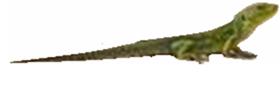 Picture 1 The Development of the Tail in Animals.
The existence of all living creatures in nature is influenced by two conditions i.e. conditions external to their body and conditions internal to their body, both of which work simultaneously. Here, an attempt is made to elaborate some of the features of these conditions, particularly the ones that may make interesting topics of discussion. These conditions, though they may perhaps be just a common issue to some people, may yet be something of great interests to scientists in search for the answers to the question, “What is it that has caused animals to have tails?”
Indeed, there are some who are of the opinion that the tail of an animal has come to emerge for the sole purpose of enabling it to keep its body in balance.
What if we take a look at the pictures below, all taken from the internet?
Here it can be seen that the movements of the living creatures are encumbered by their tails, particular at a time when they attempt to avoid predators. We may thus not say in any sense that the very long tails of these creatures function as a balance-keeper; rather, what we may say is that these tails of theirs had come to emerge only by dint of the presence of the molecular inertia of the material from which their tails had been formed. Even if they had been in the transition period, such molecular inertia could still affect such evolution of the body shape from one that was snake-like to one that was lizard-like, or vice versa.
Here we are going to deal with only the presence of proofs of evolution in living creatures from the aspect of molecular changes in measurements of Angstrom.
The development of the tail of an animal is conceivably a result of the molecular inertia of the molecules of its body. At the time the animal moves its body forward, all the molecules of its Cells look as if they were left behind. In other words, the body grows longer, though this elongation could be as miniscule as only 1 Angstrom.
This is because of the molecular inertia of its bodily matter, particularly the one at its tail.
Molecular movement caused by the molecular inertia of an animal’s tail.
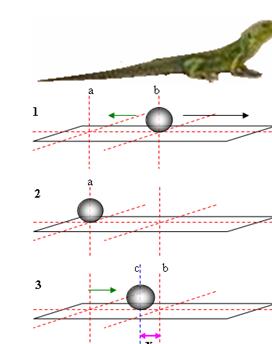
Illustration 1 shows a spherical iron ball placed on a thick piece of paper pad. If the paper pad is tugged in the direction as shown by the grey arrow, the ball, due is, due to its molecular inertia, seen to shift towards the vertical line “a” (illustration 2).
A similar occurrence can also been seen in an animal, e.g. a lizard, each time it makes a sudden forward movement. The paper pad, here exemplifies the outer part or the skin of he lizard while the iron ball the molecules in its body.
In an animal, however, while the multifarious molecules that make up its bodily cells will, due to their molecular inertia, shift backward simultaneously with its sudden forward movement, these molecules will, however, because of their flexibility, return to their original position. (illustration 1)
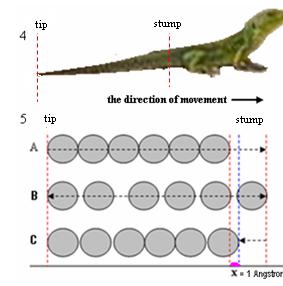
Illustrations 1, 2, and 3 depict the molecules at a particular location at the tail, while illustration 5 depicts the molecules at that part of the tail extending from the stump to the tip.
One question yet remains: Do these molecules inside its cells have the ability to return to its original position to a degree of precision of Angstrom? The answer is definitely “No!”. Such is the answer, the new position they will take is one as shown in illustration 3, where the iron ball is now seen to be at “c”. It is the distance between “b” and “c”, represented by the letter x, that will later affect the elongation of the tail as well as the other organs of the animal. In addition to this, in almost all mobile living creatures, the jerky movement they inevitably make when they start to move exceeds the one they make when they stop.
However, whether a tail will emerge or not, and whether the molecules will elongate or not, it all depends on a number of factors. Among these—apart from such factor as the bond between the molecules of the tail—is one that concerns the movement that particular species of animals habitually make in its day-to-day life.
Now, if it is supposed that at each movement or jump the x is only 1 Angstrom, just imagine how significant the figure could be after millions of years of evolution. The x here is but a result of one jump, yet if we are to assume that the total elongation that occurs a day is 1 Angstrom, what we have then is the following calculation: As 1 mm is equal to 10,000,000 Angstrom, a shift of just 1 Angstrom a day can result in x reaching 365 Angstrom a year. As such, after 100,000,000 years of evolution, the x may reach 36,500,000,000 Angstrom, which is equal to 3.650 mm or 3,65 meters.
On the left of this page is an illustration supposedly portraying the molecules inside the cells of the animal’s tail—or it could also be envisioned that they are a row of cells of the animal’s tail.
Illustration 5 maps how the molecules of an animal’s tail, which originally are in a position as shown by A, later take a position as depicted by B when the animal moves forward. Consequently there occur spaces between these molecules, though at irregular intervals. As soon as the animal stops its forward movement, these molecules return to their original position, though not quite precisely at their original spots.
In the illustration, the row of molecules, which originally resembles that as shown in 5A, becomes like what is shown in B—this a result of the animal’s forward movement. Later, as soon as the animal stops, the row of molecules attempts to regain its 5A position; nevertheless, due to the limitedness of its elasticity, the best it could achieve is a position as shown in 5C.
There thus occurs a discrepancy in length between the row of molecules in 5A and that in 5C, though by only 1 Angstrom. Later, as soon as its condition becomes stable, 5C becomes the new 5A, which is longer by one Angstrom that the original 5A. Such elongation occurs continuously and repeatedly, is passed on to its descendants, and will become obvious only after hundreds of thousands of generations have passed.
Please keep in mind that the above calculation is based on the assumption that such jump occurs only once a day and that the distance covered at each jump is 1 Angstrom. Now, what if it is assumed that 100 Angstrom of such jump occur a day. Needless to say, the evolutionary process is accelerated.
Though this is but a rough calculation, the figures here are yet not by far different from what they truly are. Here the molecules and the cells are intentionally made to appear more than they actually are and to look simple solely to ease the readers in their attempt to understand what this evolutionary journey is all about.
No matter where these molecules are in—be they in the bones, the muscles, the skin—they will all be affected when the animal moves forward.
During the elongation of its tail, empty spaces are formed between the molecules and the cells of the tail, which makes it possible for more molecules and cells to be formed to fill in the space, by way of division. This eventually entails in the elongation of the tail. And as far as living creatures are concerned, such elongation is something that they must be able to pass on to their descendants.
This, of course, is no different from the other evolutionary journey, i.e. the one subjected to mutation.
Because this is something that concerns more about the internal factors of living creatures, its further development could have something to do with Homeobox in Gene, the one related with Hox gene.
This is a possibility that scientists are expected to re-examine.
Were it to turn out that there would simply be no way for any molecular changes to be passed on to the descendants, then any attempt to explain about molecular inertia would certainly be of no use and irrelevant to the development of evolution.
The evolutionary changes due to molecular inertia took place not only at the tail but also at all other parts of the body of a living creature. The symmetrical body shape of a living creature may perhaps serve as one of the many amazing examples of this.
Conclusion
Those who believe that evolution does occur must certainly believe that before living creatures have such forms as they do today, they must, at the beginning, have been very simple in form. These believers of evolution must certainly believe that before an animal got its tail elongated to such a length as it is today, such elongation must have occurred in phases—initially emerging as an animal without a tail, it then began to develop a short tail, which then grew longer and longer to the extent that it turns into what it is today. What is extremely dominant in the whole process of such elongation is the roles that the laws of nature play.
If we were to adopt the idea that such limitations in elasticity of a living creature can never be passed on to its descendants, then this would means that we believe that the position of the molecules of the tail would return to its 5A condition.
This would then bring rise to some crucial questions: “Where has that energy needed to create the distance (x) gone? Where does it get the energy it needs to return from its position as in 5C to its position as in 5A?
A look at long-tailed animals of today, it can be said for certain that the elongation of their tails have been caused by both mass inertia and limitations in elasticity, and that any change leading to such elongation will necessarily be passed on to the descendants.
Should you disapprove of whatever is proposed in this article, we would certainly welcome any other opinion you have concerning the elongation of the tail of an animal during evolution.
-----------------------
For further explanations, read the article entitled “The Impacts of the External Influences Being Passed on to its ‘Descendants’” in www.theemergenceofthecell.com
Picture 2
Picture 3

Picture 4
|




 printable version



 Digg this
 del.icio.us
 Furl
Furl Reddit
 Technorati
 Facebook
 Gab
Gab Twitter